
“Covering Calcutta” II
Parsi institutions in the West Bengal capital continue their age old activities and traditions, albeit on a smaller scale
Though numbering around 500, Calcutta has numerous Parsi institutions and groups catering to the physical, emotional, religious and dramatic interests of the community. Parsiana previously covered the yearlong sesquicentennial celebrations of the apex body, Calcutta Zoroastrian Community’s Religious and Charity Fund (CZCRCF), (see "Calcutta celebrates,” Parsiana, November 21, 2017); our December 7 issue focused on the Ervad Dhunjeebhoy Byramjee Mehta’s Zoroastrian Anjuman Atash Adaran (established 1912), the Calcutta Parsee Club (CPC,1908) and the CZSM (1936). This article highlights the activities of the CPADC (1907), the Parsi Zoroastrian Association (PZA, 1935), The Calcutta Parsee Youth League (CPYL, 1939) and The Saklat Physical Culture Institute (SPCI, 1933).
Traditionally, each year the CPADC holds an additional paid show of a Gujarati play during a weekend close to the New Year, for Gujarati speaking sister communities, in addition to the show for community members. "We have not been able to do that since the last three years,” states Postwalla as they (Bohris, Gujaratis and others who know the language) are diminishing in numbers too.
Most of the Club’s recent productions have been based on playwright Dorab Mehta’s scripts. "We do have people who have a handful of people who can translate the scripts from Gujarati, though their number is shrinking… most actors, who include non-Parsi spouses and family members, want the script transliterated into English or Hindi when rehearsing,” he notes, acknowledging the role of vice president Yasmine Kapadia for the laborious transliterations.
Long time member and current vice president of the Club Noshir Wadia states "it is now becoming difficult to get Parsi boys and girls to act… (but we have) never failed to deliver this gift to the Parsi community.” The Club has been listed in the Limca Book of Records in 2005 as the "longest running Parsi theater.”
There are about 40 active community members in the Club. Non-Parsi spouses assist in whatever capacity they can. "You need to be an actor, or help with the prompting or the script or the props, or just about any aspect of the production, and you are welcome,” remarks Postwalla.
Postwalla is continuing a family tradition. His father Bahadur, trustee of the CZCRCF is recalled in the Club’s centenary souvenir "Celebrating 100 years of Theatre” as "the most over worked member of the Club at whose door step most problems are laid.” Bahadur has never acted, except for a 30-second role in the 2016 show; his forte is handling finances for the Club, states Ratan. The souvenir includes reminiscences by long standing members about their families’ involvement with dramatics down the ages.
It is not only about theatrics. The Club has established scholarship funds to commemorate the memory of departed members. Over 500 students have been helped over the years.
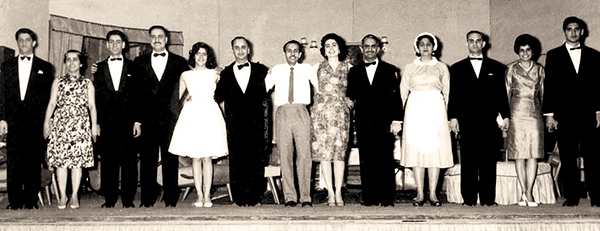
Curtain call at a production of the Youth League’s dramatic group, since disbanded
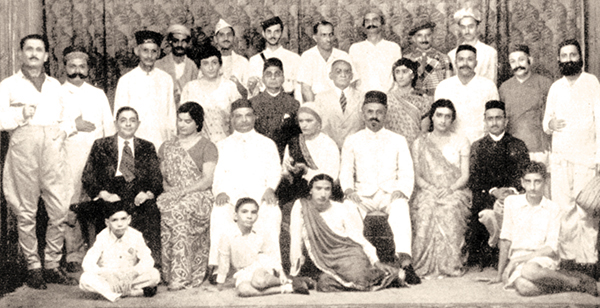
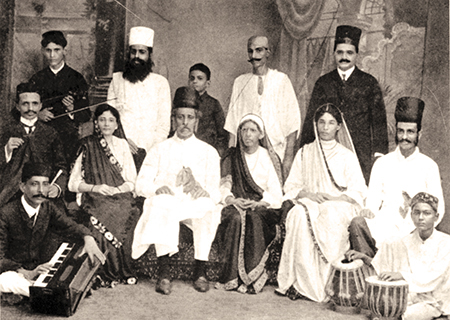
The all-male cast of the Dramatic Club’s 1909 production of Naaja Shireen
The souvenir of the Club harks back to the days of yore, starting with the 1908 staging of Boman Kabraji’s Bholi Gool (Innocent Gool). "For a number of decades the natak was staged at the Corinthian Theatre (later known as Opera) and men, women and children crowded the closed doors for an hour or two and then stampeded for seats in the front row when they were thrown open.” The Foreword recalls that the three hours of blood and thunder tragedies were often interspersed with comic relief. "Enjoyable repartee between the players on stage and the wags sitting in the audience” provided memorable moments.
Till 1954, the role of women in the Club was to ensure that the male players with female roles "were properly attired and endowed like ladies.” Six women caused "tradition to take a fall,” when in the next year they made their appearance on stage.
How does Ratan see the future? "It will be a struggle… the Club needs a commitment for rehearsals for three months… this is getting difficult, but we manage…at least in the near future, there are many who want to keep the tradition of the Gujarati plays going… interest is there…we do as much as we can.”
Focusing on health
During the last few years, taking the age profile of their community into consideration, the 82-year-old PZA "has repeatedly organized several medical seminars with eminent doctors in different fields,” states president Darayas Bapooji in an email dated November 30, 2017 to Parsiana. Eighty of the total Parsi population are over the age of 80. There were 433 Parsi Zoroastrians and 131 non-Parsi spouses and children as on March 31, 2017. During that financial year, there was only one birth and 14 deaths; and there were two navjotes and three marriages (all interfaith), according to the March 2017 annual report of the CZCRCF.
Speakers at the seminars have included medicos that specialize in geriatric care, orthopedists, eye specialists and dental surgeons. A recent audiometry test camp was followed by distribution of hearing aids at concessional rates.
A free health check-up was organized earlier this year for all community members who wanted to avail of it, followed by a talk on organ donation, Bapooji notes. In June 2016 the Association organized a special workshop conducted by two counselors of Jiyo Parsi from Bombay. "It was a big hit and we plan to have another one with them sometime early next year,” writes Bapooji.
PZA has published 11 books on religion, including those for navjoted children and "which have been hailed by scholars from different parts of the world,” notes the directory of CZCRCF. The Association is consulted by the State Government in various civic matters including recommendation of names of the delegates to the Parsi matrimonial court, states the directory.
The Association filed an application pleading to be added as a party on the side of the Mehta Adaran trustees after Calcutta resident Prochy Mehta moved the High Court asking the judges to decide who has the right of entry to the place of worship (see "The concept of gender equality,” Parsiana, July 21, 2017). "We would like to implore all like minded co religionists, individually as well as through their anjumans, trusts, panchayats to help and take up the matter of our above referred civil suit urgently. This is of prime importance, since if we fail in our endeavor then this will cause a grave affront to our religion and its activities… (we) decided to take up the matter legally for which we are sure you will support us by intervening in the subject matter,” Bapooji had communicated to the community via email (see "Insistence on intervention,” Parsiana, August 7, 2017).
Founded in 1935 to promote the religious, social, economic, intellectual activities of the community in Calcutta and "to study and solve problems confronting the community,” PZA began with organizing social gatherings for debates and lectures. It soon developed into a study group inviting scholars of eminence in Bengal, Bombay and other places to address community members on philosophy, ancient history and religion. It has also been helping in imparting religious instruction to children and holding annual competitions giving silver medals and cash prizes. Bapooji informs that the founder members of PZA were the late Dr D. N. Wadia, head of the Geological Survey of India, C. H. M. Rustomji and Edulji Olpadvala, the latter two being trustees of the CZCRCF. "The members of the first managing committee included the late A. Dinshaw, who was an active member as well as a joint secretary for many years and who played an important part in guiding the destiny of the Association,” remarks Bapooji.
"By the young”
Formed in 1939 as an offshoot of the PZA, as it was felt that the Association "did not cater to the youth of the community,” the CPYL, aims at "making the youth of our community a little bit more close-knit.” Youth League president Gulnar Mehta notes, in communication with Parsiana on November 11, that CPYL "is pledged to serve the youth to the best of its ability (by unlocking) the creativity of the young, by the young and for the young.”
The League has never discriminated against inter married members and their spouses, avers Gulnar. "We include them and their children in all our events and functions,” she states, though they cannot be members of CPYL. According to League rules, Zoroastrians between the ages of 17 to 41can become members. Gulnar states that after 41 you can apply as a patron member but cannot serve on the committee...”
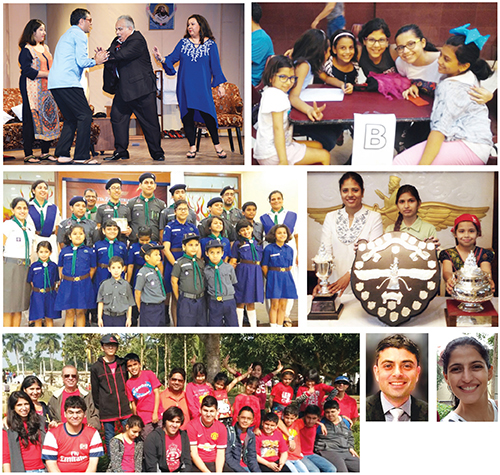
A weekend trip every year during the Easter break is a much awaited item on the calendar of community members. "Almost 70 members, guests and children visited the seaside resort of Puri in Orissa in April 2017. The days were spent either on the beach or by the poolside soaking in the summer sun...This year we also organized a musical quiz contest along with the SPCI. Eight teams participated,” notes Gulnar. The Youth League also organizes an annual drawing competition every year in January. This October CPYL teamed with the CPC to celebrate Diwali by organizing a fireworks display "along with a scrumptious canteen.”
Some 52 years ago, the Youth League had formed a dramatic group, with separate rules and regulations and a managing committee, for members interested in literature and drama, states Gulnar. The group held regular meetings, presented several plays for its members and their guests and had a fairly long life, but was ultimately dissolved due to dwindling interest. "I myself (have) no idea why it was started or how and when it fizzled out. But on asking I found out that it was started as a dramatic group for English plays because the Dramatic Club did only Gujarati shows,” according to Gulnar who is the principal of a Montessori school.
Besides her, the committee consists of treasurer Afreen Ghiara, secretary Yohan Confectioner, and members Rasheed Jeejeebhoy, Arnavaz Subawalla, Arvaan Mogrelia and Urvaksh Mogrelia.
Scouting and guiding
Established in 1933 with the objective of encouraging and developing the character and physical condition of the youth through gymnastics, swimming and scouting / guiding, in April 2009, the SPCI became the first body in the city to welcome children of Parsi women married to non-Parsis to become associates of the Institute. With a resolution passed by "an overwhelming majority,” the Institute "stood up for the cause of Parsi women and gave them an opportunity to virtually come at par and get equality of status in what was traditionally been a male dominion,” notes Noshir Wadia, president of the SPCI, in communication with Parsiana on November 10, 2017.
Both the gymnasium and swimming sections, which used to be very active in the past, are now at a standstill, informs Wadia. Institute members bemoan that "from a total of 60 scouts, guides, cubs and bulbuls in 1986, when the Scout Troop celebrated its 50 years…the Group’s numbers have fallen to 20 children” on account of the shrunken population.
Since the last 25 years, the main activity of the Institute is administering the bulbuls, cubs, guides and scouts, states Wadia. The chief operating officer of CZCRCF and an office-bearer in Bharat Scouts and Guides for the state of West Bengal, he states that members meet once a week. An annual excursion which doubles up as a camp is part of their calendar. An in-house magazine Our venture died out in 2004 after 34 years of publication due to lack of volunteers, he states.
The office bearers for the current financial year besides Wadia and Gulnar Mehta include vice president Burjor Khambatta, honorary general secretary Dinaz Jeejeebhoy and honorary treasurer Khushmand Buchia.