
50TH ANNIVERSARY
“Parsi theater will survive”
Since 1853 Parsi drama groups have entertained audiences, often performing without any remuneration
A drama can change a person’s life. How did Mohandas Karamchand Gandhi become Mahatma? He saw the play Harishchandra performed by Baliwalla Theatres. This was the turning point in his life. The play pinched his soul and Gandhiji took to truth from that day.
Many changes have taken place from generation to generation. Even then drama has proved to be one of the best sources of entertainment. Dramatics is a special form of literature and is closer to society. The foundation of Gujarati theater was laid by Parsis.
In October 1853, with the blessings of Dadabhai Naoroji, Faramji Rustomji Dalal started a Parsi drama group and they presented their first play, Sohrab and Rustam. This was the first stepping stone of Gujarati theater. Between 1853 and 1869 there were almost 20 Parsi drama groups performing without any remuneration but with complete zeal. Besides Dalal who devoted his entire life to theater were many artistes like Kaikhushru Kabraji, Cooverji Nazir, Edulji Khori, Dadabhai (Dadi) Patel, Dadabhai Thoothi, Dr Bhau Daji and Nanabhai Rani. After the first Parsi play was staged the Parsi club in Surat presented Nathari Firangan Thekane Avi, the Gujarati version of the Shakespearian play The Taming of the Shrew.
Many changes have taken place from generation to generation. Even then drama has proved to be one of the best sources of entertainment. Dramatics is a special form of literature and is closer to society. The foundation of Gujarati theater was laid by Parsis.
In October 1853, with the blessings of Dadabhai Naoroji, Faramji Rustomji Dalal started a Parsi drama group and they presented their first play, Sohrab and Rustam. This was the first stepping stone of Gujarati theater. Between 1853 and 1869 there were almost 20 Parsi drama groups performing without any remuneration but with complete zeal. Besides Dalal who devoted his entire life to theater were many artistes like Kaikhushru Kabraji, Cooverji Nazir, Edulji Khori, Dadabhai (Dadi) Patel, Dadabhai Thoothi, Dr Bhau Daji and Nanabhai Rani. After the first Parsi play was staged the Parsi club in Surat presented Nathari Firangan Thekane Avi, the Gujarati version of the Shakespearian play The Taming of the Shrew.
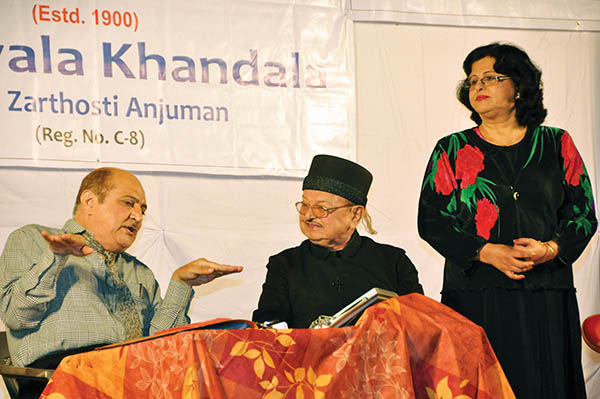
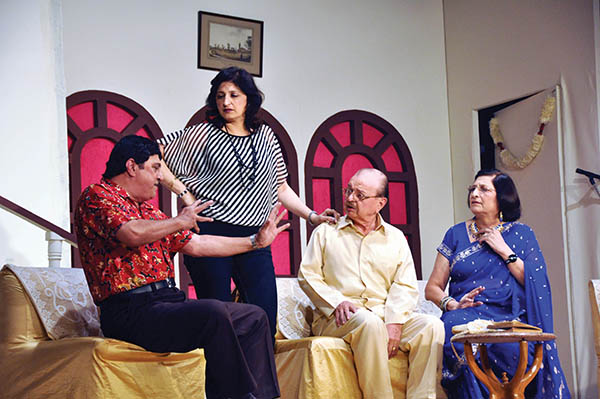
Scenes from Ghar Ghungro ne Ghotalo, with Yazdi Karanjia (in spectacles)
In the history of Parsi theater, the Parsi Victoria Naatak Club and Alfred Naatak Mandali enjoyed a long existence. They contributed in spite of many ups and downs. On August 21, 1867 Kabraji who was a good journalist, musician, poet, writer and an excellent director had established the Parsi Victoria Naatak Club. He also staged Urdu plays. He strove to see that dramatics and dramatists got the respect they deserved from society.
After his retirement, Patel took his place. He was very innovative and was the first to introduce women on stage. He brought the lady singers of Hyderabad on stage and decided to perform the play Indra Sabha at Elphinstone theater. As soon as the lady singers came on stage, the audience created a hue and cry. To control them, the police had to be called and the play was stopped. But slowly the audience reconciled to the idea and started coming to see the performances. Later, everyone appreciated Patel’s foresight. The same audience who had hurled abuses was now clapping at every scene. As there were no mikes and sound system at that time those artistes who had strong voices with a wide range of intonation were successful. The producers of these drama companies did a magnificent job with stage settings. They were so fabulously created that as the curtain opened the audience would applaud loudly.
The Bhishma Pitamaha of modern theater was Adi Marzban. The contributions of his contemporaries Pheroze Antia as well as Pravin Joshi cannot be undermined. Breaking the trend of earlier plays which continued for five to six hours, Marzban wrote plays of two-and-a-half to three hours, in simple language instead of ornate language. He felt that songs in a play broke the rhythm of the performance, so he started plays without songs. Formerly, plays had eight to 10 scenes; Marzban changed this to one or two scenes and performed successfully. Through comedies, he tried to highlight social problems on stage. He always felt obliged to Chandravadan (C. C.) Mehta, who was his companion and guide. Coincidentally, I too am highly indebted to Mehta who used to consider me as his son.
After Marzban, Moti and Pheroze Antia, Ruby and Burjor Patel, Dolly and Bomi Dotiwala, Homi Tavadia, there was a vacuum in Parsi theater for some time. But then came Dinyar Contractor, Dorab Mehta, Sam Kerawalla, Cyrus Dastoor, Roshan and Dinyar Tirandaz, Silloo Mahava, Pervez Mehta, Rohinton Cheson, Meherzad Patel who are active even today. They perform on Parsi festivals and other occasions.
I am 77 (touchwood). So, if I have missed out on any names I hope to be excused by my fellow artistes.
If we talk about Parsi theater in Gujarat, there is no noteworthy contribution, although five to six decades prior there was some enthusiasm towards performance of plays like Baap na Shraap and Pakzad Parin. Many institutions used to perform Parsi one act plays at their annual functions.
But today the only Parsi group which has kept Parsipanu intact in drama and regularly performs nationally and internationally is The Yazdi Karanjia Group. I was lucky to have been guided and encouraged by my father Naoshirwan, my teachers Keki Vaid, Prof Hakumatrai Desai and my kala gurus Pheroze Antia, Dhasukhlal Mehta, Jyotindra Dave, Dr Ratan Marshall and C. C. Mehta — the storehouse of drama literature.
With the blessings of C. C. Mehta, we wrote more than 300 radio plays that were relayed from All India Radio. We also performed in many TV serials. I was lucky to have received the All India Radio Award and an Award from Gujarat Rajya Sangeet Natak Academy. Viewing the plays of The Yazdi Karanjia Group, Eruch Pavri, C. C. Mehta, Raman Pathak, Bhagwatikumar Sharma, Chandrakant Purohit, Raj Kapoor, Sanjeev Kumar, Paresh Rawal and Boman Irani have all appreciated the innocent comedy and sense of timing which truly encouraged me.
At this point, I reverently remember the selfless contribution of all the artistes, directors, actors, costume designers, make-up artists as well as other technicians. I owe a lot to all the dear members of The Yazdi Karanjia Group who for the love of drama willingly sacrificed their time, pleasure and money. I would not have been able to do my duty towards theater without their wholehearted support.
The journey of Parsi theater from the establishment of the Parsee Naatak Mandali in 1853 until today has remained one without monetary gains. The effect of the decreasing population of Parsis shall be felt on Parsi theater. But I am sure that till there is the last Parsi living on this earth, Parsi theater will survive.
The principal of The Cambay Institute of Commerce and a trustee of the Surat Parsi Panchayat, Yazdi Karanjia started acting from childhood and even played feminine roles at school. He founded The Yazdi Karanjia Group in 1959 under the guidance and inspiration of his father Naoshirwan and has been supported by his wife Veera, family and friends. The troupe has performed in all the principal cities of India as well as Singapore, UK, USA and other places with the proceedings going to charitable institutions.
◆ ◆ ◆
From the archive