
Cover Story
Covering Calcutta
Multiple organizations serve the spiritual, sports and welfare needs of Calcutta Parsis, with varying practices on the admittance or otherwise of non-Parsi family members
A kindly, bearded, white-clad Muslim caretaker welcomed and guided on October 31, 2017 the Parsiana representative to the hand-washing area in the Ervad Dhunjeebhoy Byramjee Mehta’s Zoroastrian Anjuman Atash Adaran on Metcalfe Street in Calcutta. A short distance from the Manackjee Rustomjee Dharamsalla, the one storied structure stands out amidst Chinese nameplates on doors, small businesses and idling hand rickshaw pullers. After performing the kusti ritual, one either walks up a somewhat grand staircase, at the head of which stands a bust of Dhunjeebhoy Mehta and pictures of other donors. If one so chooses, they can take a lift up to the first floor where stained glass panels above the windows let in the sunlight and make vivid patterns on the spotless floor of the hall.

Clockwise from top left: Khorshedbai Mehta, Calcutta mobeds Ervads Jimmy Taraporwalla, Darayas Karanjia,
Darius Modi, Behramsha Karanjia; trustees Noshir Tankariwala, Yezdezard Dastoor, Jemi Bilimoria; facade of
Ervad Dhunjeebhoy Byramjee Mehta’s Zoroastrian Anjuman Atash Adaran; Dhunjeebhoy Mehta’s bust in Adaran

Clockwise from above left: A panel at the Adaran hall; front gate decked with flowers at the
Adaran’s centenary celebrations, 2011; kindly caretaker near hand-washing area;
staircase to first floor and stained glass panel
The Adaran sees an average of five footfalls a day, which swells to about 25 on important rozs, states panthaky Ervad Jimmy Taraporwalla. About 55 tables are set up for prayers during muktad days. Water from the on-site well is not used in ceremonies, relying instead on water supplied by the municipal corporation. The community in Calcutta numbered 433 Parsi Zoroastrians and 131 non Parsi spouses and children as on March 31, 2017. The Calcutta Parsee Club (CPC) sees a gathering of nearly 100 over weekends. The Calcutta Zoroastrian Stree Mandal (CZSM) has a membership of 350 women.
The year 1890 saw the opening of a dar-e-meher by China trader Mehta at his home in Canning Street. The 2014 directory of the Calcutta Zoroastrian Community’s Religious and Charity Fund (CZCRCF), the apex body of the Calcutta Parsis, records that the alat for the dar-e-meher was carried by foot from Navsari over a 73-day period. An argument at the then running Banaji Agiary between Rustomji Banaji, founder of the Banaji Agiary, and Roostomjee Mehta, son of Dhunjeebhoy, resulted in Rustomji flicking Roostomjee’s pugree. Due to this perceived insult, Dhunjeebhoy "swore never to set foot in the Banaji Agiary again.” Having made up his mind to build an adaran of his own, he "made all preparations for it,” but did not see it come to fruition in his lifetime. Dhunjeebhoy’s plan was put into action by his wife Khorshedbai and Roostomjee. Along with donations from fellow community members, the Mehtas endowed the current Atash Adaran which was consecrated in 1912, now the only place of worship for Calcutta Parsis. The erstwhile Banaji Agiary went into disuse, squatters moved in and "it ceased to be our place of worship,” notes the CZCRCF directory.
The current trustees of the Adaran are Noshir Tankariwala, Yezdezard Dastoor and Jemi Bilimoria. The Adaran celebrated the 100th anniversary of its founding five years ago. "Thanks to the dedicated commitment of generations of trustees who have steered this legacy through some very difficult times… today the community is fortunate to reap the rewards of their endeavors,” Tankariwala had said at the inaugural function of the centenary celebrations in October 2011 (see "Centenary in Calcutta,” Parsiana, December 7, 2011). Stating that the sacred fire had been kept burning for a century due to the "dedication and devotion” of their priests, he had named Ervad Burjorji Dastoor Meherjirana (who had served from 1911 to 1947), Ervad Bapuji Desai (who served till 1999) and the then panthaky Ervad Shorab Kotwal.
In the run up to the centenary, the Adaran was renovated and refurbished, the January-March 2011 issue of Calcutta Gavashni, the newsletter of CZCRCF had noted. New stained glass windows and arches were installed, the furniture polished and energy efficient lights fitted in the hall. A larger, environmentally friendly, generator set was provided.
Tankariwala had, at the inaugural function, expressed the hope that "wisdom and common sense will prevail and this little community of ours, which has been blessed, will not fall prey to the divisive elements prevalent elsewhere in the country.” These words turned out to be prophetic. In 2015, the newly appointed panthaky Taraporwalla forbade entry to Sanaya Mehta Vyas’ navjoted children Samara and Nirvhan to the Adaran. Sanaya is married to Sandeep Vyas, a non-Parsi. A plaque opposite the lift on the ground floor of the Adaran lists names of donors that include Sandeep and Sanaya. The children were earlier visitors to the Adaran freely since 2006.
Taraporwalla’s telephonic message to the Mehtas was followed up by a communication dated July 27, 2015 from Tankariwala on behalf of the trustees, asking the Mehtas to refrain from bringing the children to the Adaran. Children of out-married Parsi men are allowed entry to the place of worship. Sanaya and her mother Prochy Mehta filed an Originating Summons (OS) on December 19, 2016 in the Calcutta High Court, praying that the Court determine who has the right of entry to the place of worship (see "The concept of gender equality,” Parsiana, July 21, 2017). Prochy informed Parsiana on October 29 that the majority of the community members are "individually supportive” of her decision to take legal recourse.
The Federation of the Parsi Zoroastrian Anjumans of India at a meeting on July 30, 2017 led by president and Bombay Parsi Punchayet chairman Yazdi Desai has taken a decision to intervene in the Court case (see "Insistence on intervention,” Parsiana, August 7, 2017) despite an email dated July 24 from CZCRCF protesting against "interference in the internal affairs of the Calcutta community.”
Tankariwala was unable to comment on the matter of the non admittance of Sanaya’s children as the matter is sub judice. Manager Ketty Kapadia, replying on behalf of the trustees said that "other questions (like, where they got their kathi and sandalwood from) concern only our Adaran and are not for discussion in the public domain.”
"I have no opinion on the matter,” says Taraporwalla, about the OS. Claiming that "over 50% of the Calcutta Parsis” are behind him in the decision to bar Samara and Nirvhan from the Adaran, he states, "No religion can work to people’s convenience… If one works in a company, will not one follow the rules laid down?... It’s all about faith… The community did not ask the mobeds when they decided to admit children of inter-married males... The community as a whole should decide these matters.” Referring to the Goolrookh Gupta case, he asks, "Do you think the five judges who will decide that case are wiser than the whole community?” Gupta is fighting a case in the Supreme Court for her right to visit the fire temple and tower of silence in the south Gujarat town of Valsad.
"The people who made these rules (admittance/non-admittance) 200 years ago were not stupid,” he believes. "If I perform the navjote of a child with a non-Parsi father, I will be doing a great wrong…It has to be a logical decision to change (a custom)… Our religion gives us the liberty to change,” he states, adding, "I am tired of it all… I am now thinking why I became a panthaky!” The 44-year-old mobed will celebrate the silver jubilee of his ordainment in June 2018.
The priest opposes the performance of Zoroastrian prayers for those who opt for cremation as a method of disposal. Of the 14 deaths in the city last year, three opted for cremation. Between April and October 2017, six out of a dozen who died opted for cremation. Zoroastrian prayers recited at death are linked to dakhmenashini and there can be no geh sarna for such cases, he emphasizes. Community members told Parsiana that recently the Adaran mobeds have started performing uthamnas for those who have opted for cremation, but not the geh sarna.
Born in Amravati, Maharashtra, Taraporwalla was ordained at age 19 at Bombay’s Banaji Atash Behram. Parents Homi and Yasmin are based in Nagpur. Brother Kaizad helps out during the muktad days. Jimmy holds the late panthaky Desai, who passed away in 1999 at age 91, in high esteem. He recalls that they spent a lot of time together. "He made me assist with a wedding within a month of starting work at this agiary… He always told me that religion was more a matter of discussion… Use your logic in all matters.”
Being all clubby
"We celebrate all festivals, even Holi,” remarked travel agent and member of the 109-year-old CPC Xerxes Anklesaria, on October 29, 2017 over a chat in the Club premises on the city’s expansive downtown green lung, the Maidan. Male members pay two rupees a month as membership charges and female, one rupee. Tennis-playing members pay Rs 5. Life membership can be availed of for Rs 3,000 and for Rs 5,000 one can become a patron member. "We don’t need to increase the membership fees,” states vice president Prochy Mehta who has been a member "ever since I can remember...
"We recently collected Rs 25,000 for new equipment… Everyone donated voluntarily,” adds Mehta. Started as a cricket club, in due course, sporting activities were extended to football, hockey, tennis, basketball, badminton, table tennis and athletics. CPC admitted women members starting 1932.
"We celebrate all festivals, even Holi,” remarked travel agent and member of the 109-year-old CPC Xerxes Anklesaria, on October 29, 2017 over a chat in the Club premises on the city’s expansive downtown green lung, the Maidan. Male members pay two rupees a month as membership charges and female, one rupee. Tennis-playing members pay Rs 5. Life membership can be availed of for Rs 3,000 and for Rs 5,000 one can become a patron member. "We don’t need to increase the membership fees,” states vice president Prochy Mehta who has been a member "ever since I can remember...
"We recently collected Rs 25,000 for new equipment… Everyone donated voluntarily,” adds Mehta. Started as a cricket club, in due course, sporting activities were extended to football, hockey, tennis, basketball, badminton, table tennis and athletics. CPC admitted women members starting 1932.

Sarah Oonwala, first woman member of the Calcutta Parsee Club

Runners-up of the Cyclist Cup, Bombay, 1937

Clockwise from top left: A recent Sports Day, the first one was held in 1932; Prochy Mehta, Jahan Mehta,
Xerxes Anklesaria; the Club’s players at a recent Parsi Pentangular tournament — cricket is"one of the Club’s
premier sports;" centenary commemorative volume that took four years in the making
Located in a "tent” on the Maidan, the Club’s 198-page centenary souvenir titled "Our own little piece of earth” credits five men with founding the Club – Munchershaw Buttiwala, Byramji Nalladaroo, Nowrojee Nalladaroo, Hormasjee Kandawalla and Keki Spencer on November 4, 1908. Prior to this, Parsis played cricket at Natore Park ("with the kind permission of Maharaja Jogendranath Roy of Natore”) or "anywhere on the Maidan.” The CZCRCF directory records that the Club moved location three times; it ended at its current location on Mayo Road, which cuts through the Maidan, in 1922. In 1974, the tent was expanded and is now one of the largest on the green expanse, boasting of three tennis courts, states the directory. A canteen runs on the weekends and provides light refreshments. "And on other days, members who come bring food to go around for everyone, anyway,” states Mehta. On Saturday and Sunday evenings, "everyone from ages five to 65 assemble for a fitness class… no fitness standards required… you can work out at your own pace,” says Mehta, inviting the Parsiana representative to participate.
Sarah Oonwala, the first woman member was instrumental in starting the Club’s annual children’s fancy dress competition, which even today is a fixture on their calendar. Pointing out to the handful of children warming up before a session of basketball with her, Mehta notes that "the children are mostly from our intermarried girls.” Vice president Jahan Mehta responded to Parsiana’s queries about membership as follows: "A few years ago we had a meeting where we decided that non-Parsi spouses and their children would be made permanent guests... If you visit the Club you will notice that there is no distinction and everyone mixes and plays together.” The Club accepts children of intermarried Parsi men as members. Jahan informs that they are in the process of getting the necessary rules passed so that the same can be done for the children of intermarried women. "The basic thought in the Club is that both sexes should be treated equally,” he informs.
The Club celebrated its birthday with a jashan on November 4, 2017. Saturdays and Sundays see up to a 100 people gather in the evenings. An annual picnic during Easter holidays, a gahanbar in memory of a departed long-standing member Beji Balsara and "Tea with Zee,” a tea party in memory of a departed member couple are some of the other highlights, Prochy reiterates. The calendar includes an annual sports day, children’s parties and even a Parsi Day. "There will be the Parsi Pentangular in December,” Prochy reminds Anklesaria. "Teams from Hyderabad, Surat, Jamshedpur and Nagpur will be coming in,” he adds.
Jahan provided Parsiana with the rather chatty newsletter of the Club for 2016-17. "We conceded controversial last-minute goals (in football), hit the post more times than we care to remember, and towards the end of the season, suffered from a severe crisis of confidence,” but commends the "group of youngsters who come out and play sport regularly.” The Club’s football championships for 2017 spread over five weeks saw 75 other clubs including one from Bangladesh taking part. Hundred and fifty Calcuttans turned up for cricket trials, of which 23 were selected to play for CPC. Nearly 20 players form the hockey squad, "a good mix of experience and youth.” In-house tournaments during the year saw three teams competing in eight disciplines (hockey, football, basketball, badminton, tennis, table tennis, carom and pool) over five days. Club members have served on state level bodies as administrators and managers in basketball, football and hockey.
"The Club is our community’s home away from home,” states Prochy, walking past the little girls practicing their dribbling.
Besides Jahan and Prochy, the managing committee of the Club consists of president Jimmy Bilimoria and vice presidents Cyrus Confectioner and Dinyar Mukadam.
Women power
The women’s organization, the CZSM provides nurture to the needy: welfare money, extra nourishment, reimbursement of medical bills and hospitalization benefits. On November 4, 2017 president Khorshed Modi explained that they work closely with CZCRCF to ensure that aid reaches those who are disadvantaged. Beneficiaries receive hampers every Parsi New Year. Executive committee member Navaz Gherda mentions that gifts range from kitchen items to grains to linen to toiletries and "sometimes a cash envelope.” Come December they are given "packets of vasanu and liniment and balm to keep them healthy and limbs moving freely,” she states. Surgical beds, wheelchairs and walkers are available for those who need these aids. The Mandal owns a building at Circus Range leased out at nominal rents to seven families. Monthly programs with talks on topics as diverse as medical problems and cooking demonstrations "provide an opportunity to members to get together,” besides serving as fund-raisers.
The women’s organization, the CZSM provides nurture to the needy: welfare money, extra nourishment, reimbursement of medical bills and hospitalization benefits. On November 4, 2017 president Khorshed Modi explained that they work closely with CZCRCF to ensure that aid reaches those who are disadvantaged. Beneficiaries receive hampers every Parsi New Year. Executive committee member Navaz Gherda mentions that gifts range from kitchen items to grains to linen to toiletries and "sometimes a cash envelope.” Come December they are given "packets of vasanu and liniment and balm to keep them healthy and limbs moving freely,” she states. Surgical beds, wheelchairs and walkers are available for those who need these aids. The Mandal owns a building at Circus Range leased out at nominal rents to seven families. Monthly programs with talks on topics as diverse as medical problems and cooking demonstrations "provide an opportunity to members to get together,” besides serving as fund-raisers.

Caring for the needy CZSM committee
(sitting, L-R): Rhoda Mogrelia, Nargis Bapooji, Khorshed Modi, Roda Bulsara, Shirin Tata;
middle row (standing, L-R): Gulnar Dastur, Katy Sabawala, Pilloo Sutaria, Navaz Gherda;
top row (standing, L-R): Trista Madan, Kamal Wadia, Pervin Nusserwanji, Roshan Dandiwala, Nargis Katrak;
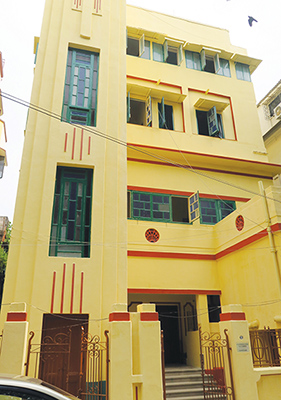
CZSM residential building
The failure in 1936 of a large Parsi firm provided the impetus to create "the original caregivers of Calcutta,” as the Mandal calls itself. "Many Parsi families found themselves destitute overnight,” notes a souvenir put out by the Mandal on its 75th anniversary. A group of women, led by Meherbai Madan and Jerbai Avasia, the principal of the Bombay Seva Sadan, decided to not only "help these needy families with some financial aid but also give the ladies the means of earning some money.” Executive committee member of CZSM Trista Madan says that while no documentation is available on the firm that collapsed, she surmises that it could be the family firm of Gazdars and the Madan Theaters. "It may have been a combination of both,” she states.
CZSM donates regularly to the Adult Literacy Fund of West Bengal’s Women’s Coordinating Council and to the West Bengal Council of Women for the education of a child. The Bai Dosibai Kotwal Parsi Orphanage and the Parsi Infirmary in Navsari also benefit via donations. The seven funds run by CZSM include The Kersasp J. Press Memorial Fund and The Maneck D. Modi Memorial Fund, to aid children of Parsi women married outside the faith till they can support themselves. The Mandal has about 350 members, states Modi, explaining that non-Parsi spouses of Parsi men cannot join. However, intermarried Parsi women continue to be members.
The souvenir throws light on the early years: The first activity of the then formed managing committee was to personally visit Parsi families to enthuse the women to join the Mandal, and to collect donations. Six disadvantaged families were the beneficiaries. Food supplements, group discussions on health, hygiene and child care followed. Community members donated knitting machines and sewing machines, skilled women taught the less fortunate to make sudrehs, pyjamas, petticoats and to stitch kors on saris. During the Second World War, the Mandal supported the Calcutta Red Cross by collecting funds and making bandages. A "young ladies” branch for those under 40 years of age was started but that initiative "had to close down very soon” as "they had to devote more time to their professional and family lives.” The CZSM purchased a two storied vacant building at Circus Range from their funds and Rs 1,00,000 collected at a fund-raiser in 1966. A floor was added in 1979.
"When I was first elected to the executive committee in 1958, I was appointed as the convenor of the education sub-committee which ran Gujarati language classes and religious instruction classes on weekends for children,” states 96-year-old executive committee member and president of the Mandal for 10 years from 1990, Shirin Tata. "We also maintained a Gujarati library which was open to community members once a month for a nominal fee. Ervad Bapuji Desai, (then) panthaky of the agiary gave religious instruction.”
Knowledgeable gentlemen from the community volunteered to give lectures on Iranian history and culture, she reveals. "Annual examinations were held for the classes and prizes were awarded to the toppers… The members of the sub-committee attended all the classes and were present at the library whenever opened.” Classes were suspended during the 1970s due to want of students, states Tata, while the library closed in 1995 because of a lack of members.
Tata rues that community members are not stepping forward to volunteer. "At present a member who resigns is replaced without elections,” she states. Last year, thanks to a huge donation from the estate of a member, the Mandal doubled the welfare payments to beneficiaries. Financial assistance given to applicants was also liberalized. The nonagenarian states that with changing times, "the committee does not have to wait for the next bi-weekly meeting to take place as much of the decision making and implementation moves forward with WhatsApp.”
The Mandal’s current 14-member executive committee is headed by president Modi with Nargis Bapooji and Roda Bulsara serving as vice presidents. "Members range in age from 52 to 96. Many have served for decades without a break,” states Gherda.
Other Zoroastrian institutions in Calcutta will be featured in the next issue of Parsiana.
◆ ◆ ◆
From the archive