
Kashmiri women victims
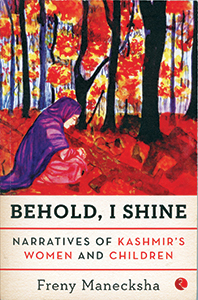
Behold, I Shine: Narratives of Kashmir’s Women and Children by Freny Manecksha. Published in 2017 by Rupa Publications India Private Limited, 7/16, Ansari Road, Daryaganj, New Delhi 110002. Pp: xxxvi + 146. Price: Rs 195.
This is not a book you’ll want to read at night. It calls for too much thought. It messes with your mind. The strong images it throws up make you lie awake and rage at the callousness, the unfairness and the downright misery of day-to-day life in the once-upon-a-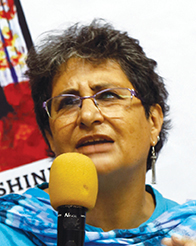 time paradise of Kashmir. Author Freny Manecksha (pictured), now an independent journalist, had formerly worked for The Times of India and The Indian Express and has reported extensively from Kashmir on human rights and development issues and her book reflects her years of experience and involvement with the subject.
Manecksha has a strong point of view and it is very clearly the voice of the Kashmiri woman — the woman who lives with "the presence of strangers holding guns and grenades, in their own fields and orchards,” the woman who contends "not only with the physical presence of the military but also the process of militarization,” or the woman who says, "I will go to any corner of the world to get justice; I will die fighting.” The author’s voice is clear — she is with these women.
The title of the book is not just appropriate for the stories but when the lol or lyric from which it is plucked out is read, the full portent of the lives of women in Kashmir comes alive. To quote from Manecksha’s preface: "Most of all, I saw women who refused to remain victims; who, despite the trauma they lived through, had the faith and courage to echo the songs of the 16th century Kashmiri Muslim poetess Habba Khatun:
The one who dazzles — have you seen that one?
 Upon him look!
A sleepless stream in search of him I run,
A restless brook.
In far off woods, a lonely pine, I stood
Till he appeared,
My woodcutter, and came to cut the wood.
His fire I feared,
Yet though he burn my logs, behold, I shine,
My ashes wine.”
Bereavement, loss and trauma pervade the stories and yet, understandably, there is little to do but bear it all. Kashmiris are like refugees in their own land — their culture torn from them, their history morphing because of political conveniences and the future shrouded. Their choices are few. Perhaps those who can leave, do so. But the majority cannot. And in any case, to leave would be to bear another kind of loss. And so, clinging to old cultures they are forced to develop new ones. Women especially are forced to evolve in deeper ways. Traditionally, as the keepers of culture, they have the responsibility of ensuring continuity. A hard task when many of them have grown up in a zone of strife.
In traditional societies women have always carved out their own public spaces. In Gujarat they would meet in the heat of the day in vavs, the famous steeped wells that gave them privacy and a cool meeting place. In Kashmir it was the yaarbals or washing ghats that served as places for washing and chatting. Manecksha met Dr Arshad Husain, a senior psychiatrist at the mental health hospital in Rainawari who spoke of the loss of traditional spaces. He explained how yaarbals gradually disappeared because of urbanization and the pressures of conflict in Kashmir. In much the same way the badamwaris where families would picnic have also vanished leaving Kashmiris with a feeling of being marooned in their own land.
As always "violence has intruded on childhoods.” Manecksha recalls the November 3, 2014 horror story of a carful of five boys on their way to see a Moharram procession. Their outing ended with two dead, two seriously injured and one traumatized. The soldiers who had pumped bullets in the car said they believed it to be full of terrorists because it had failed to stop at two checkpoints. Or another story of a child who was on a school picnic and found an interesting looking object that he picked up and hit on the ground, only to have it explode in his hand. It was a flare and the resultant damage caused him to lose his thumb and a chunk of flesh.
The book is peppered with stories that allows the readers to see the situation for themselves. The author’s voice though very much present is not annoyingly persistent. Memories of happier times are among the most evocative parts of the book because they fit into the public perception of Kashmir as a paradise. But as much as one yearns to read about happier times, the reality is stories like the one about the woman who was raped by jail officials in front of her jailed husband and who refused to file charges even though she was promised assistance by activists, because she knew that no one could guarantee that she or her husband would not be killed while seeking justice.
In such situations it is inevitable that the psyche will be damaged. Manecksha writes how the "pervasive milieu of militarization” has affected traditional Kashmiri design. Instead of the comfort of chinar leaves and flowers, shawls designed by Mahum Shabir and Suhail Mir depict barbed wire and Kalashnikovs. The designers — both in their 20s — say these designs reflect the true spirit of their times and point out that conflict is now a part of Kashmir’s collective psyche.
In the introduction to her book Manecksha rightly traces Kashmir’s troubled past back to the mid 1840s, through the British rule of India, Partition and right up to the present. It is in the context of what she evocatively calls a "Kafkaesque universe” that she urges the reader to "understand the position of women and children in Kashmir.” And at the end of the book one realizes that she has put forward their case very ably.
LYLA BAVADAM
Bavadam is a journalist with Frontline magazine of The Hindu group.