
Books
Words over wars
Theater personality Quasar Thakore-Padamsee engages writer Meher Pestonji in a discussion on her recent collection of short stories
"In 1949 Jawaharlal Nehru said: ‘Victory, without the will to peace, achieves no lasting result and victor and vanquished alike suffer from deep and grievous wounds and a common fear of the future,’” quoted Arti Desai, librarian and documentation officer of the Nehru Centre Library. She initiated a discussion between theater personality Quasar Thakore-Padamsee and writer Meher Pestonji on her recently published collection of short stories, Being Human in a War Zone.
Pestonji is a freelance journalist, theater critic, book reviewer and social activist who has written short stories, plays, novels and poems. In this collection of short stories Pestonji portrays the "humanity” human beings exhibit in war zones that range from Afghanistan, the Ukraine, Sudan, Syria and Tibet, including the USA’s involvement.
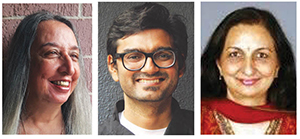
From l: Meher Pestonji, Quasar Thakore-Padamsee, Arti Desai
Thakore-Padamsee, a well-known stage actor and director who has been in the field for two decades, is a founding member of Thespo, India’s premier international youth theater movement. He currently also serves on the committee of Tata Literature Live.
Commenting on the wide geographic gamut of Pestonji’s stories, Thakore-Padamsee asked her what possessed her to create this collection. What was she looking for? Pestonji confessed that the book started out as individual stories which she sent to online magazines. Whereas the shorter stories succeeded, the longer ones did not seem to work online, so she decided to compile a collection for publication as a book.
Her interest in the subject of war was fuelled by the Zoom poetry groups formed during the pandemic-necessitated lockdown when people were stuck at home. Several of these groups had international participants. The stories took on a personal angle because suddenly one finds oneself among people one has never met, in places one does not really know. One gets acquainted with their writings, their thoughts and feelings which manifest in their poems. Some of these poets were parents, and in particular those in the USA were disturbed about sending their children to school in light of the shootouts. One poet witnessed a shootout on the way to the supermarket. There must be millions of people in real life who are similarly affected. This became the germ of the story "Mother’s Fears.”
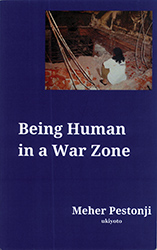 Thakore-Padamsee noted that Pestonji’s book was full of strong images and a lot of detail which give the reader a very clear sense of place. Such examples are found in the bridge from which the diver jumps off in "After War” and the description of the mountain in "Children in a War Zone.”
Thakore-Padamsee remarked on the vivid geographic descriptions which make the reader feel actually present in those locations. "I don’t believe you visited all these places,” he remarked. With a quiet, shy smile, Pestonji admitted that the "trick” was Google: "You look up everything and anything and you get whatever information you want. The image is very important because you look at the image and then put it into words.”
"Where did the inspiration for these 14 stories come from?” asked Thakore-Padamsee. From different sources, Pestonji responded. She read a news report about Ukrainians and Russians reaching the finals of a match, which became the genesis of "Rivals.” The only event she had personally witnessed was in "What a Day” about a taxi driver during the Bombay bomb blasts. She was near the Bombay University buildings when she heard the blast at the Stock Exchange and saw black smoke billowing out. She witnessed a man forcibly yanking a woman out of a taxi which she had hailed and occupied. He took the taxi into the Stock Exchange lane and returned a few minutes later with wounded people. The story is narrated from the perspective of the taxi driver.
After taking turns to read "Children in a War Zone” Thakore-Padamsee complained, "You are heartless; you paint these vivid pictures of places and make us invest so much in your characters over eight to 10 pages and then you leave us abandoned. We want to know more, we want to know what happened to the two kids in ‘Children in a War zone.’”
Pestonjee confessed that she herself did not know what eventually happens to the children. "But there must be kids in war situations and when one is pushed to the edge, things happen — the courage to grab a gun, a child feeling sympathy for the man who could be an enemy and wanting to give him a sip of water.” Since many of the stories are open-ended, Thakore-Padamsee was curious about whether Pestonji had any plans to enlarge them into novellas. Pestonji admitted, "I have left open endings because I don’t know what an ending could be. In some of the stories you see the direction in which the characters are moving but you are never sure what they will do in the future. It depends on from which character’s perspective you perceive the story. In ‘The Rebel’ you don’t know whether the daughter will do what the father tells her to do or what she pleases. You see her character develop but you don’t know for sure. I like the idea of leaving the reader thinking about what might happen rather than giving a definite picture of what it is. The crux of the story is that the wife has breast cancer and as she comes from a traditional Muslim family the idea of exposing her breast to a male doctor is unthinkable and unacceptable to the husband. I also wanted to bring out the point that if you are against women’s education how will you get female doctors? It is a contradiction.”
Thakore-Padamsee was eager to know how Pestonji opted for either the short story, play, novel or poem format. She does not really decide in advance, Pestonji replied. It happens spontaneously. When she is uncertain about whether to write a play or a novel she recalls the advice of Dr Gieve Patel, medical practitioner, artist and poet: the choice depends on whether the situation needs more dialog or more narration.
"What is easiest for you as a writer — a poem, a short story or a play?” queried Thakore-Padamsee. "Nothing comes easy,” Pestonji replied. "A short poem may be easier but everything needs reworking. Everything goes through three or four drafts, even a poem, till I am satisfied that it works. And then too I’m uncertain as to whether it really does work.”
How long did it take to complete the stories in the book under discussion? The research for each story took a week. Pestonji thought 10 months to a year would be an accurate assessment for the book. She started out with a collection of 10 to 11 stories but the publisher felt that the book would be too slim, less than 100 pages. He asked her to expand the stories, which she did not want to do. So she wrote three additional stories in three weeks. These were the last three as the earlier ones had already been prepared for publication so the order of the stories could not be changed.
Not all the stories deal with war. Some deal with conflict as in "The Rivals” and some with the aftermath of conflict. In "After War” readers get to know that even though some wars ended decades ago in Africa, Cambodia and Vietnam, land mines have still not been cleared. They don’t get defused by floods which instead tend to wash them down to civilian areas sometimes causing fatal injuries to innocent and unsuspecting people, including children.
During the question-answer session, Pestonji was asked what the title of the book would be if she had to change or abbreviate it. She was unable to answer, but Thakore-Padamsee suggested: "Please Stop It!”
◆ ◆ ◆
From the archive