
Comment
“Reverence to truth”
Independent researcher Farrokh Vajifdar’s review of Rohinton Nariman’s The Inner Fire has drawn diverse comments
I read with some concern, a review ("Reverence to truth,” Books, Parsiana, August 7, 2017) by Farrokh Vajifdar of Justice Rohinton Nariman’s book The Inner Fire – Faith, Choice and Modern-day Living in Zoroastrianism.
Vajifdar, as always, is feisty and entertaining and he apparently has the credentials, but I believe in this case he has made some unwarranted comments. I am not a scholar of our religion but I nevertheless wish to bring a few things to the attention of your readers lest an opinionated review deters them from reading this book — a book which I believe every Parsi should read.
Although Vajifdar has, of course, acknowledged the overall merit of this book, he has perhaps missed the purpose of the publication. The value of the book lies in two seminal aspects: first the attempt to explain the core message of the Gathas in simple and accessible English and second to assimilate the essential themes and ideas that run through them into a unified and coherent picture of the revelation of Ahura Mazda. There is therefore obviously a limit to the amount of information and analysis that can be provided in such a book — source material and knowledge which I know Nariman has accumulated in abundance over decades.
Vajifdar, as always, is feisty and entertaining and he apparently has the credentials, but I believe in this case he has made some unwarranted comments. I am not a scholar of our religion but I nevertheless wish to bring a few things to the attention of your readers lest an opinionated review deters them from reading this book — a book which I believe every Parsi should read.
Although Vajifdar has, of course, acknowledged the overall merit of this book, he has perhaps missed the purpose of the publication. The value of the book lies in two seminal aspects: first the attempt to explain the core message of the Gathas in simple and accessible English and second to assimilate the essential themes and ideas that run through them into a unified and coherent picture of the revelation of Ahura Mazda. There is therefore obviously a limit to the amount of information and analysis that can be provided in such a book — source material and knowledge which I know Nariman has accumulated in abundance over decades.

Farrokh Vajifdar, (left) and Rohinton Nariman: Compelling case for Zoroastrianism
Nariman’s task was not an easy one. I have seen other books on the Gathas and most of them are literal or free English translations. Nariman’s book attempts both the exercises of a free and meaningful translation as also a collation of essential themes and ideas. To call this as falling "between translation and paraphrase” is less than fair.
What Nariman attempts to do is to present not just the words but their significance. This often requires giving meanings to words that may not result from a literal translation. For example Nariman replaces the word "cow” with "Mother Earth” to signify that the cow was used as a metaphor for the sustenance and maternal love of Mother Earth itself and not just to describe a provider of milk. Vajifdar finds that "abstruse” and he says that these meanings would not have been understood by what he calls "the down-to-earth shepherds and tillers of the soil.” But that is probably precisely why the symbolism of a cow would have been of easy understanding to what was an agrarian community.
 Were the Gathas revealed only as a message for the shepherds and tillers of the time or do they contain a more universal and everlasting revelation? As that great scholar Dr Irach Taraporewala says, "In the spiritual sense the ‘sheep,’ the ‘cows’ and the ‘cattle’ are human souls. If we see in the Gathas only ‘cattle-tending’ and ‘fodder’ and ‘meadows’ we would lose their inspiration completely (The Religion of Zarathustra, pp 84-85).”
M. L. West who has himself attempted a modern translation of the Gathas (The Hymns of Zoroaster) emphasizes that "Any translation of the Gathas necessarily has a provisional character” and refers to the "alternative possibilities.” Ervad (Dr) Ramiyar Karanjia says that "The Gathas are highly abstract, metaphysical and philosophical texts and hence very difficult to understand. Many translations of the Gathas are available, each differing somewhat from the other (Jam-e-Jamshed, August 26, 2017).”
Take Vajifdar’s criticism of what he calls an "arbitrary” definition of "Srasha/Sarosh” which Vajifdar defines literally as "hearkening” and which he says Nariman wrongly construes as "conscience.” Hearkening means to listen. Obviously listening could mean through the ear (an outward listening) or through one’s consciousness (an inner listening). It is in that sense that Nariman construes Sarosh as one’s conscience or the moral voice within. After all the role of Sarosh is variously described as the intermediary uniting man to Ahura Mazda, or the mediator between them. A mediator both listens and speaks to those who he is the mediator between. Sarosh listens to the cries of men wronged by the daevas and those who think like them. He also comes to earth to combat and chastise them. As such, Sarosh receives the Good Religion from Ahura Mazda and teaches it to men. He has also been described as "God’s all-hearing ear...” and in later Avesta, Sarosh also appears at the Chinvat bridge to assist the soul across it. (R. C. Zaehner The Dawn and Twilight of Zoroastrianism, pp 55-56, 95-96).
Of course Daena, the Yazatha, has been construed as the personification of the inner self and also good conscience (Zaehner, pg 76). But, as Vajifdar accepts, Daena is drawn from the root "di.” The literal meaning of Daena and "din” is "religion” (Mary Boyce, Textual Sources for the Study of Zoroastrianism, pp 19 and 38). Hence "humdins” i.e. "co-religionists.” Taraporewala calls Daena the personified abstraction of Faith (The Religion of Zarathustra, pg 49). Thus, religion and faith have been construed as good conscience. What then is arbitrary about characterizing Sarosh who teaches our religion to us, listens to us and chastises us, as the moral voice within us?
Also unwarranted is Vajifdar’s comment that Nariman’s translation of Ushta as happiness is "saddening.” According to Vajifdar, "Ushta” carries a far deeper significance than "mere happiness” and he construes it as a boon conferring "enduring moral power.” But Vajifdar overlooks the fact that Nariman has referred to Ushta as "light” (pg 137) and that various authorities such as Taraporewala have translated Ushta literally as illumination and in a free English rendering, as light (The Religion of Zarathustra, pg 193). Light and illumination can be construed as happiness and indeed therefore Taraporewala also construes "Ushta” as "happiness” at the beginning of Chapter V of his book (pg 31).
Differing interpretations which do not detract from the core of the message are a matter for scholastic debate, not sarcasm. Only Ahura Mazda will be able to give the definitive meaning. For example Vajifdar’s interpretation of fire strengthened "Asha” as "justice” is intriguing. Most scholars construe "Asha” as "righteousness” or "truth,” (Zaehner, pg 64), "righteousness” or "purity” or even "the Great Law of God” (Taraporewala, pp 17-18 and 21) and fire as the symbol of truth (Zaehner, pg 74). Mary Boyce (Zoroastrians Their Religious Beliefs and Practices, pg 19) says Asha is "order, righteousness and justice.”
Finally the reference in the last para of Vajifdar’s review to Karl Popper and ignorance being a refusal to accept knowledge, is unintelligible in the context of Vajifdar’s acceptance, qualified as it is, of the strength and persuasiveness of Nariman’s book. Was it a dig at readers? Or was it an unnecessary and unjustified conclusion? Academic criticism is welcome, acrimony is not.
Nariman presents a compelling case for Zoroastrianism as a revelation that remains valid and even modern in its outlook. One review should not affect that! To your readers I say: "Go read the book! You will cherish it.” I’m sure Vajifdar will agree.
DARIUS J. KHAMBATA
•••
Reading Vajifdar’s review of this book, I thought that this work deserves a non-technical review by a non-scholarly person. Of course, this ex columnist of the lowly "Bawa Musings” does not have the temerity to quibble with Vajifdar on din, humdin, weh-din and beh-din; nor do most of your readers have the ability to appreciate what are the "benefits of diacritics for Gathic clichéd Avestan.” Be that as it may, this lucidly written book is a primer for anyone remotely interested in Zoroastrianism. The book’s uniqueness lies in its categorization of Gathic hymns, subjectwise and conceptwise.
Even for those of us who believe that what matters most are the Manthric vibrations of our prayers, not understanding its meaning does make the exercise less fulfilling. If you read this rather short book carefully, many of the prayers will suddenly seem meaningful. For instance, the author tells us that the short kusti prayers are in three languages: Kem na Mazda (Gathic Avestan), Ahura Mazda Khodai (Pahlavi) and Jasme Avenghé Mazda (later day Avestan).
Derived straight from the Gathas (not emanating from prophet Zarathushtra’s mind but direct revelations from Ahura Mazda himself, as the author puts it), the Kem na Mazda prayer is immensely potent to ward off black magic and evil. Our father’s Sufi guru urged all his Parsi disciples to constantly recite the Kem na Mazda.
Interestingly Nariman, who is unlikely to have read Ilm-e-Khshnoom literature, speaks of the Gathas referring to the Maga Brotherhood, akin to a church or organization to propagate the faith. This will warm the cockles of the Khshnoomists who believe so much in the Magav Sahebs of Daemavand Koh, being the Great White Brotherhood of the Parsi Theosophists, or the spiritual hierarchy protecting the faith. Vajifdar, on the other hand, with his liberal hue, is singularly unimpressed by this claim.
 Nariman terms it a miracle that the Gathas have been transmitted to us, over thousands of years, in an "extremely accurate form” as evidenced by its flawless poetic meter. The first four Gathas were composed and sung by the prophet himself; the fifth being only a postscript on the occasion of the prophet’s daughter’s marriage, and, therefore, of lesser importance. This miracle has occurred, despite Avesta being a dead language, due to its great similarity with Rigvedic Sanskrit (the prophet is said to have belonged to the Old Rigvedic religion before he received enlightenment). It is significant that many devout Parsis recite the four Gathas every day; its powerful vibrations emanating from Ahura Mazda, the supreme creator himself. Significantly, our gah sarna (funeral prayers) are a part of the Ahunavad Gatha; strong enough to obliterate the earthly memory of the deceased (pregnants being forbidden to listen, as it allegedly can abort the foetus).
 Nariman’s judicial mind (much extolled and much admired — but that is a story for another day) is evident from the structuring of this book. Starting with Ahura Mazda ("slow to anger, but should never be provoked to wrath,” says the author) and his prophet Zarathushtra, sent pursuant to Mother Earth’s complaint to the Almightly about the prevailing evil (though Vajifdar contends that it was not Mother Earth, but the "collective soul of all domesticated animals,” who complained). The book introduces pithily the core concept of Asha, in the Zoroastrian cosmology, which according to the author, is truthfulness. The Ashem Vohu prayer, which incorporates this concept of Asha is reflected in Krishna’s teachings in the Gita about Nishkaam Karma (good deeds done for the sake of it, and not in anticipation of any reward, worldly or other worldly).
Similarly, the concepts of Vohu Mana (the good mind, the free choice of Zoroastrianism, between good and evil); Spenta Mainyu (the Archangel), and his evil twin, Angra Mainyu; Armaiti or right-mindedness (whom the famous occultist Rudolf Steiner called the solar angel always standing near your right shoulder to guide you) and Sarosh (the conscience), are explained in easy to comprehend language.
Nariman’s interest in his religion was kindled by his navar ceremony at 11 years of age and he lays no claim to being a trained scholar. Of course, for nearly 35 years, he has acquired extensive knowledge of Avesta, Rigvedic Sanskrit and nuances of the Gathas. This reviewer was a trifle amused with some of Vajifdar’s technical criticisms. [Sarosh, says Vajifdar is not ‘conscience’ but ‘hearkening’ (hearing); but isn’t conscience, the hearing of the inner voice?] Even scholars and students have predilections, as is evident from the fact that the author places Zarathushtra in "an era way before 500 BC,” while Vajifdar positions him much later in 600 BCE. Perhaps, due to a confusion about King Vistasp (whom the prophet converted) wrongly seen as belonging to the Achemenian dynasty, instead of the much earlier Kayanian dynasty. To the pure mind of the Gathas though, the placement of the prophet is hardly relevant.
Vajifdar has taken cudgels with the author about the technical accuracy of some terms and concepts. Irrespective of who is right, the fact remains that this book is not a thesis to gain a doctorate, but rather to rekindle the inner fire of interest in the lay Parsi about the great gift of the Gathas, and the miracles, their dedicated recitation can bring about, in our daily lives. BERJIS DESAI
• • •
Justice Rohinton Nariman, a member of the Delhi Parsi Anjuman, has studied the Gathas and comparative religion over several decades. Before writing his book, The Inner Fire, on two separate occasions, he shared his knowledge with the members of our Anjuman in a series of talks, which were very well received.
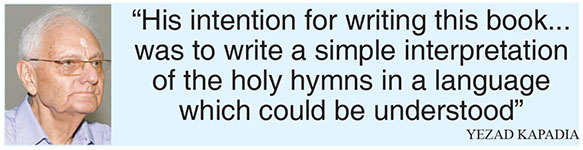 His intention for writing this book was not, as done so far by other scholars, to write a scholarly dissertation on the Gathas, but to write a simple interpretation of the holy hymns in a language which could be understood by lay people. He has succeeded in doing this as far as our members are concerned
The Gathas, written in the ancient Avestan language, are open to interpretation in different ways. Perhaps Vajifdar may have done well to comment on the book as a whole rather than give his own interpretations of individual words and concepts. YEZAD KAPADIA
•••
My assessment of Justice Rohinton Nariman’s Inner Fire has attracted the ire of two eminent jurists — on grounds deemed unacceptable. Darius Khambata has drawn up well-known heavy-weights to support his objections, before proceeding with suggestions of sarcasm, having "a dig at readers,” and even acrimony (!) leaving me breathless with disbelief. Popper was, in fact, brought in to substantiate Nariman’s own view as printed at the very end of the review.
Berjis Desai’s perspectives, altogether balanced, include the Kam.na mazda and Ka varathram.ja both of which precede our kushti-bastan ritual. The first invokes one’s daena; the other entreats Sraosha, "hearkening” to reach whomsoever Mazda wills. The two do not merge and are not interchangeable! On animal wealth, it should further pique his interest that horse-racing, literal and metaphoric, plays an important part in Zarathushtra’s teaching program.
Thanks to Yezad Kapadia for his searching review of my Justice Nariman’s book review: it’s a novel experience! I cannot determine whether it is meant to be interpretive or controversial. The very thought, which never previously occured to me of Zarathushtra’s key concepts being anything one wanted them to be deserve deep consideration. It has implaned notions that perhaps, after all, the sage really didn’t know what he was talking about. I shall duly consult "simplified” grammars and lexicons not otherwise available.
I stand by my review, favourable to Nariman’s Inner Fire, in both form and content. Should any serious student of the Gathas, via this enterprising book, wish further particulars, then may I suggest they e-mail me on f.vajifdar@btinternet.com so that space on Parsiana’s pages be freed up for other matters? It’s only fair.
FARROKH VAJIFDAR
◆ ◆ ◆
From the archive