
In Memoriam
Submariner’s supreme sacrifice
Lt Cdr Firdaus Mogal, executive officer of the submarine INS Shankush saw three of his comrades being dragged into the sea by the strong southwest monsoon winds that lashed the Bombay coastline on the morning of August 30, 2010. This was shortly after the submarine had been brought to the surface following a minor hitch. The 36-year-old gallant officer with two aides immediately jumped into the water in an attempt to rescue them. "Six of them were then in water,” reminisces the Commanding Officer of the submarine G. Murli who sought emergency rescue support from the naval base.
Before relief could arrive, five of them had already clambered up the submarine with Mogal giving them the necessary push from below. "He was asking everyone to go before him,” relates Murli. Being the last one in the water he was trying to haul himself whilst holding onto a suspended metal ladder. Just then another merciless wave came crashing upon him, causing the seasoned sailor to lose his balance and fall unconscious into the sea. Once again some naval officers plunged into the water in a bid to assist him but he kept drifting away from the submarine. Shortly thereafter the helicopters arrived on the scene and the rescue team rushed him to hospital but they could not revive Mogal.
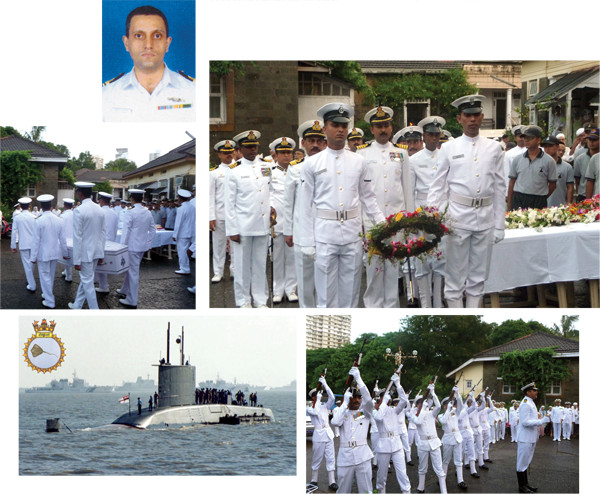
Military honors accorded to Lt Cdr Firdaus Mogal (right) at Doongerwadi Photos: Ministry of Defence; (below left) INS Shankush and its crest (inset)
According to Capt M. Nambiar, chief public relations officer (defence), "Mogal made the supreme sacrifice in an unmatched show of fearless valor whilst saving the lives of his shipmates onboard INS Shankush…”
Mogal’s dauntless deed earned him a hero’s farewell at Bombay’s Doongerwadi in the early morning hours of September 1, 2010. The coffin was draped with the national tricolor and his ceremonial uniform with cap was placed on his body. His immediate family that included his wife Kerzin, parents Darabshah and Armin, two brothers Harvesp and Hush-rav, parents-in-law Shiraz and Arnez Sarbhanwala, along with other close friends stood beside the coffin placed in the pavilion connecting the Albless Bungli. Many of the tearful mourners who had come to offer their condolences were in fact being consoled by Kerzin.
On the road outside were lined the naval troops who accorded him a ceremonial guard of honor, presenting arms as a mark of respect. Thereafter the ceremonial guard proceeded with the reversal of arms. Senior naval officers like Vice Admiral Pradeep Chauhan, Chief of Staff, Western Naval Command, Rear Admiral Babu, Flag Officer Defence Advisory Group and other personnel then placed wreaths on the body. The trumpeter’s soulful rendition of the Last Post followed by the Reveille set the tone for the final firing of three volleys by the ceremonial guard after which the troops marched off.
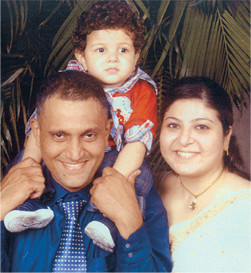
From left: Firdaus, Yashan and Kerzin Mogal
The body was subsequently taken for the sachkar and geh sarna ceremony. After the paidast when the body was being carried to the dakhma the initial stretch was lined with uniformed naval officers and sailors paying their final salute.
Commissioned into the executive branch of the Indian Navy as a sub lieutenant on January 1, 1998, the adventurous Firdaus volunteered for the submarine arm and passed the Basic Submarine course with impressive results. His naval career included appointments as anti submarine warfare officer onboard INS Shalki, training coordinator of the Submarine School INS Satavahana at Vishakhapatnam and the recent executive officer duty where he was second in command of INS Shankush. At the time of his demise, INS Shankush representing the Indian Navy was involved in a four-day joint exercise with the French Nationale Navy.
"When I was an instructor at the Submarine School he was my student in 2003,” mentions Murli who yet recalls Mogal’s enquiring mind, eagerness to participate and ability to grasp. Happy to have him as his second in command on INS Shankush Murli explains how Mogal assumed responsibilities and worked on the training of all the officers, keeping their welfare in mind. After finishing time as second in command he would have qualified to command a submarine and therefore sought his senior’s counsel and advice, acknowledges Murli.
Three years earlier his "professional competence, zeal, enthusiasm and devotion to duty” had earned him a commendation from the Flag Officer Commanding-in-Chief, Western Naval Command.
Having been inspired to join the National Defence Academy after attending the Holiday Programme for Youth (HPY) in 1990 when he completed schooling from the Maneckji Cooper Educational Trust in Bombay, the Ahmedabad born Mogal sought to impress subsequent batches of students to join the armed forces, mentions Commodore Aspi Marker. A regular speaker at the HPY, this year Mogal took the initiative to expose the students to INS Vikrant.
Amongst the present Zoroastrian officers serving the Indian Navy, "he was the youngest with a very promising career,” states Kerzin adding, "He was born to be a soldier… wanted to serve his country. He was always heroic… could never do the wrong thing.” Sacrificing one’s life "during war times is expected but doing so on humanitarian grounds in the course of one’s duty” makes her proud of his selflessness. She believes he is "an example for the Indian Navy on how an officer is supposed to protect” his subordinates.
Firdaus had joined the Defence Forces as an Airforce Cadet and was trained to be a fighter pilot but when he was given a ground posting although he sought active service, he opted for the submarine branch, considered the cream of the Navy. Not many civilians realize their intensive drills, how they are physically and mentally trained to work for days, weeks and sometimes months without fresh air and sunlight when the submarine is under water, points out Kerzin, referring to their struggle of "mind over matter.”
Having met through a common friend seven years ago, after two years of courtship they married in 2005. Reading was a passion with him as also looking at movies and listening to good western classical music and old Hindi film songs. Viewing him as "an absolute liberal,” Kerzin commented that he had a "live and let live philosophy, never labeling anyone.” Prayers every night were a regular ritual with him and the family would frequent the agiary regularly and enjoy spending a weekend in Udvada.
Whilst she tries to "live up to the expectation of a soldier’s brave wife,” for the present Kerzin is saving all the media clippings so that their two-year-old son Yashan can read about his father’s sacrifice when he grows up. Firdaus’ other dreams of giving their son "the best education with an active interest in sports” she’ll now pursue single-handedly realizing that the "void in my life will never go.”
"His sacrifice deserves a bravery award,” commented Dr Nitin, a blogger on the web, describing him as "a true naval hero. He was a very nice and down-to-earth person. He served the Indian Navy in an unselfish manner.” As pointed out C. D. Pereira, "What Mogul has displayed is chivalry in the face of grave risk to personal safety. In war time, such acts generally receive the highest military awards like the Vir Chakra. Here the odds were not enemy action but life-threatening adverse sea state…The Navy needs to relook at safety procedures to minimize such grave losses of such premium assets like highly trained manpower.” Opined Yashna on her blog, "A submarine should be named in his memory so that the waves would also remember his spontaneous sacrifice.” Another sailor boy suggested, "Whilst nothing can replace his loss, let us, as a nation look after his bereaved family.”
A post from Calypso, another blogger, remarked, "It is very easy to sit and comment from armchairs. The conditions and the lives of the submariners cannot be even imagined. Heroes like him inspire and fuel the imagination of this country.” Reiterated Shriprakash Singh, "This is an inspiration for all the leaders to lead from the front, even if it means sacrificing our lives.”
◆ ◆ ◆
From the archive