
Life-Style
An aesthetic blend
Memories and modernity are pleasingly juxtaposed in Dhun Mehta Ghose’s elegant apartment in Nagpur
The elegant apartment home of Dhun Mehta Ghose in Nagpur is not heavy with antiques, as might be expected from a person of her lineage. Nor does it have the brash and crass look of the modern nouveau riche home because she is not one of those. I can only describe it as "classy.” Her home is an aesthetic blend of the old and the new. Ghose lives on the second floor of a six storey apartment building called Silver Oaks. It is one of the better and new apartment buildings, exuding an air of greenery, space and serenity. Ghose’s three bedroom apartment covers an area of approximately 5,000 sq ft.
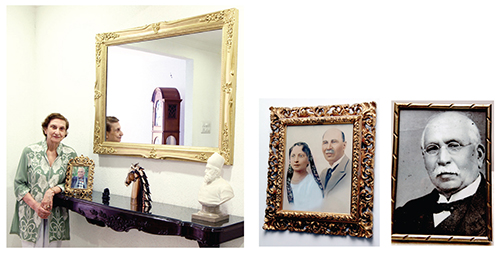
(Clockwise, from top): Dhun Ghose with photo of Nanu and marble bust of
J. N. Tata; Dhunmai and Sir Sohrabji Mehta; Sir Bezonji Mehta; formal drawing room
That Silver Oaks is an apartment building which cares for its residents is amply evident from the moment one enters. There is ample parking for residents and visitors. Alighting from one’s car, one sees a wall with the 21 names of Lord Ganesha artistically inscribed upon it, along with a benign Ganesha sculpted there. There is a well kept garden with common areas for holding children’s birthday parties and other social gatherings for the residents. Round the clock security and CCTV cameras add to the sense of security.
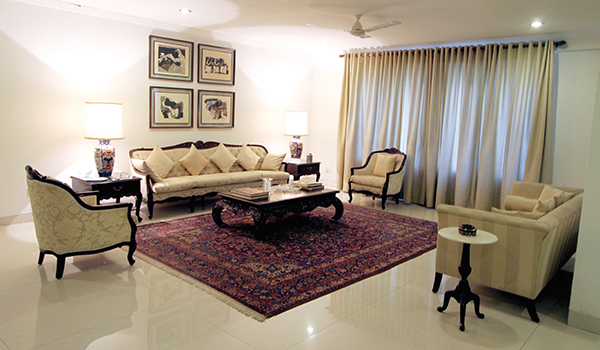
Ghose’s front door opens on to a lobby. To the left is a large and lovely space that houses the formal drawing room, dining room and bar. Each of these flows into the other with no walls or ornate partitions between. Near the dining room is a meticulously maintained kitchen, where antique wooden cupboards store fine china and glassware. The bar is a masterpiece of modern carpentry, solid but graceful, newly made but in sync with the older pieces. The drawing-dining-bar area opens out on to a balcony, surrounded by flowering gulmohur and kachnar trees. "I spend most of my time here, reading, writing and working on my I-Pad,” Ghose says.
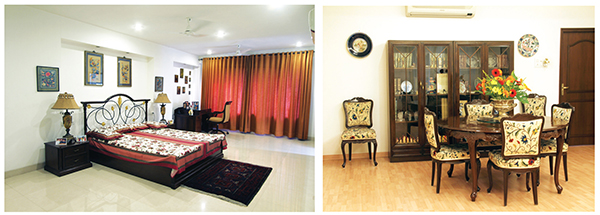
(Left): The children’s bedroom; (above): part of the informal drawing room
The other side of the lobby has an informal seating and meeting arrangement and a round table for cards, mahjong and meals. This room opens onto three bedrooms, each with an attached bathroom. There is Ghose’s own bedroom, with everything in its place and a place for everything. She is meticulous about the way she keeps both home and person.
The largest bedroom with windows opening out on to a lot of greenery is always kept ready for when son Biren or daughter Anita come to visit. Biren is based in Bangalore and Anita lives in London. The third bedroom is for other guests.
Ghose’s home is a harmonious mix of things with nowhere a discordant note. There are pencil sketches of her children and grandchildren done by a pavement artist located outside the Prince of Wales Museum in Bombay. There is a camphor chest engraved with the date 1871. An attractive grouping of Christianity related pictures painted by a priest in Bandra adorns the walls.
With a marble topped table from the bathroom of Ghose’s childhood home The Tamarinds and her parents’ elegant wedding chairs, memory and modernity are pleasingly juxtaposed. Age and elegance walk hand in hand in Ghose’s lovely home.
Can Silver Oaks ever compare with The Tamarinds in Nagpur, a gracious old bungalow set on eight acres of land, with its own tennis and badminton courts, rose gardens and tamarind trees? "Never,” sighs Ghose, who grew up there. "It was the family home of three generations of Mehtas. Sir Bezonji Dadabhoy Mehta, my great-grandfather, Sir Sohrabji Bezonji Mehta, my grandfather whom I adored and my parents Gev and Mucca Mehta.” Ghose went on to speak of her idyllic childhood. "As an only child, I was thoroughly spoilt. My every word was their command.”
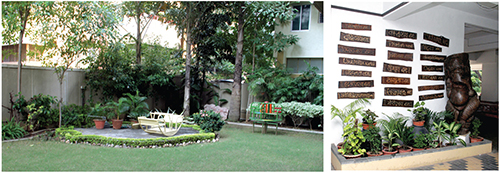
Garden and children’s play area; (left):
21 names and statue of Lord Ganesha at the entrance to Silver Oaks
The story of the knighting of Bezonji Mehta is the stuff that legends are made of. In 1912 His Majesty George V the King Emperor came to India to attend the Delhi Durbar, held in his honor.
On their return to Bombay, King George and Queen Mary’s train made a special halt at Nagpur station. There on the platform under a canopy, on a red velvet-covered stool, the King ordered "Kneel Mr Bezonji Mehta.” Tapping Mehta on each shoulder with his sword, the Emperor then pronounced "Rise Sir Bezonji Mehta!” The honor was bestowed in recognition of Bezonji’s role in establishing and running the renowned textile mill, The Empress Mills (now closed) which provided a livelihood to thousands of people and changed the face of Nagpur city.
Bezonji was the managing director of the mills. "My great-grandfather shunned honors,” said Ghose, "but honors were thrust upon him.”
While in her 20s Dhun married her badminton court sweetheart, Biressor Ghose. Nanu, as he was affectionately called, and Dhun travelled all over the country and to many parts of the world. It was only 40 years later, after Nanu retired from CEAT that they came back to Nagpur. "I was not keen to return to Nagpur,” admits Ghose, "but Nanu, the more sentimental of us, yearned to get back to his roots.” Sadly, their return to Nagpur and their stay at The Tamarinds which she had inherited, was sweet but much too short, for Nanu passed away some years after their return.
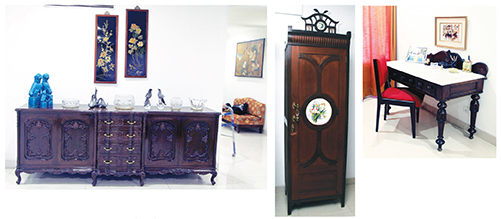
(L-R): Wooden cabinet with Chinese stone inlay work
pictures above; antique cupboard; marble topped table
Always a close knit family, Biren and Anita have been pillars of strength after Nanu’s death. "I was numb with grief but Biren took the decision that I should move out of The Tamarinds and into a more compact home, Ghose explained. "The Tamarinds must have held too many memories,” I sympathized. "It had too many memories and too many doors,” Ghose exclaimed!
Overcoming her sorrow, with grit and determination Ghose moved to Silver Oaks where she is liked and respected and can be given a helping hand by good neighbors, when needed.
She immersed herself into making her apartment the beautiful place it is, with a touch of class in every piece and every placement. Older people’s homes are usually cluttered with the memorabilia of years. But Ghose has had the strength and sensibility to keep her memories within the covers of her diary, leaving her home to live up to the adage "less is more.”
"Memories will always be there,” she philosophized, "but life has to be lived in the present.”
◆ ◆ ◆
From the archive