
Politics and Policy
“The sun is there”
The doongerwadi lands should not be used as burial grounds, counseled a high priest and the Federation president at the zonal meet of south Gujarat anjumans
The doongerwadi lands should be utilized for the disposal of the dead or for planting baval trees to provide wood for the agiaries and other religious purposes, but not converted into aramgahs (burial grounds), was the advice given to anjuman representatives at the West Zone B Federation of the Parsi Zoroastrian Anjumans of India (FPZAI) meet held in Valsad on July 24, 2016.
The eight-point agenda for the south Gujarat anjumans meet included the item, "Steps to ensure maintenance and safeguarding unused dakhma land — discussion and suggestions.” The inclusion of this sensitive subject on which a decision had been put off in earlier zonal meets may explain why the invite to the Parsi Press was sent only six days prior to the meet while the invitations to the anjumans were sent two-and-a-half weeks earlier. Parsiana and Parsi Times attended the Sunday meet.
Udvada high priest Dastur Khurshed Dastoor told the 50 or so, nearly all male, south Gujarat anjuman representatives gathered at Bejan Hall, "Dakhmenashini is our system. Why not make the best use of it...the sun is there.” The Parsi population is small, and deaths are few. "The dakhmas in the mofussil areas are not full of bodies,” he noted.
"If you say there is a problem, tell me, we can discuss it further... If someone does not want to go (to the dakhmas), that is a different matter,” stated Dastoor. "Dakhmenashini has been going on for ages. For what reason should we sacrifice our land? I’m not in favor.” (Applause)
The eight-point agenda for the south Gujarat anjumans meet included the item, "Steps to ensure maintenance and safeguarding unused dakhma land — discussion and suggestions.” The inclusion of this sensitive subject on which a decision had been put off in earlier zonal meets may explain why the invite to the Parsi Press was sent only six days prior to the meet while the invitations to the anjumans were sent two-and-a-half weeks earlier. Parsiana and Parsi Times attended the Sunday meet.
Udvada high priest Dastur Khurshed Dastoor told the 50 or so, nearly all male, south Gujarat anjuman representatives gathered at Bejan Hall, "Dakhmenashini is our system. Why not make the best use of it...the sun is there.” The Parsi population is small, and deaths are few. "The dakhmas in the mofussil areas are not full of bodies,” he noted.
"If you say there is a problem, tell me, we can discuss it further... If someone does not want to go (to the dakhmas), that is a different matter,” stated Dastoor. "Dakhmenashini has been going on for ages. For what reason should we sacrifice our land? I’m not in favor.” (Applause)
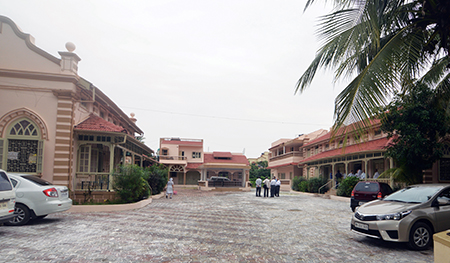
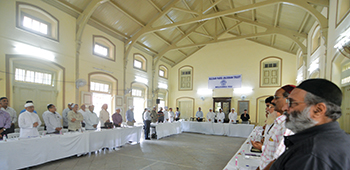
Humbandagi at the venue Photos: Jimmy J. Vajifdar
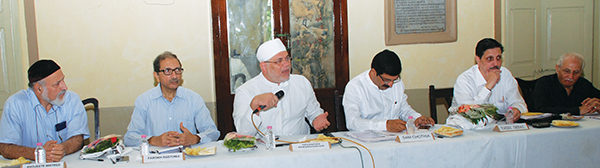
From left: Khojeste Mistree, Farrokh Rustomji, Dastur Khurshed Dastoor, Sam Chothia, Yazdi Desai and Jamshed Dotivala
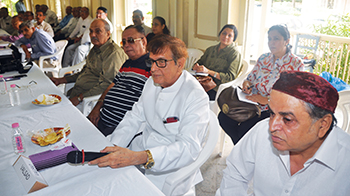
Valsad anjuman trustees and others
He termed the baval plantation project implemented by the Vyara Songadh Anjuman (see "Baval bounty for Vyara,” Events and Personalities, Parsiana, July 21, 2016) a "sundar (beautiful)” and beneficial one. "Adopt this project,” he urged the anjuman trustees present. "Nothing is better than this. Even if funds are not available, 25% of the land can be developed.”
Vyara trustee Persi Buhariwala said the anjuman had no funds but raised the money through donations. The Faramji Hormusji and Maneckji Faramji Sethna Trust donated Rs 28,73,000 and the anjuman was grateful to the Trust’s managing trustee Rustom Vakil who attended the function on June 12, 2016. He had been instrumental in obtaining the donation. . .
While raising the issue of utilization of doongerwadi lands and introducing Dastoor, West Zone B vice president Sam Chothia requested the delegates to "listen peacefully.” He noted where the land was leased for disposal of the dead and not used for that purpose, "the government could take it back...If religious scholars say we can start aramgahs and there is no legal objection,” the anjumans could consider the proposal.
WAPIZ (World Alliance of Parsi Irani Zarthoshtis) founder trustee and former Bombay Parsi Punchayet (BPP) trustee Khojeste Mistree spoke of the elaborate religious ceremonies prior to the erection of a dakhma and how the concept of naso (bodily waste) was unique to Zoroastrianism. "The dakhma does not permit the naso to come out” of its precincts. He stated that during the Bombay plague a British gazette officer had said, "There was no better man-made system than the dakhmas...no infection came out.”
He asked the delegates to distinguish between the physical and spiritual world. The body may be disposed of in the dakhma but "the soul hovers near the body for three days. The soul is in difficulty...the dakhma protects the soul. The four days’ prayers comfort the soul, cauterize the soul. Why go into a method that will be damaging to the soul?...A dual system is not compatible,” he said referring to the arguments that both dakhmenashini and burial could co-exist.
Regarding resorting to other modes of disposal, the Zoroastrian Studies founder inquired, "What is religiously right? This is the important question.” Referring to changing customs as alluded to by some of the delegates, Mistree advised them to distinguish between the "core and periphery” of the religion. "External things change all the time. But there are some things no one has the right to change.” If these were changed, "confusion” would result. "Do not underestimate the religious importance of the death ceremony...Dakhmenashini is not the problem. We can strengthen it,” he said referring to the possibility of "vulture resurgence.”
He said one "can’t leave choices of a spectacular nature to individuals. As an individual you should uphold what your forefathers implemented.” In the western hemisphere people turned to cremation or burial out of "majburi (necessity)” as no dakhmas were available.
FPZAI president, BPP chairman and WAPIZ founder trustee Yazdi Desai endorsed Mistree’s contentions, noting that what was important was not the individual’s preferences but "what is religiously allowable.” Until 2001 Desai had the "conviction that whatever our high priests say we should follow blindly. If a high priest says it is light (even though it may be dark), it is light.” Similarly for when they proclaim it is dark. At the time a debate was brewing over whether a bungli at Bombay’s Doongerwadi could be assigned for those opting for cremation. Various arguments were put forth when Desai’s friend and guide in religious matters, Mistree, mentioned to him that only in Zoroastrianism is death viewed as the work of the devil. So how could one inter a defiled body into the earth or in a fire? "The natural elements were held in high esteem,” in Zoroastrianism. "If that is our theology we cannot think of cremation or burial. You can put the land to any use. Build walls around it but you can’t have a burial ground. I don’t even know if it is legally permissible.” One would have to approach the Charity Commissioner’s office with a cy près application for any change in usage. "Revere the dakhmas,” Desai counseled. Within eight weeks of putting the body on a dakhma pavi the corpse totally disintegrates. "Only the skin and bones remain.” The sun dehydrates the body and "even during the monsoons, sunlight will be there during the eight-week period. Be guided by what our high priests say.”
While one had to respect an individual’s wishes, one was also "duty bound to do what is in the interests of the trust, not the individual,” said Desai. "If the trust says dakhmenashini, we have to follow that. Changing a social custom is different from changing the very fabric of the religion.”
Noting that the issue was not an objection to dakhmenashini but observing the last wishes of the deceased, Brig Jahangir Anklesaria (Retd), president of the Ahmedabad Parsi Panchayat stated some people "like to be cremated. The wishes of the individual regarding the last rites need consideration. Not once do we say dakhmenashini is not right, even if there is not one sparrow.” Out of 10 Parsi deaths in Ahmedabad, three opted for burial, he noted. "We are duty bound to honor an individual’s last request.”
Dastoor suggested explaining to the individual and asking them the difference between burial and dakhmenashini. "Let us try. If 90% believe in dakhmenashini I can’t foresee any problem with the system. Once you start an aramgah, future generations will opt for the short cut.”
Ardish Vapiwala of the Shree Daman Vapi Parsi Jarthosty Anjuman noted that when the local Parsis carried the corpses into the dakhma they noted two skulls had been moved to one side and were placed side by side. Someone must have entered the tower and possibly performed some tantric rites. Other delegates also voiced a concern over unauthorized people entering the dakhmas.
Dastoor asked the anjumans to keep the dakhmas locked and employ watchmen. They said they were doing so but the possibility of someone entering was a reality. Ervad Yezdi Panthaki of the Saronda Parsi Jarthosti Anjuman suggested starting plant nurseries on the doongerwadi lands to both utilize and safeguard the property while at the same time raising funds.
Baman Cama, president of the Shri Parsi Panchayat, Vadodara inquired, "Why should the religion deny the last rites” to people opting for other means of disposal? The BPP had banned two priests from performing any religious ceremonies at Doongerwadi and two agiaries controlled by the trust since they recited prayers for those opting to be cremated. "Why deny them the choice?...We know of the state of the dakhmas in Bombay,” a reference to the horrendous sights viewed in the photographs and the video circulated by community activist Dhun Baria some years ago. "Systems go on changing,” he said noting that except for Dastoor and Panthaki no other delegates were wearing traditional clothing.
Dastoor noted, "We are not prohibiting the ceremonies. Nowadays mobeds are performing the prayers.” He said the choice to perform or not was left to the priests. "It depends on each and every priest. His conscience decides. Please respect his wishes.”
Anklesaria noted that in some cases the priest has no objection to praying "but the trustees object.”
"Tell him (the priest) it is his choice,” counseled Dastoor.
Valsad Parsi Anjuman trustee Bomi Mehernosh noted that in a particular village there were only two Parsi women residing, both in their 80s. The doongerwadi property resembled "a jungle. It is not maintained.”
Dastoor noted where the population was less and the corpses few, relatives brought the body to Udvada or the nearest town that had a functioning dakhma.
M. R. Marfatia of Valsad pointed out that the sons of farmers did not want to become farmers. Often the trustees of the doongerwadi property "stay elsewhere. There is no one to look after” the land. Dastoor commented that Pervez Khergamvala of Khergam had complained to him about encroachment on the trust land. When the high priest asked him for a written complaint so he could take up the matter with the state and other authorities, Khergamvala refused to give any letter.
Aspi Sui of Pardi referred to a dakhma long closed with the 90-year-old trustee residing in Bombay.
Marazban Baria, president of the Bilimora Parsi Anjuman, narrated how the trust had sold some land and raised money to protect the doongerwadi property by building a wall and maintaining a garden. "It is the responsibility of the trustees to protect the property,” he averred.
To be continued in the next issue
◆ ◆ ◆
From the archive