
Observation
Of vintage value
Nagpur’s oldest Parsi gentleman, 93-year-old Jamshed Cassad continues to lead an active life
Until he was 91, Jamshed Cassad rode to all his social, religious and business appointments on his tried and trusted Luna moped. Because of the chaotic traffic and the roads being what they are, this worried and upset his children. When all their pleading went unheeded, Shahrukh, the elder son, just made the moped disappear one day and arranged for an autorickshaw to come and take his dad out on his errands. Slowly but surely the father came to appreciate their concern.
He may not have made it big in terms of worldly acquisitions but the genial military engineering officer turned mine-manager turned Life Insurance Corporation of India (LIC) agent accumulated a wealth of experiences. He served as a managing committee member of the Nagpur and Kamthi Parsi Zarthosti Anjuman for many years. At age 93+ he has the distinction of being the oldest Parsi male in Nagpur and one of the most respected.
Born in April 1921 in Rangoon, Cassad passed his matriculation from the St Paul English School there. He recalled how "Burma was part of erstwhile India. One just took a boat from Calcutta to Rangoon.” His father had worked as a manager at a Singer Sewing Machine shop while simultaneously studying law. After getting a degree, he practiced at the bar. "In those days, Rangoon had a sizeable Parsi population, an agiary and, if memory serves me right,” reminisced Cassad, "the dasturji’s name was Ervad Unvalla.”
He may not have made it big in terms of worldly acquisitions but the genial military engineering officer turned mine-manager turned Life Insurance Corporation of India (LIC) agent accumulated a wealth of experiences. He served as a managing committee member of the Nagpur and Kamthi Parsi Zarthosti Anjuman for many years. At age 93+ he has the distinction of being the oldest Parsi male in Nagpur and one of the most respected.
Born in April 1921 in Rangoon, Cassad passed his matriculation from the St Paul English School there. He recalled how "Burma was part of erstwhile India. One just took a boat from Calcutta to Rangoon.” His father had worked as a manager at a Singer Sewing Machine shop while simultaneously studying law. After getting a degree, he practiced at the bar. "In those days, Rangoon had a sizeable Parsi population, an agiary and, if memory serves me right,” reminisced Cassad, "the dasturji’s name was Ervad Unvalla.”
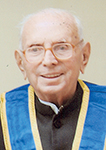
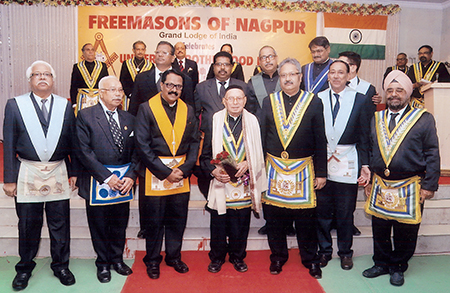
Jamshed Cassad; wearing a topi at his felicitation by the Freemasons in June 2014

Army Overseas Service medal; and Red Cross badge
In 1938 just before the outbreak of World War II the family was sent back to India to their ancestral home in Navsari. His father followed later. Young Cassad only spoke English and knew little about India, its culture or its languages. He went to Surat in 1942 to study for a diploma in mechanical engineering from the Surat Parsi Technical Institute. With his diploma under his arm, the young man went to Poona and signed up for the Military Engineering Service (MES).
As sub-divisional officer in the Mechanical Engineering PIA Force, Cassad traversed the Middle East for three eventful years. His longest term was at the Abadan Oil Refinery in Persia. He was never in the front line of fire but worked diligently to keep the army well oiled and moving.
The end of the War meant another life and change of location. Cassad drifted to Nagpur to work in the coal mines of his elder brother, Dhunjisha. Soon, his mother decided it was time for Jamshed to settle down. As devout Zoroastrians, he and his family were frequent visitors to the Nagpur agiary. His mother asked Ervad Hormuzdiar Pavri, the head priest of the Nagpur Dar-e-Meher to find a suitable girl for her son. Mindful of his duties as caretaker of his flock, the priest lost no time in shortlisting 10 suitable girls.
Jamshed, his mother and his grandmother, all had great faith in Shri Mahipatram, a Gujarati astrologer in Navsari and consulted him on all important issues. He advised that they insist on matching horoscopes before deciding on the bride-to-be. The main reason for this was that Jamshed was a Manglik (one born under the influence of Mars). Those who believe in tapkas (horoscopes) say a Manglik must marry another Manglik or the spouse would fall prey to bad luck or even death. Among Hindus and other Indian communities a Manglik girl will first garland and be married to a tree, thereby allowing the tree to absorb all the bad luck! But that must have been before the environmentalists and ‘Go green’ guys made their presence felt!
Of the 10 horoscopes received, only Zarine Battiwalla was a Manglik. "She was fair and pretty, so my mother readily agreed,” revealed the 93-year-old with a twinkle in his eye.
Four days before the wedding Jamshed fell down in the bathroom, hurt his face badly, resulting in loss of vision in his right eye. Undeterred, Zarine stood beside her betrothed who ascended the wedding stage with an eye patch!
The couple raised three children: daughter Khushnoor, the eldest, followed by Shahrukh and Neville. Zarine passed away in 2013, just two years short of their diamond jubilee.
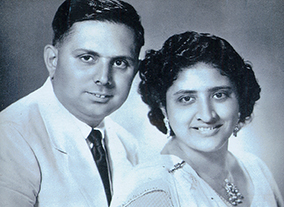
Jamshed and Zarine Cassad
Jamshed worked in the coal rich mines in Chindwara until 1961, when Kumar Mangalam, then minister of mines in the Indira Gandhi led government, nationalized the coal mining industry. Private mine owners were hit hard by the ordinance. Dhunjisha Cassad filed a case against the ministry of mines for nationalizing the mines. The case dragged on for years but one rarely wins against the government. Hardest hit was Jamshed. All the other workers were absorbed as government employees but Kumar Mangalam refused to retain Jamshed. "Because you are D. P. R. Cassad’s brother and he was the man who filed a case against the Government,” he accused. In one fell sweep, Jamshed lost everything — his pay, perks and pension.
Jamshed did not waste time licking his wounds. He got a job as an agent of the C. P. Syndicate and was posted first at the Gurumashani iron ore mines and then at Badampahar, all suppliers to TISCO (Tata Iron and Steel Company). He met Russi Mody often and spoke of him in glowing terms. "A true champion of labor,” he eulogized. "Saw that every worker got his due. He helped me a lot, bless his soul.”
While he was working at the Gurumashani mines, a Bengali film unit came and stayed at the mines’ guest house to film some footage. So impressed were they by the spunky, much travelled young man that they gave him a part in the film. "The film called Life from Stone depicted the life of miners,” recalled Jamshed.
With the children growing up, the family wanted a more settled life. So Jamshed returned to Nagpur and started work as an agent of the LIC. Riding a bicycle with a smile on his face, he pedaled his way to form a successful and satisfied coterie of clients for the Corporation. After his in-laws, Banoobai and Hormuzdji, passed away, Jamshed and his family took over the running of Banoo Industries, a small scale business of manufacturing vinegar, ketchup and pickles.
Jamshed was a member of the Lions Club and is an even more ardent member of the Masonic Lodge. He is the only surviving member of the (recently dissolved) Pench Vale Lodge. On World Brotherhood Day celebrated by the Freemasons of Nagpur in June 2014, Jamshed, the oldest Mason of Nagpur city, was recognized and felicitated by the Fraternity of Freemasons. Sarosh Dordi, another senior member of the Masonic Lodge told us, "At 93, Jamshed is as enthusiastic as a 39-year-old member. He attends all meetings at the local and regional level, always wearing a Parsi topi because he truly considers the meeting place of the Freemasons to be a temple.” Jamshed is a member of not one but various Lodges in the city and continues to take active interest in all aspects of Freemasonary.
As often as he went to the agiary and to weddings and navjotes, he would also visit ailing friends and attend funerals. Despite having one bad eye Jamshed is an avid reader. To this day he subscribes to Parsiana, Jam-e-Jamshed, Reader’s Digest, Outlook and The Ashlar (a magazine for Freemasons) and reads each one from cover to cover. All this, after the day’s newspapers have been devoured!
So full of energy and enthusiasm, Jamshed is truly worthy of admiration and emulation. He does not count the days he lives; he makes the days he is alive, count.
◆ ◆ ◆
From the archive