
Stoking the Flame
Over 20 events were organized in Delhi to create awareness of the exhibitions mounted under The Everlasting Flame Programme
.JPG)
Scene from "Ma’arfet — The Awakening"

Dr Cyrus Poonawalla and Dr Shernaz Cama
All the Parzor cultural events were sponsored by Dr Cyrus Poonawalla, chairman of the Serum Institute of India in memory of his wife, Villoo.Talented artistes from India and Iran entertained the audiences with their prowess in music, theater, puppetry, cinema, photography, art at the India International Centre (IIC), Indira Gandhi National Centre for the Arts (IGNCA) and the India Habitat Centre. The cultural program began with a dance performance "Elemental Divine” by Astad Deboo and his troupe on Jamshedi Navroz, March 21, to coincide with the inauguration of "Threads of Continuity (ToC)” exhibition at IGNCA (see "Exhibition euphoria — III,” Parsiana, June 7, 2016).
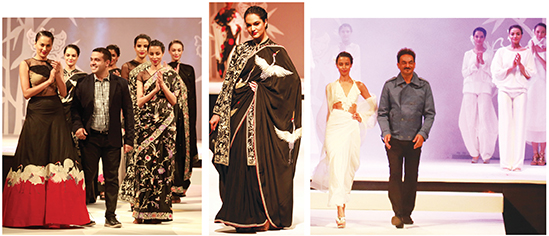
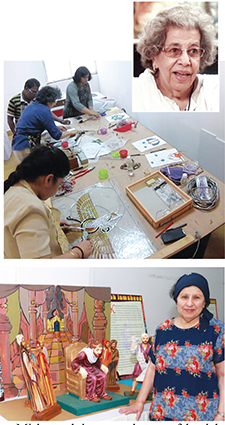
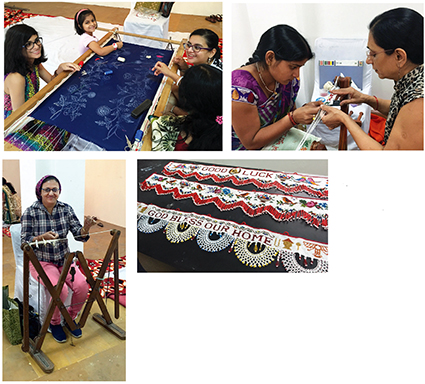
The other events at IGNCA included "Spenta — Magical Manifestations” on Khordad Sal, March 26, featuring a puppet theater performance by Dadi Pudumjee and The Ishara Puppet Theater Trust and a fashion show by Ashdeen Lilaowala and Wendell Rodricks. A parallel exhibition "Ferdowsi’s Shahnameh” curated by Silloo Mehta was on view from March 29 to April 4. Katayun Saklat held a stained glass workshop from April 3 to 10. Kusti weaving, toran making demonstrations and Parsi embroidery workshops were held on April 14 and 15. Parzor Film Festival Screening and interactive talk on "Zoroastrian Motifs in Parsi Embroidery” by Cama and Lilaowala took place on April 16. Muskil-e-Asan participative prayer rituals conducted every Friday at IGNCA during those two months were attended by around 30 persons. Parsi food stalls run by Rustom’s, Bagli’s Kitchen, Mahair Kharas and Nilufer Dhondy on Navroz and Khordad Sal contributed their own aroma. SodaBottleOpenerWala had organized a food cart throughout the duration of the ToC exhibition.
Inspired by Zoroastrian religious scripts and teachings, Pudumjee presented an electrifying melange of puppetry and dance, titled "Ma’arfet — The Awakening.” Ahura Mazda, the kind and just Creator was opposed by the evil Angra Mainyu who filled the universe with unhappiness and destruction. Ahura Mazda then created the Amesha Spentas as Guardian Spirits to protect the material world from such depravity.
"I have showcased the inherent problems of mankind, how the mind and body can fall prey to evil thoughts and dark deeds. The concluding act showcases the problems of choosing between good and evil and the reason why one needs to make a conscious and ethical choice,” stated Pudumjee, one of India’s foremost puppeteers who established the Ishara Puppet Theatre 30 years ago as a platform for innovative puppetry to address serious social issues in India.
"Since Ma’arfet has a very different dance and theater style, it was the sponsorship of Poonawalla which made it possible to get the music composed by Amit Bhavsar, the voice over by Inder Mishra and also cover the cost of the elaborate puppets, actors and puppeteers,” adds Pudumjee, a trustee of the Parzor Foundation and one of the co-curators of the ToC exhibition.
As there is need for compassion at all levels in today’s world, designer Wendell Rodricks presented an abstract, spiritual aspect through his purely white fashion collection titled "The Gireban Collection.” The Goan designer drew inspiration "to create clothes that speak of purity, fluidity and sanctity” from the "Kisse-e-Kerfeh” or the "pocket of good deeds” in the sudreh which though small in size, has a vast and meaningful symbolism. Through his garments in fine gauze, dense-weave linens, light crepes, satins, georgettes and silk, handwoven Malkha cotton, all in white, he sought to transport the audience with accompanying music from an Iranian repertoire "back to a time in Persia where beauty and peace, spiritual harmony and soulful sanctity reigned supreme…”
"I am humbled and honored to bring the Gireban collection to the Parzor celebration as a tribute to a great, generous community in India whose values, legacy and enormous contribution have enriched India in many spheres,” explained the ace designer.
With his new collection, "The Scent of the Orient,” Lilaowala has taken traditional Parsi hand embroidery to a larger canvas, mixing different concepts to create dazzling, ethnic compositions. "Each sari and garment has been painstakingly created and inspired by the fine Chinese decorative art… This Chinoiserie aesthetic inspired me to decode the rich motifs, patterns and colors to create my romanticized notion of the exotic east.”
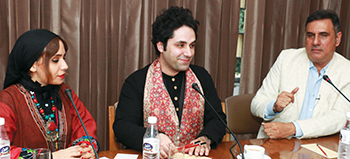
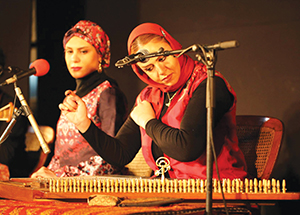
Boman Irani with members of the Basha Ensemble of Iran
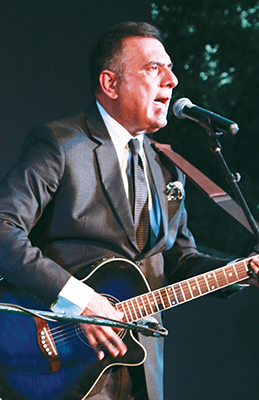
Boman Irani (left) sings for the audience at the India International Centre
The Fashion Show began with the "Blue and White” theme as seen on fine Chinese porcelain. Flora and fauna from these pieces were delicately embroidered in shades of blue and white on saris, dupattas, jackets and kurtas. Fluid chiffon and crepe silk saris in rich tones of cobalt, crimson, burgundy and slate, perfectly contrasted the embroidery. Border details from Chinese imperial jackets were interpreted for saris and blouses. Floral patterns of roses, peonies and chrysanthemums along with exotic birds from Chinoiserie contributed to the "Garden of Paradise” collection comprising of saris, lehengas, modern kurtas and embroidered pyjamas, embellished with metallic gold and silver threads to heighten the opulent look. The "Black and White” section comprised of Birds of Paradise and Ashdeen’s signature, "Flying Crane” motifs on saris, skirts, jackets and blouses.
"I have evolved further as a designer with ‘The Scent of the Orient Collection,’” declared Lilaowala who has been associated with Parzor for the last 15 years. He explained that he had tried "to create a balance and a fine twist between tradition and modernity… Aesthetics and the essence of the craft cannot be compromised as one presents a modern collection for a new audience.”
From Boman to Basha
The cultural events at the IIC commenced on April 1 with the screening of Ferrari Ki Sawari. Thespian Boman Irani was scheduled to interact with the audience that day but paid a surprise visit the following day to the great joy of the audience. He shared the evening with the Basha Ensemble of Iran.
The actor’s solo act was punctuated with humor, mimicry and music. Tracing his journey as a "waferwala” to the present day, he paid tribute to his mother who impressed upon him the "mystery and beauty of cinema.” During his performance, he reiterated his mother’s questions, "How was the crowd in Delhi? Did they show you love and respect?” In his rich baritone voice he sang We are the World and Give me some Sunshine, as he strummed the guitar.
After his performance, the actor was surrounded by spectators with requests for autographs and "selfies” and presented with a token of appreciation by eminent jurist Soli Sorabjee on behalf of TEFP.
Performing for the first time in India, the five-member Basha Ensemble from Iran regaled the audience with their lilting songs in Persian, celebrating the arrival of spring and Navroz, and Zarathushtra’s teachings of good thoughts, words and deeds. Based in Tehran, they work in different fields related to music such as concert performances, composing music for albums, TV series, the theater and movies.
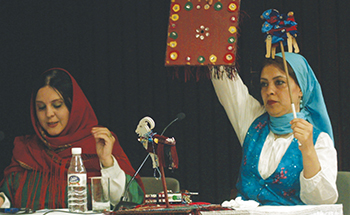
Poupak Azimpour (left) with Zohrer Behrouzinia holding Teke
Peyman Khazeni, the founder and composer of the Ensemble, is the group’s "tar” player (an instrument resembling the Indian sitar). For TEFP, he started "to study our two cultures (Indian and Iranian) and realized the message of peace and humanity was mutual between us. "I realize how culturally related our two countries are... Exhibitions and festivals of this nature are important to enable us to understand each other, live peacefully together and respect our opinions and culture.”
Morteza Sanayei, is the band’s "ney” player; the "ney” resembling the Indian flute. Rabeh Zand plays the "qanun,” similar to the harp and piano. Shayan Yazdizadeh plays the "tonbak,” a common Iranian percussion instrument resembling the Indian tabla or drum. One of its peculiar features is its ability to make different sounds with 10 fingers at the same time. Haniyeh Gholibeikian, is the Ensemble’s vocalist. The Ensemble’s executive manager Astiaj Ziaei plays the sitar and piano.
Puppets for prosperity
Yet another cultural contribution from Iran was the lecture-demonstration on the Teke ceremony and puppets from Azerbaijan by Poupak Azimpour Tabrizi, faculty member of the School of Performing Arts and College of Fine Arts, University of Tehran on May 6. Teke is a puppet in the shape of a decorated male goat that announces the coming of spring. The concept of life and fertility in a male goat is the prime reason for the selection of this iconic animal in these puppet shows. The Teke puppet is dressed in red to symbolize happiness and embellished with mirrors to signify light, bells for music and bright stones for prosperity.
The responsibility of whirling the Teke in four directions by the tekechi or holy puppeteer dramatizes life and expresses the spiritual needs of society while reinforcing the belief in the elements of nature and the changing seasons. The puppeteer who visits the homes of mountain dwellers and villagers in the agricultural and pastoral households in Azerbaijan is warmly welcomed as the heralder of spring, health and prosperity. The tekechi sings traditional songs of well-being and abundance and is greeted with great cheer and gifts of rice and sugar in each home.
"The Teke ceremony is a very unique and ancient ritual, derived from shamanism,” stated Tabrizi who has spent 15 years to write a dictionary on traditional Iranian puppetry.
Dr Oindrila Raychaudhuri, chief archivist at Bombay’s Tata Institute of Fundamental Research (TIFR), took the audience along the corridors of the prestigious science Institute to view the priceless collection of very high quality art which makes it unique among similar institutions anywhere in the world. In her talk on "The Art Collections at TIFR” on May 13, Raychaudhuri gave credit to the founder and nuclear scientist, Dr Homi Bhabha for being one of the pioneers in lending institutional support for collections of Indian art. An artist himself, known for his charcoal sketches, Bhabha also encouraged, supported and mentored several artists. He created interest in the modern Indian art movement and was an important patron of the Bombay Progressives which produced artists like F. N. Souza, M. F. Husain, Tyeb Mehta, K. H. Ara and S. H. Raza. He selected some of their most impressive early works for the TIFR collection. Bhabha had also recognized the greatness of Amrita Sher-Gil. The audience learned of the most important single work in the TIFR art collection, the remarkable 45-foot mural executed by Husain and titled Bharata Bhagya Vidhata.

Dr Oindrila Raychaudhuri (left) and Dr Spenta Wadia
Designing the new Institute provided Bhabha the opportunity to indulge in his love for art and simultaneously showcase what was best in contemporary Indian art. In the words of his brother Jamshed Bhabha, "For Homi Bhabha, the arts were not just a form of recreation or pleasant relaxation; they were among the most serious pursuits of life and he attached just as much importance to them as to his work in mathematics and physics. For him, the arts were… ‘what made life worth living.’”
On the occasion of his birth centenary in 2009, the TIFR had made a film on Bhabha’s life and achievements. This was screened by Prof Spenta Wadia, founding director, International Centre for Theoretical Sciences (ICTS), Bangalore, before the Delhi audience on May 20. The film traced Bhabha’s early life in Bombay, his student days in Cambridge, his scientific work, his return to India leading up to the establishment of TIFR and the Atomic Energy Establishment. Wadia’s subsequent talk highlighted Bhabha’s life and ideals. It was the intensity and quality of excellence of the visionary administrator that brought to bear on anything he took in hand. The audience was left in awe of the legacies Bhabha left behind, not just the tangible programs — buildings, equipment, works of art, gardens, but also intangible — the trained personnel in science institutions, and the vision of a new India.
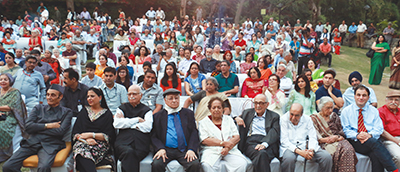
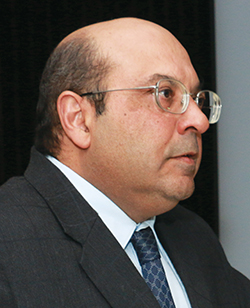
Justice Rohinton Nariman’s talk on "Outlines of Persian history — The Achemenian and Sassanian empires” on April 8 drew a full house. "Out of the five Persian empires, the Peshdadanian has no recorded history at all. It formed part of Khodai Namah in 500 AD under Khosrow I, also known as Anushiruwan and was the basis for the Shahnameh, 500 years later. Prophet Zarathushtra belonged to the second Persian dynasty called Kayanian, which again has no specific record,” he explained.
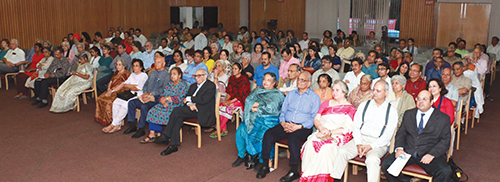
Audience at talk
"The first Persian empire in recorded history is the Achemenian empire which had 10 kings,” stated Nariman, particularly recalling the accomplishments of Cyrus the Great who wanted to be remembered as a liberator and not a conqueror. The second important ruler of the Achemenian dynasty was Cambysis who added Egypt to the Persian empire by defeating the Pharoah and slaying the famed Apis Bull. The next great ruler, Darius I was ninth in the series of Achemenian rulers. During his reign, the Persian Empire stretched from the Indus River to the Mediterranean Sea and from the Caspian to the Red Sea. However, he could not defeat the Greeks in the Battle of Marathon in 490 BC in Athens and lost his huge Persian army.
The "Book of Esther” in the Old Testament of the Bible is devoted to King Xerxes whose campaigns against the Greeks met with complete defeat. The Bible is the primary source of information about the next ruler, Artaxerxes I who was called "Longimanus” and was requested to rebuild the walls of Jerusalem. He was succeeded by Xerxes II whose uneventful reign was marked by a peaceful co-existence with the Greeks.
The longest reigning monarch of the Achemenian dynasty was Artaxerxes II. "Mithraism” was born as a Persian religion which spread powerfully into the Christian and Roman pantheons. The 12 constellations of Mithra were worshipped and temples were built to this divinity and the water goddess. Artaxerxes III slayed the Apis Bull and built the Mausoleum of Mausolus in Turkey as one of the seven wonders of the Ancient World.
The Sassanian empire had 48 rulers and saw a great revival of the Zoroastrian religion in Iran and Armenia. The founder of this dynasty, Ardeshir I, descended from a shepherd called Sassan, defeated the last Parthian ruler, Arthawan, married his daughter and revived the Zoroastrian religion. During his 18-year rule, Ardeshir I annexed Armenia, fought the Romans and proclaimed, "Religion and kingship are two wheels of a chariot. If not tempered by power, the chariot cannot move.” His successor, Shapur I, defeated the Roman Emperor Valerian in 260 AD at Naqsh-e-Rustam. Shapur II won back all the Roman acquisitions.
Yazdegird I was called "The Wicked.” He was tolerant to other faiths, married a Jew, presided over the Christian Council, and ruled for 20 years. Behram V defeated the Romans, married an Indian princess and was a great proponent of science and agriculture. Yazdegird II forced the Armenians to convert to Zoroastrianism but after his death, all his subjects reverted to their old faith.
King Khosrow I was called Nausherwan-e-Adil and "Caesar of the East” who ruled for 48 years after ascending the throne by murdering his brothers. He authorized the composition of the Khodai Namah and the Avestan alphabet. The Sassanian Empire was imperilled when Hormuzd V was blinded and killed by his brother-in-law and his son Khushru Parvez was named as the greatest conqueror of the dynasty. Yazdegird III was defeated by the Arabs and Islam was imposed upon Persia. The fall of this great empire and his murder in 651 AD marks the commencement of the Shahenshahi calendar.
"The Persian civilization has never died down and has a resurgence among the Kurds. The Persian civilization will continue to live on and teach its tenets of truth and non-violence at all times,” concluded the learned judge.
The talk was followed by the screening of Homi D. Sethna’s sensitive documentary Happiness unto others that traced the journey of the Parsis from Iran to India. Made at a time when Parsis were at their peak, flourishing in trade and all walks of life, the film introduces the world’s first monotheistic religion, built on a single premise that happiness comes to him who brings happiness unto others.
The packed auditorium at the IIC joined renowned author Amitav Ghosh in bringing down the curtains on TEFP on May 27. In his valedictory talk on "The Parsi connection with China and its role in the making of modern India,” Ghosh mentioned that "India and China have been exchanging goods, ideas and technology for millennia, but during the British Raj, this trade took a new turn” with the export of opium from Bihar and Malwa that impacted social, cultural and economic life.
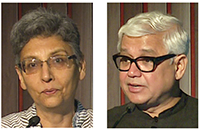
Shernaz Italia (left) with Amitav Ghosh
Parsi traders played a vital role in trade and in the cultural exchanges between the two countries as they were the most adventurous of the subcontinent merchants. They took to the seaborne China trade much earlier than the other merchant communities of colonial India in the 18th century. The China trade led to the foundation of many important Parsi business houses including the Tatas and also provided the Parsis "cultural capital.” Parsi ingenuity and enterprise when combined with the resources of the China trade, became a potent mixture, empowering members of the community to become leaders and innovators in diverse fields from industry to the arts.
The opium trade was the bedrock for traders like John Jacob Astor of America who established the Astoria Hotel chain. In the mid 19th century, Sir Jamsetjee Jejeebhoy led the trade boom between India and China which resulted in an exchange of visual ideas and experiences between the Parsis and the Chinese in Canton. Intense cohabitation and no racial segregation was the norm in China during this period. The great Parsi seths modelled themselves on the Chinese taipans of this period. They patronized the arts and Jejeebhoy subsequently established the J. J. School of Arts in Bombay. "The China trade was the crucible of the modern Parsi enterprise. The opium trade between India and China formed the basis of modern India capitalization and shaped modern India,” concluded the speaker.
The parallel exhibitions held at the IIC were "Udvada — A Photographic Exhibition” by Shantanu Das and "My Family and Other Parsis: Photographic Exhibition” by Sooni Taraporevala. Of interest to the local community was an interactive talk by historian Rusi Sorabji on the Delhi Parsis and the Zoroastrian diaspora. Other films to be screened as part of the Parzor Festival were Pir-e-Chak Chak, Glimpses from the Bahrot Caves followed by an interactive talk on "Zoroastrianism and Ecology” by Dr Homi Dhalla; and Café Irani Chai with chef Anahita Dhondy speaking thereafter.
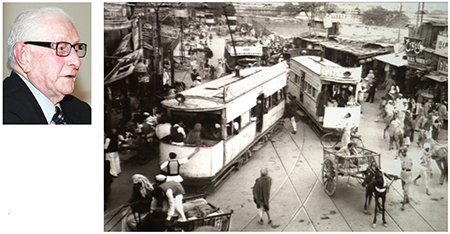
Rusi Sorabji and a vintage photo of Chandni Chowk in old Delhi
"It is a great boon for our community to have not just one, but four different exhibitions in Delhi on the same subjects at the same time,” commented Prof Rustom Bharucha who moderated a panel discussion on April 23 with the curators of two of the exhibitions which formed a part of the event: "No Parsi is an Island” at the National Gallery of Modern Art (NGMA) and the ToC at IGNCA.
Professor of Theater and Performing Studies in the School of Arts and Aesthetics at the Jawaharlal Nehru University, Delhi, Bharucha declared that he has written several books on many communities but finds it "very difficult to represent my own community.” He envisages three imminent problems in the writing of this book: the controversy on religious conversions, the growing incidence of intermarriage and the disposal of our dead. "None of these sensitive issues have been addressed in these exhibitions,” he stated.
"While eccentricity became our signature, our community exemplifies good citizenship and enterprise,” he observed, adding, "In exhibitions, the lens widens and the assemblage of different materials — objects, interviews, performances, displays in an expansive space — tell their own story.” To him the challenges in curating the current exhibitions would be demarcating Parsi Zoroastrians from Iranian Zoroastrians and the representation of new identities that are emerging.
Framing the exhibition is another curatorial challenge as also finding a unique balance in the displays so that a particular collection does not take over the exhibition narrative. "What is to be included and what to be excluded is vital in the curator’s scheme of things. One must tap the resources of the middle class and not only of the rich and famous which are renowned,” he asserted. The final challenge for a curator is to find patronage by way of funding and audience.
Cama who jointly curated ToC as also TEF at the National Museum explained the program was visualized in 2013 following the Government’s involvement with the "Jiyo Parsi” project. "Painted Encounters” and "No Parsi is an Island” that were on view at the NGMA were part of the World Zoroastrian Congress in Bombay in 2013. She however felt the time had come to educate the world about Zoroastrianism and Parsi culture. This became the vocabulary for further discussion. "The Ministry of Minority Affairs brought back the Zoroastrianism discourse into the public domain and stressed that advocacy was needed to make the world realize that the Parsis are a race worth saving,” she added.
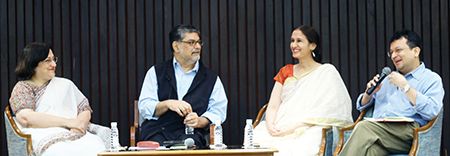
Ranjit Hoskote, co-curator of "No Parsi is an Island” exhibition, termed the four exhibitions as a "large ambitious project.” He revealed how Parsi artists negotiated between the interior worlds of the Parsi community and the larger cosmopolitan landscape and how the exhibitions showcased their contributions to film, poetry, dance, theater and literature.
Nancy Adajania, co-curator of "No Parsi is an Island,” said that Parsis cannot be limited by birth, but by the commonality of retrieving lost histories. "Fourteen Parsi artists over 150 years were marginalized and forgotten.”
Bharucha felt there were some overlaps in the exhibitions and further expressed a sense of isolation in the wide open spaces between exhibits. The curators of "No Parsi is an Island” responded that connective texts and interrelationships had been created within the works. "The wide open spaces allow the viewer to meditate on the displays,” they stated.
Considering that it took 19 years for the Parzor Foundation to rediscover Parsi/Iranian culture that was lost to the community, Cama recommended, "The stories of Navsari and of Iran are untold stories. A program is thus necessary to bring together these vignettes of Zoroastrian history.” She added that ToC was the only exhibition not based on a museum model. It revealed stories of homes from where each object was painstakingly sourced. "Morality is more important than proof,” she believed. "Dance and music is important. Myths keep our linguistic identity and traditions alive. The figure of God Mithra became Prophet Zarathushtra. While documentation is needed to tell the complete story, a homely touch and approach to the exhibits from the Far East, Iran and India convey eons to the learned audience,” she concluded.
For the smooth running of the cultural programs, Niloufer Shroff of Parzor acknowledged the efforts of many volunteers and well-wishers: Shernaz Italia, Freny Khodaiji, Mahtab Irani, Dushyant Mehta, Sanha Kohli and the team from Mahatta’s, Air Cmde Naresh Verma, Premola Ghosh and Lalsawmliani Tochhawng (Teteii) and her team at IIC. The success of the Navroz feast, tables and food stalls was possible thanks to Farida Variava, Kaenaz Engineer, Zavher Chowdhury, Kerman Mehta, Ashdeen Lilowala, Ava Khullar, Kainaz Shroff, Rukhsana Shroff, Veera Mavalwala, Villie Aria, Sarvar Irani, Shernaz Lilaowala. For the staging of the Parsi natak Behram-ni-Sasu at the India Habitat Centre, credit should go to Yazdi Karanjia and his team from Surat, Meenakshi Bhujwala, Engineer and Variava.
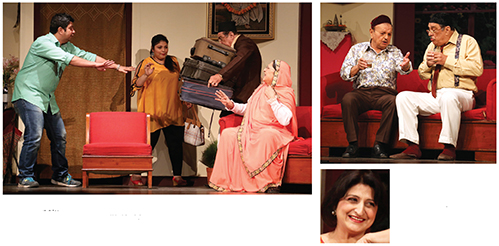
Scenes from Behram-ni-Sasu by the Yazdi Karanjia Group
The comfort of the guests at DPA’s Dharamshala was overseen by Dhun Bagli and Binaifer Bagli with support from Variava, Bhujwala and Engineer. The logistics of accommodation at IIC proceeded smoothly thanks to the assistance of Trilochan Singh, Neeraj Sahai, Pudumjee, Dr Noshir Shroff, Asha Bhardwaj, Irani and Arvind Saxena. Transport arrangements for the guests was undertaken by TBI ably led by Homa Mistry and Deepak Sahay. Flashing timely messages on the Delhi Parsi Anjuman SMS group was Mavalwala.