
History
Angry young man
Despite his remarkable medical achievements, Dr Kaikhusroo Bahadurji’s short life was replete with battles for justice and fair play
The life of Dr Kaikhusroo N. Bahadurji (November 4, 1860 to August 7, 1898) cries out for a biographer. I came across him while working on the history of the Bombay plague of 1896. It was like being dazzled by a meteor. Entrapped in his brilliance, I felt bitterly cheated when it was extinguished. Since then, the memory of that glimpse has stayed with me as a talisman.
Just a few facts about him are extant. With obituary politeness, they transform him into a boy wonder, a romantic who lived large in a blink of time.
No doubt all that’s true. And, it should suffice to earn him, more than a century after his death, a melancholy sigh, perhaps even a momentary blurring of vision.
Just a few facts about him are extant. With obituary politeness, they transform him into a boy wonder, a romantic who lived large in a blink of time.
No doubt all that’s true. And, it should suffice to earn him, more than a century after his death, a melancholy sigh, perhaps even a momentary blurring of vision.
-9.jpg)
Dr Kaikhusroo Bahadurji (top)
But Bahadurji would have been out of patience with all that. He seems a man quickly irritated by adulation, likely to riposte with spitfire repartee, uncaring of the discomfiture it may provoke.
Naturally, in the 1890s, he was a nuisance to the British, but were he alive today Bahadurji would be bad news everywhere. He would be a social pariah, blacklisted by the medical profession, and persecuted by the rightist fringe that speaks only with a bomb or a bullet. His brother, an illustrious lawyer, would have to clear his calendar. In a democracy that tolerates no dissent, keeping Bahadurji out of jail would be a career in itself.
The Press would call him an activist. To the government he would be a trouble-maker, and to the police he would be, quite simply, a terrorist.
Yet, in his brief life of 38 years, I doubt if Bahadurji ever broke the law.
There were draconian laws. Perhaps more politely couched than today, but the law, nonetheless, of an oppressive and alien government — and Bahadurji, at every available opportunity, opposed its injustice.
That’s why, despite all his impressive medical achievements, his legacy remains a political one.
What did it take to be so persistently angry against injustice?
No, Bahadurji was emphatically missing that proverbial chip on the shoulder — a deprived childhood. I know nothing about his family, but it’s on record that he was a remarkable student.
The Gilchrist Scholarship, then in its early years, offered Indians an education in Britain. It was understood that, thus equipped, they would return to enlighten India.
Naturally, in the 1890s, he was a nuisance to the British, but were he alive today Bahadurji would be bad news everywhere. He would be a social pariah, blacklisted by the medical profession, and persecuted by the rightist fringe that speaks only with a bomb or a bullet. His brother, an illustrious lawyer, would have to clear his calendar. In a democracy that tolerates no dissent, keeping Bahadurji out of jail would be a career in itself.
The Press would call him an activist. To the government he would be a trouble-maker, and to the police he would be, quite simply, a terrorist.
Yet, in his brief life of 38 years, I doubt if Bahadurji ever broke the law.
There were draconian laws. Perhaps more politely couched than today, but the law, nonetheless, of an oppressive and alien government — and Bahadurji, at every available opportunity, opposed its injustice.
That’s why, despite all his impressive medical achievements, his legacy remains a political one.
What did it take to be so persistently angry against injustice?
No, Bahadurji was emphatically missing that proverbial chip on the shoulder — a deprived childhood. I know nothing about his family, but it’s on record that he was a remarkable student.
The Gilchrist Scholarship, then in its early years, offered Indians an education in Britain. It was understood that, thus equipped, they would return to enlighten India.
-1.jpg)
Vividh Vani, iconic book for all things culinary
Bahadurji won the coveted scholarship at 22, and soon proved himself a diligent student at the University College, London, where he studied medicine. In common with many of the Englishmen who have contributed to the Socratic dialog between the two nations, John Borthwick Gilchrist was a physician. He appears to have enjoyed conversing with his patients, for he soon took time off to compile a dictionary in colloquial Hindustani, threw medicine to the winds, and spent the rest of his life on the cause of education. The trustees of his legacy evidently thought Bahadurji’s achievements would have pleased him, for they extended the scholarship to cover further study in Europe.
Evidently Bahadurji distinguished himself while working towards the MRCS (Member of the Royal College of Surgeons) and MB (Bachelor of Medicine) degrees, for he went on to pursue a bachelor’s degree in surgery, and concluded his list of honors with an MD (Doctor of Medicine) degree, the first Indian to have achieved this.
When he returned to India, Bahadurji was qualified in every branch of medicine.
These, then, are the facts that make up his early life. Nothing prepares us for his incendiary future in Bombay, beginning with his meeting the governor, Lord Reay.
Now chiefly remembered by a sleepy railway station on the Harbour Line, Lord Reay had a taxing time as governor largely due to his uncompromising stand against municipal commissioner Arthur Crawford.
During Reay’s governance, Crawford was accused of bribery and corruption. A commission of enquiry cleared Crawford, but Reay, aghast at his excesses, pursued the matter until Crawford was put out to grass. This earned Reay the respect of men like Gopal Krishna Gokhale and Bal Gangadhar Tilak. Among Indians, Reay had a reputation for fairness. Naturally, the British couldn’t wait to see the last of him.
Reay welcomed Bahadurji and gave him the post of professor of pharmacology at the newly opened Petit Laboratory in Grant Medical College. This appointment decided the rest of Bahadurji’s life in an unexpected way.
Beyond this point, I know little of Bahadurji’s life except for the handful of trinkets on permanent public display. Nothing explains the restless militancy that makes his life a talisman for a nation sunk so deep in apathy, it seems to have abandoned all reason.
Let’s look at those trinkets, anyway.
In a dusty drawer somewhere, a memento made insignificant by time is a tarnished silver medal for surgical anatomy, stamped with the head of a luxuriously bearded Victorian gent. His name is Wellington Gray, and he was Bahadurji’s nemesis. He made life hell for Bahadurji.
The idea of a native holding a professorship was intolerable to the members of the Indian Medical Service — which was ‘Indian’ only by geographic location. Native doctors were shown their place, and a very good place it was too, by British reckoning, with a munificent monthly stipend of Rs 25.
As principal of Grant Medical College, Gray and his British colleagues made certain Bahadurji was forced to abandon his work and resign his post. Undaunted, Bahadurji took up private practice, and began to battle for the rights of Indian doctors.
A second trinket is the one familiar to students of sociology — Bahadurji’s role in the Factory Commission. You’ll find his opinion quoted derisively, marking him as a chamcha (sycophant) of tyrannical mill owners. Bahadurji’s opinion that mill hands were better off than most other laborers should be, in all fairness, reviewed in context.
There was famine everywhere. The mill guaranteed a wage that could buy a meal. Laying off people or restricting hours of work could mean death for the family.
A third trinket shows him vociferously carrying the good fight for doctors’ rights into a session of the Indian National Congress.
By now, Bahadurji had managed to collude the issue of doctor’s rights with the larger nationalistic one. His demands are now seen as no more than yet another discontented murmur in the growing noise of nationalism. Every plea he made for a fair deal will be read as a demand for nationhood.
He travelled to England as a representative of the Bombay Committee for Medical Reform in India, to give evidence before a Royal Commission. He posited that the Indian Medical Service should separate its military identity from its civil one. The offended Indian Medical Service took that as an attempt to "dismiss present incumbents and promote present native subordinates in their places, and supply future vacancies from indigenous sources.”
The quarrel featured in the British Medical Journal (August 26, 1896), and Gray emerged from retirement to have the last word on his bête noire. After reminding readers of the "contemptuous and vituperative language applied to us in Bombay by the delegate (Bahadurji) himself, his fellow agitators and their friends and admirers generally” he assured them that there never had been any and never would be any intent to appoint Indians to the Medical Service: "When the resolution of the medical faculty was discussed the local graduates were not even thought of. The words ‘any source’ had reference to European specialists from home and Continental schools of medicine.”
Before the quarrel could go any further, the plague broke out in Bombay, and Bahadurji was in the very thick of it.
His heroics during the plague are well documented. And then, in the middle of it all, he died.
Surrounding his death is a fourth trinket, a romantic one, linking him with a lovely young woman, Meherbai Jamshedji Wadia, who died of the plague before she could publish her magnum opus, familiar today in most Parsi households as the old reliable for all things culinary — the encyclopedic Vividh Vani (collection of recipes).
Recently, the city’s historic Rajabai Tower was opened once again to the public. I have yet to make that pilgrimage. It had been closed since April 25, 1891 when two cousins, Pherozabai (16) and Bachubai (20) fell to their death on a sunny afternoon. The two girls were out on a ramble. It is easy to picture them full of chatter and excitement, running up the stairs.
What happened? Nobody knows. Arrests were made, and the accused acquitted, much to the ire of the community. The court ruled the deaths as accidental.
Which brings me to the fifth, and final, trinket: Bahadurji stormed into Sir Pherozeshah Mehta’s presence in furious protest, and was calmly shown the door.
What was Bahadurji protesting? The acquittal? The failure of the police and the court to arrest the right man? Or simply the blatant impossibility of two young girls out on a carefree jaunt falling off the balcony ‘by accident’?
Here they are then, the trinkets on public display. They don’t explain the man, and we do need to know him better.
He is my talisman at moments when even the most trivial change involves a battle.
I found his photograph recently — and he looks exactly as I imagined him: a poet with piercing eyes.
We could use that gaze now: sceptical and unconsoled, restless and impulsive, and always unafraid of the inconvenience of truth.
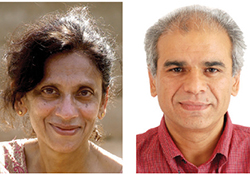
Kalpana Swaminathan and Ishrat Syed are surgeons who trained in Grant Medical College. They write together as Kalpish Ratna. The love story of Dr K. N. Bahadurji and Meherbai Jamshedji Wadia features in the chapter "The Dying Detective” of their book ROOM 000—Narratives of the Bombay Plague (Pan MacMillan, 2015).
◆ ◆ ◆
From the archive