
Zoroastrians Abroad
“No director will sit back”
Edul Daver, president of the World Zarathushti Chamber of Commerce, intends to involve all regional heads in the progress of the global organization
"If you have got a degree and can start something on your own, why work for someone else?” is the premise based on which New Jersey based Edul Daver has been inducing members of the community to start their own business ventures. From the time he served as corporate secretary of the World Zarathushti Chamber of Commerce (WZCC) during its formative years until his election as global president last December, he has been reinforcing that entrepreneurship is "the only way to generate wealth and give back to society.”
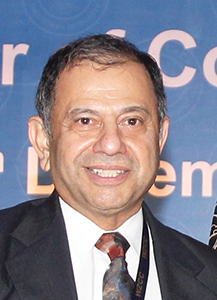
Edul Daver: "give back to society"
Should the business not succeed, "What would happen in the worst scenario? You still have your degree. You can start all over again. Here (in India) they would say ‘kharaab laagsé (it would be embarrassing).’ In the West there is no stigma attached to failure. Taking a loan is not regarded as a bad thing,” commented Daver during an interview with Parsiana. Although he readily consented to a tête-à-tête, he realized he was fighting against time when trying to squeeze in meetings with the new board in the midst of the scheduled program in Goa from December 18 to 20, 2015. Ultimately, the diminutive figure selected rear seats during a bus journey on December 20, 2015 (whilst on a sight-seeing trip) to have an undisturbed chat with the magazine when he shared information about himself, his involvement with WZCC and his style of working!
Following his retirement from his thriving business ACuPowder in 2012 Daver was planning to lead a relaxed life with his wife Niloufer but his predecessor, Minoo Shroff, being "very persistent” convinced him to take over as global president. "I finally agreed,” the 71-year-old incumbent told the WZCC members on December 19, shortly after being introduced as the new president. He then proceeded to outline the global priorities for the current board that took charge the same day (see "Challenges for the Chamber,” Parsiana, January 7, 2016). The other office bearers are vice president Yazdi Tantra, corporate secretary Adi Siganporia and treasurer Katayun Kapadia who will work with directors from eight regions.
Expressing confidence in "the solid team,” Daver hoped, "No director will sit back.” He was keen that all directors be present for the annual general meetings to "provide quality and value” to the members in attendance. Having already drafted a plan of action for the coming year, he added that "it will be fine-tuned, confirmed and prioritized to get a running start.” In addition to meeting the "ongoing administrative and functional needs,” they also plan to pursue "new value added activities.” All chapters will be encouraged to hold at least four meetings in a year and extend their operations to accommodate "seniors not astute in computer skills.”
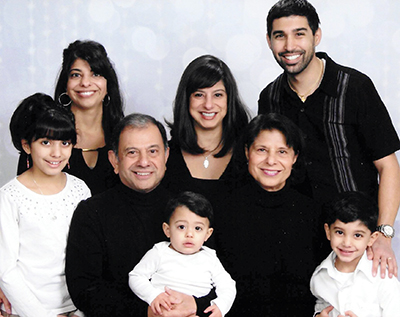
Edul and Niloufer Daver (seated, center) with (standing, from left) Delara,
Farzana, Zaneeta, Cyrus Cama; (in front) Arzan and Rayan
Whilst WZCC is "on a firm ground in India,” to strengthen its financial position and the working of the administrative office in Bombay the directors plan to raise revenue through events, programs, sponsorships, advertisements. A WZCC Foundation with a corpus of two to three crore rupees is being considered by hiring professionals to manage the funds. Whilst welcoming ideas from chapter chairs, the board would like WZCC "to expand its reach with other organizations,” by having a closer working relation with the Federation of Zoroastrian Associations of North America (FEZANA) and making WZCC visible at the North American Zoroastrian Congresses.
"Everyone can be an entrepreneur; even a homemaker,” stressed Daver, sharing his definition of entrepreneurship as "a pursuit of opportunity beyond resources currently controlled.” He bemoaned the general tendency of parents to encourage their children to become professionals instead of encouraging business ventures, and cited the instance of Sundar Pichai’s mother who candidly stated that she doesn’t understand what her son does as chief executive officer of Google but had he worked a little harder, he could have been a doctor!
In response to Parsiana’s queries, Daver guesstimated that approximately one-third of the income generating Zoroastrian community in North America must be entrepreneurs, including within this segment even self-employed professionals like doctors and lawyers. The community overseas being smaller in size, "they tend to help each other more,” he observes. Under his stewardship he would like WZCC to focus on networking, helping members to do business with one another, explore opportunities for import-export, share management techniques, serve as mentors. He is keen to bring together a group of experienced people who could play an advisory role as mentors. He refers to a course he did at Harvard Business School in the 1990s on Owner/President Management "attended by individuals from all over the world. We learnt a lot from each other.”
Having played a stellar role in the early days of WZCC, Daver appreciated Rohinton Rivetna’s foresight in initiating a business networking organization. Leading members of the US community studied business related issues and the kind of guidance and assistance needed by the community to prosper. Although "initially visualized only as a US Chamber of Commerce,” when they were in the process of formalizing the organization and finalizing a name, Ness Lakdawala, a founder director of WZCC, recommended that they involve overseas associations and include the word "World” in the set-up. bThey then tapped their contacts in different regions to expand the scope, drafted a mission, terms of reference, constitution and bye-laws to launch WZCC in 2000. "Each area was quite involved,” said Daver who as corporate secretary for six years would monitor the progress through emails, "insist on getting more details, not take no for an answer,” and push the directors to read their reports at the AGM.
Amongst the WZCC chapters in the US, Daver considers Houston, New York and Chicago as being the most active. Wary of opening new chapters unless assured of sustained interest, the president referred to the New York chapter which started with five members, each of whom had to bring 10 people along for the chapter meetings. Currently he is gratified to see "more youngsters coming to the New York chapter meetings.”
Daver, who had been honored with the Outstanding Zarathushti Entrepreneur Award in 2014 at the WZCC meeting in Dubai, had remarked then, "A good education and a good job lead to a comfortable life which is a deterrent to becoming an entrepreneur.” An alumnus of the Doon School and the Indian Institute of Technology in Bombay, Daver did his postgraduation in Powder Metallurgy from the University of Wisconsin at Madison after which he joined Alcan Metal Powders in 1967, having become its president 20 years later. Acknowledging the importance of "being in the right place at the right time,” Daver told Parsiana, "I have never written a resume in my life.”
To rescue the then struggling Powders division, in the mid 1980s, Daver approached Alcan Corp with an offer to buy it over. Although he knew he was taking a major risk, Daver launched ACuPowder International and implemented "open book management” techniques with all his 100 employees having a stake in the business and 20% of pretax profits. This strategy ensured "worker loyalty and long-term commitment,” he states. To start a new venture, money can be raised, he mentions, citing the instance of Indus American Bank, headquartered in New Jersey, that gives commercial loans to people of Indian origin. When he started his capital intensive enterprise ACuPowder "we needed a lot of loans. Even when we sold off we had a loan,” he states nonchalantly. Being an owner driven business, he concedes he had to work "24x7, answering calls at 2 in the morning was routine” since they operated in three shifts. Having turned it around to show annual revenues of $ 100 million, Daver formulated an exit strategy in 2010 and ultimately retired in 2012.
Since then Daver who had served on one of the first boards of the Zoroastrian Association of Greater New York (ZAGNY) in the 1970s has been devoted to the cause of rebuilding a Darbe Mehr in New York. To raise funds for this project, a group of 16 Zoroastrians invested $ 500,000 (Rs 34,000,000) to form a company, New Darbe Mehr Initiative LLC to pursue their dream, realizing that if they do not succeed they would need to bear the loss. Though the target of $ 4.5 million seemed a distant goal, they persisted and were slowly able to convince Zoroastrians from ZAGNY and the Iranian Zoroastrian Association to invest in their future place of worship. They were determined not to use any trust funds. Designed by architect Dinyar Wadia, after 18 months of construction the Darbe Mehr will be inaugurated in March 2016. This venture is "a real example of entrepreneurship,” he asserts.
Whilst Daver makes time for community related organizations, Niloufer who retired as a teacher, volunteered for Starfish, a Jewish organization that helps the elderly who need to be taken to doctors, hospitals, etc. Always trying to influence family and friends to become entrepreneurs, he has been attempting to convince their daughter Farzana’s husband Cyrus Cama who is in the Information Technology sector to launch out on his own. But with Farzana, a physical therapist, being currently tied up with raising their three young children in New Jersey, Cyrus does not want to take a risk. The Davers’ elder daughter Zaneeta works in Washington for a trade organization that services university directors and senior administrators.
When a young WZCC member from Bombay consulted the president for recommended reading on open book management, Daver was delighted. Always in favor of exchange of ideas, even at the departure lounge of the Goa airport, Daver was seen engrossed in a meeting with a couple of his WZCC board members.
◆ ◆ ◆
From the archive