
Health
The Parsis and the Prince
Specialized health care at Prince Aly Khan Hospital is availed of by residents of nearby baugs
"We have to re-engage with the community,” states Dr Feroza Panday, medical director at the 164-bed Prince Aly Khan Hospital (PAKH) in central Bombay. Noting that the Hospital has always been active in community service, she says there needs to be a synergistic partnership with the community around the Hospital. She cites the example of health camps organized by PAKH from the late 1980s onwards for the residents of the nearby Zoroastrian colonies of Jer Baug and Rustom Baug.
The director, who has been associated with the Hospital since 2003 as pathologist and laboratory director is proud of the 100 plus consultants who serve at the Hospital. She informs that specialists offer their services free of cost at the outpatient department (OPD), in a walk through the estate which, in addition to the main building, houses OPD clinics and laboratories in adjacent buildings. Over 35,000 patients are seen to in these clinics annually, and in addition another 90,000 patients attend the consultation clinics, she reveals.
Hugh Annett, officer in charge at the Hospital states Panday, along with Drs Mehroo Elavia and Roshni Chinoy, are the medical practitioners who will "revitalize the confidence the neighborhood community has in the Hospital.” Speaking to Parsiana at the Hospital in August 2015, the quartet unanimously believes that they need to "re-affirm to the community that we do what we say we do.” The Hospital functions as one arm of the Aga Khan Health Service, which runs 325 health centers, dispensaries, hospitals and diagnostic centers across Asia and Africa. Panday states that guidelines for safety and ethics are provided regularly and there are frequent independent reviews of practices followed. "We want to be seen as a Hospital with a heart,” she emphasizes.
Expanding on the future plans for PAKH, Annett and Panday state that a new 250-bed facility is on the horizon, to be built in two phases, over the next five years. This will not be located in the same estate where the current building has stood since PAKH moved there in 1955, but a short distance away. The Hospital started operations in 1945 as a 16-bed facility for the Ismailia community and opened its doors to all communities in 1958. Air India, Reserve Bank of India, Mazgaon Docks and the United Arab Emirates consulate figure in their list of corporate clients.
The director, who has been associated with the Hospital since 2003 as pathologist and laboratory director is proud of the 100 plus consultants who serve at the Hospital. She informs that specialists offer their services free of cost at the outpatient department (OPD), in a walk through the estate which, in addition to the main building, houses OPD clinics and laboratories in adjacent buildings. Over 35,000 patients are seen to in these clinics annually, and in addition another 90,000 patients attend the consultation clinics, she reveals.
Hugh Annett, officer in charge at the Hospital states Panday, along with Drs Mehroo Elavia and Roshni Chinoy, are the medical practitioners who will "revitalize the confidence the neighborhood community has in the Hospital.” Speaking to Parsiana at the Hospital in August 2015, the quartet unanimously believes that they need to "re-affirm to the community that we do what we say we do.” The Hospital functions as one arm of the Aga Khan Health Service, which runs 325 health centers, dispensaries, hospitals and diagnostic centers across Asia and Africa. Panday states that guidelines for safety and ethics are provided regularly and there are frequent independent reviews of practices followed. "We want to be seen as a Hospital with a heart,” she emphasizes.
Expanding on the future plans for PAKH, Annett and Panday state that a new 250-bed facility is on the horizon, to be built in two phases, over the next five years. This will not be located in the same estate where the current building has stood since PAKH moved there in 1955, but a short distance away. The Hospital started operations in 1945 as a 16-bed facility for the Ismailia community and opened its doors to all communities in 1958. Air India, Reserve Bank of India, Mazgaon Docks and the United Arab Emirates consulate figure in their list of corporate clients.
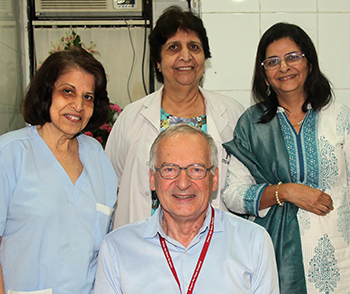
Clockwise from top left Drs Mehroo Elavia, Roshni Chinoy, Feroza Panday, Hugh Annett (sitting);
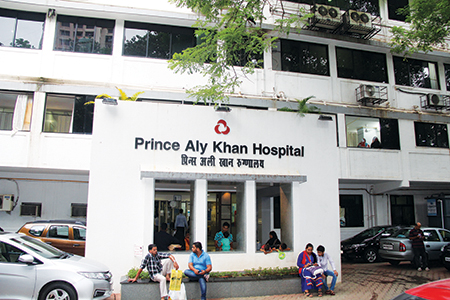
A view of the main building
Elavia, who joined the Hospital as an anesthetist in 1980, served as the chief operating officer from 1988 to 2001. The joint secretary of the governing council of the Hospital for 12 years states that 10% of the beds are free to all, irrespective of the community the patient belongs to. Thirty percent of the beds are reserved for the economically challenged, where PAKH does not even recover the operating costs, states the medico who now serves as head of the department of anesthesia.
A breast cancer rehabilitation clinic was started in 1993 by a survivor, Anahita Vesuvala, which to this day offers support to patients and care-givers too. The clinic provides free services even to patients of other hospitals. The scope of the clinic was expanded later to include support for victims of cancers of the larynx and bladder. PAKH claims to be the pioneer in airway restoration surgery (head and neck surgery) with the help of experts from the Aga Khan Health Service in Paris.
We have to walk the talk, chips in Chinoy who is the consulting histopathologist (a doctor who deals with the pathological examination of tissues) at the Hospital. She is concerned at the high incidence of breast cancer among Zoroastrian women. What about cancers among males, we ask, specifically prostate cancer? "Yes, they are at risk, she states, but laughs that Parsi men are ostriches who bury their heads in the sand, preferring to ignore all health risks.
"We are not a large hospital, which we must use to our advantage to provide personal attention,” concludes Elavia.
◆ ◆ ◆
From the archive