
Cinema connections
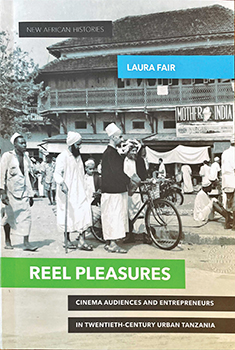
Reel Pleasures: Cinema Audiences and Entrepreneurs in Twentieth Century Urban Tanzania by Prof Laura Fair. Published in 2018 by Ohio University Press, 30 Park Place, Suite 101, Athens, OH 45701-2909, USA. Pp: 452. Price: Not mentioned.
Written by Prof Laura Fair with great awareness of the multifaceted factors that make up this public area of recreation and business, of song and politics, this comprehensive study of cinema audiences and entrepreneurs in Tangan- yika/Tanzania over the past century has broader relevance than its title suggests.
 These entrepreneurs, mostly from the Indian diaspora, governed how the public and private worlds of film reception brought communities together and contributed to the construction of genders, generations and urban citizenship. It is a remarkable achievement having taken place, as it did, in countries which were moving through a century of radical social change from traditional societies to colonies of foreign powers, to the independent nations of Tanganyika and Zanzibar, and finally to the United Republic of Tanzania. And which, for a long period, were also the politically sensitive bell-weather of the freedom movements all over the African continent, particularly of South Africa.
The dukawalla (shopkeeper) business community of the Indian diaspora, played a large part in the cinema industry, and therefore in this volatile process. And a large part of that consisted of Parsi-Irani entrepreneurs. Prominent among them was the Talati family from Zanzibar.
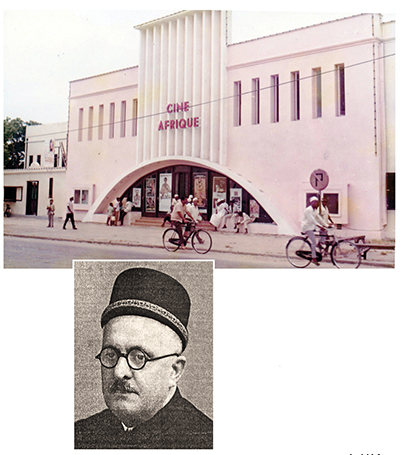
Shavakshaw Talati (above) and a world class cinema theater built by him in Zanzibar

Asad Talati: international contacts

Prof Laura Fair: researching Zanzibar
During the early 1950s, another Parsi-Irani group entered the film distribution business in East Africa. This was the Indian Film Combine, "one of the two largest distributors from India." It was a Bombay corporation, which had a branch in Nairobi, Kenya, from which it operated in the whole of East Africa and South Africa. Their resident director in Nairobi for the region was first Lim Billimoria, then Burjor Billimoria and then Paul Maneckshaw, the latter assisted by Nariman Mehta. Whilst stationed in Nairobi, Maneckshaw also founded the Lions movement in East Africa. Over the decades from the 1950s to the 1980s, the Combine was an influence not only on film distribution but also on government policies on the taxation of entertainment.
All these connections were, surprisingly, of the greatest importance to Indian cinema and its history. Fair writes: "In the 1950s and 1960s East Africa was the most lucrative overseas market for Indian films in the world… In fact, in the 1950s and 1960s Indian films earned 10 times as much in East Africa as they did in the United Kingdom. Audiences in East Africa were obviously a critical — and lucrative — overseas market for Indian producers. The region is where Bollywood first really went global."
The Parsi-Irani entrepreneurs were thus not participants in sidebar transactions. They were major players in the most important foreign market.
From the earliest times of Indian cinema, there were connections between Bombay and the East African entrepreneurs. And there too Parsi-Iranis were deeply involved. Fair records, "In the 1910s Jariwalla (a Bohra importer and exhibitor in Dar-es-Salaam) received his prints from Ardeshir Irani and Esoofally, owners of Alexandra Company in Bombay. (This is most likely why Jariwalla named his first two cinemas Alexandra.) He chose well when he partnered with Irani and Esoofally who were industry pioneers of incredible magnitude… In 1914, Esoofally partnered with Irani, and four years later they opened a picture palace named the Majestic at a time when there were only a handful of permanent venues in all of India… But Irani was not content with showing foreign films, and he quickly expanded into production. His studio (Imperial) grew into one of the best in India. Irani produced nearly 250 films over the course of his life, including the first Indian talkie, Alam Ara, in 1931. Jariwalla did business with the best, and the East African audiences benefited."
Nor does the book overlook the role of other Parsi-Irani producers and their impact on East African audiences. In discussing the issue of the popularity of the early silent movies and Nadia as a lasting draw even after talkies were common, Fair writes: "Fearless Nadia starred in some 34 films, many of which were produced by Wadia Movietone, an innovative movie studio in India owned by the Parsi brothers J. B. H. and Homi Wadia, the latter of whom was married to Nadia… Many (Tanzanian viewers) identified Fearless Nadia, a circus performer who became the first female action star of Indian films in Hunterwalli (produced by the Wadias in 1935), as one of the most popular personalities of that generation."
In a major consideration of the introduction of the Drive-In Cinema in Tanzania, the author mentions C. C. Patel as the owner. One of Patel’s partners was Homi Mistri, a highly respected Dar-es-Salaam hotelier.
Through that half century, there were many Parsi-Iranis in the technical and exhibition sides of cinema too. Noted Bombay photographer Zubin Pastakia’s still, Projection Room, Moti Talkies, Mumbai, is a haunting reminder of that connection.
The Talati family had through those years also been prominent in public and social service in Zanzibar, and both Shavakshaw and his wife, Motamai, had each been awarded the MBE (Member of the Order of the British Empire) for their individual social work, by the then ruling British government. Their eldest son Keki had also been awarded the MBE for his public work. He had also been the first chair of the Zanzibar Township Council in 1955. Much later in 1962, their second son, Purvez, was the first mayor of Zanzibar City. They were partners in the leading legal firm of Wiggins and Stephens, Advocates. Shavakshaw had by then retired from the business and the Talati film interests, under the banner of United Film Distributors (UFD), were being managed by his youngest son Asad, who was also a partner in a legal firm.
In Tanzania, in 1967, significant political changes took place. Upon the promulgation of the Arusha Declaration, large scale nationalizations were effected. The film industry was among them. All its assets were vested in a newly formed parastatal, the Tanzania Film Corporation (TFC). The cinemas, as buildings, were vested in the National Housing Corporation.
These policy steps were however not matched by the availability of public servants of capacity to take over at the TFC. For a constant supply of films, the TFC returned to the private sector’s established local distributors. The author writes that Asad’s "UFD had superb international connections to film suppliers across the globe. These connections, established over decades, allowed Talati to tap traditional suppliers as well as new, innovative and independent producers from Hong Kong, Italy, Germany and the United States. When Anglo-American and TFC severed their relationship in 1982, UFD went from providing some 30% of the films screened in 1981 to 70% in 1985… According to the internal TFC reports, UFD was the only company that promised to bring in sufficient products to keep Tanzanian theaters functioning, and equally important, it fulfilled its promises… Talati’s interventions in booking and distribution were critical in keeping the exhibition industry going.
"According to exhibitors, however, he was the real brains behind the business, and without him to turn to the TFC’s monopoly on distribution decisions would have killed the industry long before it eventually expired." UFD is described as "the largest and most important providers of films for Tanzanian theaters after Independence." Asad subsequently retired and has settled in Toronto, Canada.
With evocative photographs of persons, the cinema halls and memorabilia, the book is greatly enjoyable. It is also important and valuable for its detailed research and for the insights it gives to readers on Tanzanian and East African politics, on the Indian diaspora, on the dukawalla, and on much of the East African history of the time.
Fair is the author of several works on Zanzibar and the culture of the East African coast, and teaches at Michigan State University in the USA.
PHEROZE NOWROJEE
Nowrojee is a Kenyan born lawyer, poet and author.