
Politics and Policy
A place for prayers
Two new prayer halls at the Worli crematorium are due to become operational this August
A jashan for well-wishers, family and friends of those connected with the creation of the two new prayer halls at the Bombay Municipal Corporation’s (BMC) sylvan crematorium at Worli had been scheduled for the evening of August 3. When Parsiana visited the site two weeks prior, the contractor Ashok Punjabi was putting the finishing touches to the premises created by The Prayer Hall Trust (TPHT). The polishing of the floor was in progress while two plaques acknowledging a donation from the A. H. Wadia Trust towards construction of the halls remained to be placed. A large parking lot is to be spruced up. Once the civil work is over, landscaping of the area will begin, courtesy Godrej who have an in-house gardening department.
The BMC has allocated around 3,700 sq yd of land in the over 10-acre cemetery complex which has facilities for wood funeral pyres, electric crematoria and burial. The L-shaped prayer halls are for use by all with Parsis getting preference at the time that funeral ceremonies are normally held.
The BMC has allocated around 3,700 sq yd of land in the over 10-acre cemetery complex which has facilities for wood funeral pyres, electric crematoria and burial. The L-shaped prayer halls are for use by all with Parsis getting preference at the time that funeral ceremonies are normally held.
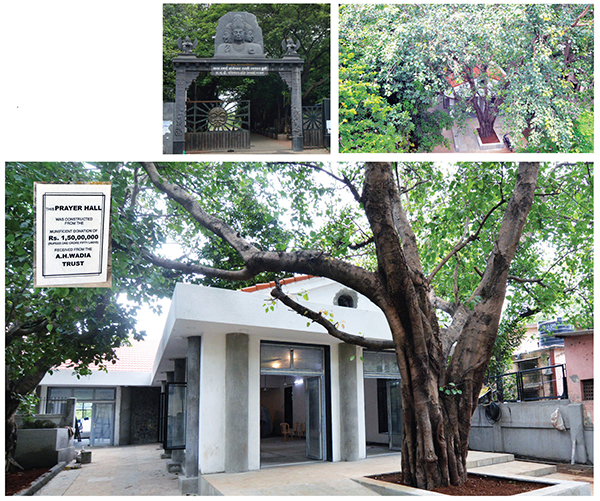
Clockwise from top right: Crematorium main entrance,
view of Prayer Hall from terrace of adjacent building, Prayer Hall
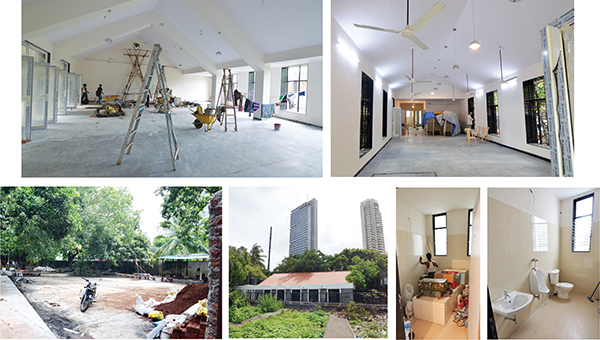
Clockwise from above: prayer halls, toilets, view of hall from adjacent plot, parking space
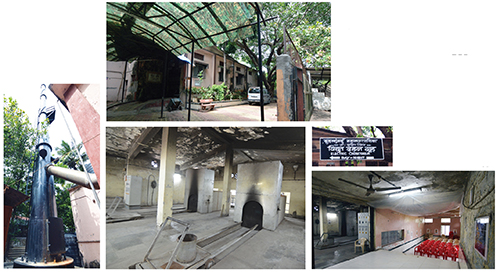
Clockwise from far left: chimney, entrance to electric crematoria, signage, hall, furnaces
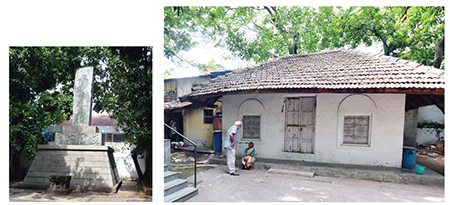
Japanese shinto shrine and prayer hall
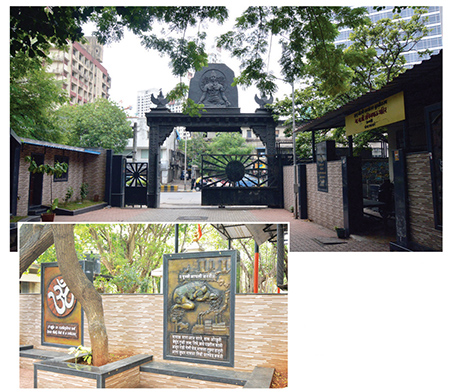
View of front gate from within the complex; Murals along the driveway
A Japanese shrine neighbors the halls on one side where once or twice a year the Japanese consulate and other dignitaries gather to pay homage to the departed. A benign and smiling, elderly, sari clad woman resides in a small shanty adjacent to the shrine.
On the other side of the halls is the electric crematorium, with two working furnaces, which is in need of repairs and a coat of paint. A plastic sheet is hung over the area where relatives and mourners sit on red plastic chairs. The BMC has sanctioned Rs 40,00,000 (US$ 62,500) to spruce up the place. The TPHT will bear the expense of putting up a toilet in the crematorium compound. The trustees of the TPHT are Dinshaw Tamboly, Fali Sarkari, Keki Elavia, Karl Tamboly, Sarosh Bharucha, Farzana Mojgani and Adil Wadia.
The Trust placed advertisements in the Jam-e-Jamshed of July 12 and the Parsi Times a day earlier inviting applications for a coordinator "to assist and coordinate all the four-day funeral obsequies for Parsi/Irani Zoroastrians wishing to have these done at the New Prayer Hall…constructed at Vaikunth Dham, Dr E. Moses Road, opposite the Four Seasons Hotel, Worli.” The notice states the facility "is expected to become operational by end August 2015 where the last rites…may be performed at the customary times…irrespective of the method of disposal (cremation, burial, dakhmenashini).”
The hall was constructed after the Bombay Parsi Punchayet (BPP) trustees refused to permit use of the existing Doongerwadi bunglis for those opting for other means of disposal to dakhmenashini or to allocate space for a new structure. This despite the bunglis being occupied only 18% of the time (see "Bunglis’ utilization,” Parsiana, June 21, 2014), as relatives opt to have the subsequent ceremonies after the paidast at agiaries near their residence. The annual Doongerwadi deficit is around two crore rupees (US$ 3,12,500), if not more. The litigation over barring the two priests from Doongerwadi alone cost the BPP between 2.5 to 3.5 crore rupees (US$ 3,90,625 to 5,46,875). The priests were victimized for performing ceremonies for those opting for cremation.
Jamsheed Kanga, a former BPP trustee and municipal commissioner of Bombay along with Homi Khusrokhan, former managing director of Glaxo Burroughs Wellcome, a director of several Tata companies and president of the Bombay Natural History Society, had taken up cudgels on behalf of the banned priests Ervads Khushroo Madon and Framroze Mirza. While differences subsequently cropped up between the two priests, both are expected to jointly perform the August 3 jashan ceremony for the new halls.
In an email to Parsiana dated July 19, 2015, Kanga provided the backdrop to the Worli project:
"When I was the municipal commissioner in the 1980s I got a phone call from J. R. D. Tata
enquiring which of our crematoriums in Bombay would be appropriate for the funeral of his brother D. R. D. Tata who had passed away, as many dignitaries were expected to attend. Unfortunately, some of the crematoriums were under upgradation and closed and others were very shabby. We hurriedly tidied up the one at Dadar and when I went there to condole with him he said Bombay deserves a better one.
"I immediately took a round of all the existing ones and selected the one at Worli as it had a lot of space and is conveniently located for South Bombay. I asked the city engineer to select a good architect to design a hall for this. Unfortunately after I was transferred this project was shelved.
"When we realized that the BPP would not give a hall for prayers after cremation for Parsis, Homi and I thought of raising funds and building a hall at Worli by forming a trust. We were extremely lucky not only to get good cooperation from the BMC with two additional municipal commissioners taking active interest, but also a big donation from the A. H. Wadia Trust, advice and supervision from an eminent engineer who had worked in Tata Housing, Rustom Dadabhoy, and support from the Godrej engineering team under the guidance of Maneck Engineer. Dinshaw Tamboly and Homi have looked after the administrative tasks and I have chased BMC engineering and health departments so without any delay this project has been completed in good time for which the credit goes to the team. The contractor, Ashok Punjabi, has done a good job and on time. The Godrej gardening department is preparing a plan for a garden on the premises. All in all it has been a combined effort of a number of dedicated persons.”
Kanga further points out that as compared to the payment that has to be made to the BPP for use of bunglis at Doongerwadi, "the use of all the crematoria in Bombay are free and also the prayer halls. There is only a small booking fee for the crematorium.”
"After three or four years of searching for a prayer hall in South Bombay I had given up hope as real estate costs were prohibitive,” noted Khusrokhan in an email dated July 24. "However in 2010-11, when interacting closely with Jamsheed during the ‘Ban on Priests’ case he mentioned the Worli crematorium and we decided to make one more attempt to revive his old pet project of building a prayer hall there. To our pleasant surprise the MCGM (Municipal Corporation of Greater Mumbai) were very receptive to the idea of allowing us to construct a well-designed prayer hall for all communities within this vast complex, but with priority at certain times for Parsis and Iranis. They in fact allowed us to choose a site which is tucked away in a corner next to a Japanese Shinto shrine. We set up the trust under the able chairmanship of Dinshaw Tamboly and he has hand-picked a set of like-minded trustees. Dinshaw is a brilliant organizer and extremely quick in his execution. The project really took shape and reached where it has thanks to his leadership. A large number of persons have come forward to assure us of financial support and we were able to take the project forward with even greater speed thanks to a truly generous donation of Rs 1.5 crores from the A. H. Wadia Charities. We have also set up The Prayer Hall Services and Maintenance Trust and have started collecting funds for the purpose of maintaining the prayer hall, keeping it clean at all times and to assist those Zoroastrians wishing to avail of the facility. We may never be able to match the solitude and ambience of Doongerwadi but many who have seen the prayer hall say it has exceeded their expectations. At the end of the day, we all owe a huge debt of gratitude to Jamsheed without whose connections with the MCGM and the enormous respect he still commands there, nothing would have been achieved.”
At Parsiana’s request Dinshaw Tamboly sent his report and views on the Prayer Hall:
"For more than a decade, during my tenure as a trustee of the BPP (1996 to 2008) we debated the need for allowing funerary prayers to be performed at Doongerwadi and thereafter permit family members to dispose of the corpse through alternate system of disposal — cremation or burial.
"With some trustees being in favor and some not, pressures from the clergy and vociferous sections of traditional Parsis, this issue was not allowed to move forward. Those professing liberal views and ready to consider alternate systems of disposal were informed they should not expect BPP to approve of their proposal and they should go ahead and make their own arrangements. Thanks to this sagacious advice, the seeds that were sown in the 1980s began to sprout in 2014.
"Kanga and Khushrokhan, the two champions who successfully took on the BPP in the ‘Ban on mobeds’ issue and some of us others considered raising funds and building a hall at Worli by forming a trust. Thus came into being TPHT...
"All in all, the creation of this much required facility started in March 2014 and was completed in August 2015 has been the result of the combined effort of our dedicated team.
"Upon its completion by end August 2015, the Prayer Hall will be handed over to the Municipal Corporation of Greater Mumbai (MCGM).
"We have also discussed with the MCGM and obtained their approval that a sister trust that we have already established, called The Prayer Hall Services and Maintenance Trust will continue to provide periodic cleaning of the halls; security to safeguard the fixtures and fittings in the halls; and maintenance of gardens and greenery within and surrounding the plot on which the prayer halls are constructed...
"The Prayer Hall will be used solely for the last rites of persons of all communities and no activity besides funerary services and rituals will be permitted.
"The Parsi-Irani Zoroastrian community shall be permitted, in perpetuity, to use the said prayer hall for the purpose of prayers, rituals and last rites as per their religious customs and traditions, for four days after the funeral. For them it will be permissible to also conduct these prayers at certain times as per custom over the next four days following the funeral, even if the last rites are not performed in the facility.
"Subject to availability, when there is a request for use of the Hall, members of the Parsi-Irani Zoroa strian community will be given priority to use the prayer hall during the following hours: 7 to 9 a.m., 3 to 8 p.m. and 4 to 6 a.m., in perpetuity, if not in use at the time.
"The Prayer Hall, a need of our times, has now become a reality and will begin to function from end August 2015 onwards, meeting the needs of a growing number of Parsis opting for alternate systems of disposal.
"I personally feel blessed to have been provided the opportunity to be associated with what I believe is a historic movement forward in the right direction for the Parsi-Irani Zoroastrian community of Bombay.”
The BMC has 61 cemeteries and crematoria in Bombay of which 11 are electric crematoriums, according to their website mcgm.gov.in. Non-BMC or "private” cemeteries/crematoria number 136.
◆ ◆ ◆
From the archive