
Religion
“How Ahura Mazda’s competitors were downgraded”
A High Priest and a columnist debate the hierarchy of Zoroastrian deities
When columnist Berjis Desai wrote on the existence of three Ahuras, and the downgrading of two of them at a later date, presumably by the clergy (see "How Ahura Mazda’s competitors were downgraded,” (The Occasional Piece, Parsiana, November 7-20, 2023), Parsiana requested Dastur (Dr) Firoze Kotwal to comment on the unusual topic. Kotwal refuted Desai’s contention, saying Ahura Mazda had always been supreme and that the clergy did not downgrade the other deities. He wrote that Desai was being "intentionally provocative.” Desai readily responded that he was keen to provoke a debate to arouse interest in the religion, and cited his sources. Parsiana reproduces both their views for the benefit of readers.
Dastur (Dr) Firoze Kotwal opines
Berjis Desai makes many misleading assumptions. Most serious scholars do not see the demotion "and the fall from grace” of Meher Yazad, as he puts it, as being engineered by the Sasanian clergy (224-651 CE). It may be of interest to note that Prophet Zarathushtra addresses his worship to Ahura Mazda over 190 times in his hymns, the Gathas, versus only once to Mithra (Yasna 46.5).
Likewise, in the inscriptions of our great Achemenian kings (550-331 BCE), Ahura Mazda is invoked repeatedly. For example, Darius the Great (522-486 BCE) declared, "By the grace of Ahuramazda I became king” (Bisitun inscription col 1 v.6-7). He later declared in the same inscription panel, "Ahuramazda bore me aid” (Bisitun col 1 v.9). In another inscription, Darius declared, "A great god is Ahuramazda” (Naqsh i Rustam v.1).
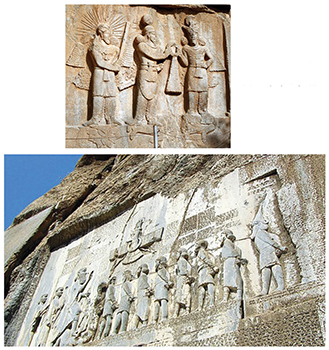
Top: Bas-relief at Taq-e Bostan showing investiture of Ardashir II (3rd century CE)
with yazata Mithra on the left with raised barsom;
above: The Behistun Inscription photographed in 2019
Photos: Wikipedia
Likewise, his son Xerxes (486-465 BCE) continues to recognize Ahura Mazda as "a great god… The greatest of the gods (baga vazarka auramazda hya mathishta bagānām” (Kuh I Alvand, Hamadan v.1-2). Xerxes’s son Artaxerxes (465-424 BCE), on a molding pedestal from Hamadan declared, "Let Ahuramazda, Anahita and Mithra (protect) me (and my kingdom) and this is which we have done.” Clearly in this inscription, An(ā) h (i) ta and M’tra are mentioned as divinities always subservient to Ahura Mazda. There is no mistaking that Zarathushtra, in his divine hymns, the Gathas, and the great Achemenian kings always recognized the supremacy of Ahura Mazda but acknowledged Mithra and Anahita as lesser divinities in the Zoroastrian pantheon of yazatas.
All these references illustrate the supremacy of Ahura Mazda, and this was noted many centuries before the High Priest Adarbad Mahraspand (mid-4th century CE) did so, as Desai alleges. He further wrongly speculates that "… in all probability, the Avestan version of this Yasht was edited, if not composed by… (him).” Meher Yazad is an important divinity, but it is erroneous to postulate that Meher Yazad was demoted by the "orthodox clergy in Sasanian times.” Scholars widely accept that most of the Yashts were composed before the Sasanian era, by which time the Zoroastrian theology of Ahura Mazda, the ameshaspentas and the yazatas was already canonized and established. Therefore, it is provocative and erroneous for the writer to state that "the clergy was a master of thought control” as there was no valid reason for the clergy to obliterate the role or position of Meher or Apam Napat and promote Ahura Mazda as Ahura Mazda was, and always has been, regarded as the supreme being in Zoroastrianism.
The author also states that the Indo-Iranian divinity Apam Napat was eclipsed by the great Iranian Zoroastrian water divinity Anahita. Again, it should be noted that Anahita is referred to in King Artaxerxes’s inscriptions many centuries before the Sasanian era. Therefore, the charge made by the author against the Zoroastrian clergy is false, and the orthodox Sasanian clergy cannot be held responsible for Anahita being given preeminence over Apam Napat in Zoroastrianism.
Again, the writer claims that by invoking Meher or Apam Napat, the devout are hedging their bets (possibly he means spiritually). This has no basis in reality, as each day of the Zoroastrian calendar month gives a synergetic link with all the yazatas, and both Meher and the water divinity Anahita constitute a part of mainstream Zoroastrian worship linking a Zoroastrian back to the divine hymns of the prophet Zarathushtra.
On a personal note, it strikes me that the writer intentionally seeks to be provocative to confuse and mislead the reader by blaming the Sasanian clergy who should be credited for having safeguarded and preserved the religion and its ritual traditions as we know them today.
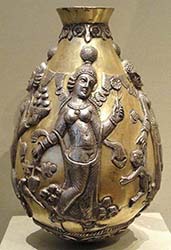
4th-6th century Sasanian vessel, assumed to be
Anahita (Cleveland Museum of Art) Photo: Wikipedia
Berjis Desai responds
Dastur (Dr) Firoze Kotwal, whom I have repeatedly acknowledged as the leading authority on Zoroastrian rituals and liturgy, disagrees with my statement that like most clergy the Sasanian clergy were "masters of thought control” and were responsible for downgrading Mihr or Meher Yazad from a peer of Ahura Mazda to a mere deputy minister in the former’s cabinet (not even one of the six ameshaspandas, only a yazad). From first class to economy class straightaway!
Kotwal does not categorically deny that there was such downgrading, both of Mihr and Apam Napat. However, he submits that such downgrading was not done by the Sasanian clergy. He also states that there was no valid reason for such a demotion.
Assuming for a moment that the Sasanian clergy (for whom Kotwal has more than a soft corner) did not downgrade these deities, scholarly evidence does nevertheless establish that there indeed was such downgrading and only one of the three Ahuras from the original triad managed to emerge supreme in this theological coup.
It is secondary whether the Sasanian clergy did this or whether it was initiated by their predecessors. The reason for such downgrading is obvious. Mihr, Apam Napat and Anahita were all foreign gods, while Ahura Mazda was not.
Consider the following sample of the evidence for the above propositions:
— Mihr shared the guardianship of asha (order, righteousness and justice) with the two other Ahuras in the ancient Iranian religions. By one account, once Zoroaster proclaimed Ahura Mazda the most supreme of the three Ahuras, as the one uncreated God, he worshipped him as the master of asha (Dr Mary Boyce, in Zoroastrianism: Its antiquity and constant vigour, 1992, pg 19).
— In this way a great triad of gods was conceived: Ahura Mazda, Ahura Mitra (Meher) and Ahura Varuna (Apam Napat) (Boyce in On Mithra, Lord of Fire, 1975, page 69).
— Mithraic theophoric names form the majority of the names found in the Aramaic inscriptions at Persepolis from the time of the Achemenid king Darius. In fact compound names with Mithra outnumber those referring to Ahura Mazda by five to three (Richard Frye, 1975 in Prof John Hinnells’ edited, Mithraic Studies.)
— Gnoli Gherardo in The Idea of Iran, 1989, pp 166-167 notes that "Sasanian Mazdeism was not a monolithic bloc which is corroborated by non Mazdean sources that we have to resort to in order to get a sense of the complexity of the religious landscape of Iran during the Sasanian period. A picture of Mazdeism more preoccupied with Mihr and Anahita as the foremost deities emerges than with a moralizing Ahura Mazda as the sole object of worship. We become aware that there is quite a considerable discrepancy between later mobadic propaganda (read Sasanian clergy and thought control) and actual practice.”
— In Meher Yasht, Ahura Mazda declares that Meher is the only one who is worthy of being worshipped alongside him.
— Similarly, in most prayers, Meher alone amongst all the ameshaspandas and yazads, is singled out for praise with the words mithraim vohuroom gaiyotim yazamaide.
— There are numerous inscriptions by various kings showing Ahura Mazda and Mihr, side by side.
The above is only a sample. Evidence concludes that Mihr was once a peer of Ahura Mazda and that he was a foreign god. This was the reason he was demoted to a mere yazad, a deputy minister in Ahura Mazda’s cabinet. The third of the triad, Apam Napat, is not even a member of the cabinet, though most prayers include a special mention of him (Apam napat yazamaide).
Kotwal says that I have been intentionally provocative. He is right. To provoke a debate so as to make Parsis who are indifferent to their great religious heritage, curious and interested.
My intention is not to blame the Sasanian clergy or any of their predecessors. It is only to highlight that Ahura Mazda did, at one time, have competing divinities who were imports into Persia. These were progressively obliterated or diluted by the Persian clergy (Sasanian or otherwise) from the public consciousness to purge it of its belief of non-Persian gods.
One does understand the dilemma of the present day orthodoxy. If such exalted divinities in the Zoroastrian pantheon were foreign imports, it becomes very difficult to criticize extra religious worship and beliefs.
If nothing else, I am sure that your readers will now venerate Meher Yazad more than before. I don’t think Kotwal would have any issue at all with such veneration of a former Ahura.
◆ ◆ ◆
From the archive