
Cover Story
Language of laughter
Laughter in the house! 20th-century Parsi theatre by Meher Marfatia. Published in 2011 by 49/50 Books, 33, Peacock Palace, 69, Bhulabhai Desai Road, Bombay 400026. Pp: 285. Price: Rs 2,500.
Laughter in the House celebrates the lives and laughs of at least three generations of actors and audiences who, in the 20th century, brilliantly brought alive the amazing cultural phenomenon that was Parsi theater. The writers, actors and directors are wonderful emissaries of the lightness and loveliness of their time. Formidably talented writers and directors on the one hand and ultimately skilled performers and technicians on the other, each one’s exciting stage journey is a consummately inspiring experience.
Recently published with the blessings of Asia’s second oldest newspaper Jam-e-Jamshed, in size and weight worthy to adorn your coffee table, the book is "dedicated to the comm-unity that knows how to laugh and make laugh and how to live and let live.” How did this remarkable book come about? The author, Meher Marfatia, describes how, during a Chinese lunch, her actor friend Shernaz Patel, daughter of veteran stage luminaries Ruby and Burjor Patel, suggested: "Why not write a book on our theater of at least the past 50 years?” To the would-be author "the bamboo rice suddenly smelt much more fragrant, the Oriental music sounded less tinny, waves of excitement flooded in. Why not? I repeated to myself.”
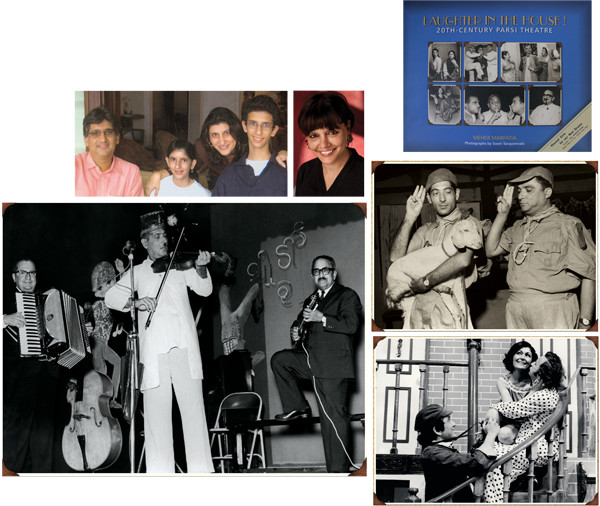
(L to R) Noshir, Ayesha, Meher and Zarir Marfatia; Sooni Tarapore-vala; Goody Seervai, Jimmy Pocha and Adi Marzban in Thodik Rammat Thodik Gammat; Pocha and Eric Paymaster in Hormusji nu Honeymoon; Homi Wadia, Aban Patel and Burjor Patel in Lafra Sadan
The book, designed by Khurshed Poonawala, processed by Commercial Art Engravers and published by Khushru Patel and Aspi Forbes of Jak Printers, boasts a delightful foreword by our Pun Queen, Bachi Karkaria. It describes how outside audiences "laugh with and sometimes at the eccentric bawajis who alone could come up with such ludicrous farces and who else could lampoon themselves so disarmingly or so self-destructively. But within the kaum’s embrace, it played a deep sociological, even karmic role.” The foreword ends on an ominous note: "Don’t underestimate what the Parsi natak once stood for, or undermine how much else will fall with the curtain.”
Jam-e-Jamshed, from its inception in 1832, forged lasting bonds with every aspect of Parsi culture, especially theater. Apart from its chronicling of the community and relevance to the Parsi way of life, the paper has always asserted distinct ties to theater which has been the passion of its successive editors. From Fardoonjee to his son Jehangirjee, followed in turn by Pherozeshah (Pijam) and his son, the redoubtable Adi Marzban, each generation of this family has contributed richly to Parsi theater. "Jame is therefore proud and honored to be associated with this book, Laughter in the House.”
Chief of the many who changed the face of Parsi theater over the last century was Adi Marzban. As far back as in 1933, studying in Elphinstone College, he got together theater enthusiasts who tooled their skills under his direction to present amateur plays for local charities. By 1950, Adi was directing English productions like Sacred Flame and a few others. He also directed a few plays in Gujarati of which the most successful was Piroja Bhavan which was "to change the trajectory of Parsi drama for ever.” Performed in 1959, it marked a shift from blood and thunder historic sagas to light-hearted themes like love and marriage, inheritance, old age and patriotism. Adi was hailed as "the laughing philosopher and the despair of serious theater” by producing plays like Mota Dil Na Mota Bawa, Kataryu Gap and Mari Pachi Kon? Even in ostensibly comic plays, he would smuggle in a seed of some contemporary idea. A national icon, he won the Padma Shri in 1964 and, six years later, the Sangeet Natak Akademi Award for direction on stage.
Adi had the knack of getting the best out of his performers. He was a dramatist beyond compare and his wide range of interests included painting, music, palmistry, astrology and foretelling the future! Other gifted writers and directors of that era were Pheroze Antia, the prolific Dorab Mehta and the insightful Homi Tavadia, and years later, the fervent Yazdi Karanjia. Their Parsi plays boasted a laugh a minute. As the late artist M. F. Husain had declared in a phone call from London: "Nothing in the world was more joyful than Parsi theater in Bombay 50 years ago!”
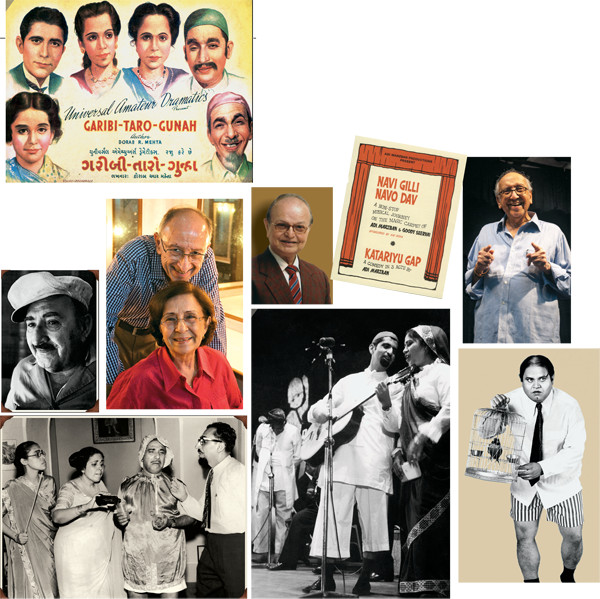
(L to R) A youthful Adi Marzban; Burjor and Ruby Patel; Yazdi Karanjia; Sam Kerawalla; Dolly Dotiwala, Piloo Wadia, Dadi Sarkari and Homi Tavadia in Maatidao ne Udha Paaro; Pesi Khandalavala and Uma Pocha in Thodik Rammat Thodik Gammat; Dinyar Contractor in Lafra Sadan
In 1917, Dr J. R. Wadia introduced a central theater to help charities. Several well-known Parsi doctors performed a unique brand of originally written pieces, "from cheeky parodies of Shakespeare to bedroom comedies and charity revues.” A play called Madhouse Na Mehman received the warmest appreciation in Bombay and other towns.
The packed crowds of delighted viewers presented a much wider mix of people conversant with Gujarati. Outrageous spoofs of tragedies Hamlet No Omelate and Manchoo Macbeth and an Indianized Romeo and Juliet were hugely popular. Between 1970 and 1991, the plays collected the then princely sum of Rs 80 lakhs for various charities.
A random thought — if doctors who deal in life and death problems could thus appear on stage, why not the trustees of the Parsi Punchayet who deal in housing squabbles and petty disputes regarding the disposal of the dead? All it needs is a sense of humor and the ability to laugh at oneself. Surely a body like the Parsi Punchayet should be up to it! Doctors have set the example. What better way is there for the trustees to follow this example to win public acclaim? No doubt the community would laugh — but it would be a different sort of laughter — not at the trustees but with them in happy conviviality!
In the late 1970s, Parsis and Gujaratis joined hands through the good offices of the Indian National Theatre (INT). Their plays like Khunnas, Lafra Sadan and Hello, Inspector made unforgettable theater. The INT had a Parsi wing attached to it. A quoted conversation between playwrights Prabodh Joshi and Tarak Mehta acknowledges the finesse and perfection which Parsi theater imparted to Gujarati theater.
Capturing the essential comedy for the reader is expert photographer Sooni Taraporevala whose professional touch gives substance and strength to the book, portrays the fun of it all in her speaking photographs which occupy several of the pages in this major undertaking.
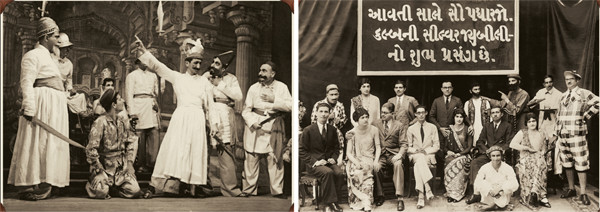
Dadi Sarkari, Jimmy Pocha, Dinshah Daji, Homi Tavadia and Jangoo Irani in Parsi Raja Harishchandra ; The cast of Jaltu Jigar, Calcutta, 1931
There are almost 60 full-page stills depicting the ludicrous aspect which was the spirit of those plays. Amongst the many that bring enjoyment is a scene from Marzban’s Gustadji Ghore Charya, where Homi Tavadia, suited and booted, is bending low to kiss Ruby Patel’s left hand, while she is threatening him with a shoe raised in her right hand. There is another of Pheroze Antia proudly displaying what looks like a toothbrush to Moti Antia, Mani Bamboat and Mani Patel in Wah Re Behram. Equally entertaining is the one where Dolly Dotiwala, Piloo Wadia and Dadi Sarkari offer a sick-looking Homi Tavadia a dose of medicine in Maatidao Ne Udha Paaro. The Kings of Comedy, a quintet of merry men — Minoo Davar, Jean Bhownagary, Dinshah Daji, Jimmy Pocha and Jangoo Irani — are portrayed on one page while another depicts scene stealers Dinyar Contractor, Pervez Mehta, Veera Sorabji, Naju Sukhia, Villoo Panthaky, Jerry Kumana, Aban Patel and Mahiar Patel.
The crucial question this book raises, and partly answers in its final chapters, is the revival of Parsi theater. Of the 13 persons closely connected with Parsi theater it consulted, only three felt that revival is possible. Burjor Patel states: "There is an opportunity for the new generation among us to revive Parsi Gujarati theater. I am confident Parsi business houses will come forward to support such an activity.” Nozer Buchia declares: "We Parsis are the only species that have the ability to laugh at ourselves. That, in my opinion has been the main reason for the success of our theater.” Daisy Irani maintains: "There was, is and always will be a special place for Parsi theater.” The book’s last chapters hold out the same hope.
We may well recall John Steinbeck’s words, "Theater is the only institution in the world that has been dying for four thousand years and never succumbed.”
Bringing to a close this highly inspirational, priceless work of art, Marfatia concludes: "We would do well to recreate that delicious slice of life. Few plays have achieved the wealth of mass appeal and the literary cachet of those from the pen of top writers from the last half century. Fewer still have displayed their wicked humor, the wild whoosh of word play which elicited endless delight from Parsis and non-Parsis alike.
"After all, the language of laughter is universal. Let’s celebrate it. Here’s to an unabashed journey of joy. May the road be ridden with plenty of chuckles and guffaws. Maja karjoji!”
◆ ◆ ◆
From the archive