
Crime and punishment
A doctor who was hanged for murder in the UK and a colorful healer in the USA were newsworthy Zoroastrians in the first half of the 20th century
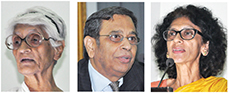
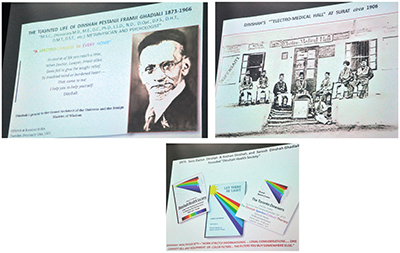
Slides from Pandya’s presentation on Dinshah Ghadiali
Covering the ‘crime’ in the title of the set of two lectures, Dr Kalpana Swaminathan, who is a surgeon by profession and a writer by passion, said that "on May 12, 1936, Ruxton, born Bakhtyar Rustomji Hakim in Bombay and an alumnus of Grant Medical College, was hanged at the Manchester Assizes.” There was no proof, she expostulated, that he had indeed committed the crimes he was accused of, and continued that "today there is no doubt that Ruxton’s trial was unjust.” She questioned why no one except Ruxton was ever investigated for the murders of Isabella and Rogerson.
Describing the police version of the murders, Swaminathan stated that according to them, the murders took place on September 15, 1935 and that the crime scene was the landing at the top of the stairs in the Ruxton residence in Dalton Square, Lancaster, that stood just opposite the Town Hall-cum-police station. "Autopsy evidence suggested that Isabella had been strangled, but there was no evidence how Rogerson was killed,” said Swaminathan. The police held that Ruxton, who was "insanely jealous” of his promiscuous wife, carried the two bodies to the bathroom on the first floor landing where he decapitated and ‘drained’ the bodies in the bath tub and "stored the remains in one of the upstairs rooms.” The police version, according to Swaminathan maintained that on the night of September 16, Ruxton loaded his car with the remains and drove to a nearby river called Gardenholme Linn, cruised across the bridge and flung out parcels of the remains of his wife and Rogerson.
Based on her study of the legal transcripts of the case, Swaminathan provided Ruxton’s version of what happened on that September night, where the doctor stated that "Isabella returned home at midnight of September 15 from a trip to Blackpool and told him that she was off to Edinburgh with Rogerson the next morning.” Ruxton, suspected that she was off to Edinburgh in a company of one of her many admirers, but claimed he "did not however admit to a quarrel on that night,” Swaminathan stated.
Weighing the police version with Ruxton’s account, the author argued that a man who was known to be as loving a father as the doctor was known to be, would not expose his three children, whose bedroom was just off the top landing of the stairs, to a crime as gruesome as was alleged. She further stated that he would have had to work really fast if he was to dismember the two bodies into 68 parts and be done between midnight and 6.15 a.m., when he was seen by Ms Oxley, their charwoman. This surgeon turned writer questioned why the instruments used to decapitate the bodies were never found. "Would a doctor, who was responsible for delivering 250 babies without a single complication and one who had done pro-bono work for two years commit such a ghastly act?” she asked.
Quoting from press reports in the UK, Swaminathan said that the doctor was variously described as Hindu, Muslim, Parsi and Bengali in the course of the trial. "Every epithet was meant to reveal he was not English, not Christian, and beyond that, it did not matter,” she said. Swaminathan bemoaned the fact that the Bombay newspapers of the time were rather sketchy in providing details of the trial of Ruxton. She stated that his mother was interviewed, byThe Times of India as was his Parsi wife, whom he had married in May 1925 and who spoke of him "with great candor and generosity.”
On the morning after the hanging, The News of the World printed the doctor’s confession, stated Swaminathan, where he wrote, "I killed Mrs Ruxton in a fit of temper because I thought she had been with a man....Mary Rogerson was present...I had to kill her.” The paper had bought the confession off Ruxton the day after his arrest, and the money, she said, was used to pay his lawyer’s fees. Swaminathan concluded that it was time to reopen the Ruxton case and reappraise the evidence with new forensic techniques, as this "might just restore his honor.”
"Self styled Parsi Edison”
Tracing the early days of Ghadiali, Dr Shubhada Pandya (covering the ‘misdemeanor’ in the theme of the lectures) referred to him as "an extremely self confident and precocious child who had not a moment of self doubt.” Fascinated by all things electrical and electro-magnetic, he tinkered with electrical equipment from a very early age. Landing in the United States of America in 1896 at the age of 23, he was quoted in an interview with The New York Times that "the Orient advanced in medicine much before the West,” said Pandya who is a retired clinical neurophysiologist. Originally a resident of Parsi Bazar, Bombay, Ghadiali styled himself as an alumnus of the Independent College of Medicine, Chicago, Illinois and claimed to have deposed before the ‘India Plague Commission.’ This self styled Parsi Edison who "had a life-long affair with color, was a promoter of vegetarianism, teetotalism and theosophy,” stated Pandya, who worked on the history of leprosy in Bombay, 1840 to 1947, for her doctoral thesis.
Pandya continued that within two years of his having emigrated to the United States in 1911 with his wife Manek and two children this maverick applied for and acquired two patents for two machines, one of which was named the Faultfinder, that were perhaps forerunners of the spectrometer he is most known for. He acquired one more patent in 1929 for a machine he called the Itisometer. Pandya quoted the Parsi Prakash as reporting that Ghadiali acquired a colonelship in the New York Reserve Police shortly after his emigration.
Ghadiali, who founded the Spectrochrome Institute in New Jersey, USA, based his ‘treatments’ on the principle that human organs are characterized by electro-magnetic rays and can be stimulated or suppressed by colors. He believed that colors "have a panacea for every ill, and a cure for all.” His color chart, depicting the colors that heal included the color Kashmiria, named after his daughter. After having achieved success in treating the niece of a friend for colitis, Ghadiali was supported by a few doctors in his methods of treatment and he "continued to make improvements in the machines used for treatments.” Among the many honors and degrees Ghadiali laid claim to were Doctor of Chiropractic, Doctor of Philosophy and Doctor of Legal Law, said Pandya.
His pièce-de-résistance, the spectrochrome was later in 1948 described by the Time Magazine thus: "a 1,000-watt bulb was propped up in the back of it, shining through red, yellow, green, blue and violet panes of glass. The instructions that came with the box reflected sunny assurance: it would ‘measure and restore radioactive and radio-emitive equilibrium by attuned color waves.’” The therapy, according to Pandya, consisted of color waves that he claimed were to be applied to the bare skin "as clothing would intercept them.”
In December 1925, this ‘man of medicine,’ Pandya said, was sentenced to five years’ imprisonment in Atlanta, for taking part in a ‘pistol battle’ but was released after four years on account of the services rendered to co-prisoners during a prison riot, said Pandya. On being released, the daring man claimed in his advertising that he was pardoned by the President himself, a statement that the Department of Justice refuted. He continued to practice his brand of healing, and by 1940 was reported to have made over one million US dollars (Rs 6,30,00,000) by selling spectrochromes.
Listing his misdemeanors, Pandya stated that this practitioner, who moved for "a spectrochrome in every home,” was involved in several tangles with the Food and Drug Administration (FDA) between 1942 and 1948 and had 17 suits filed against him for "misbranding equipment.” In 1947 he was fined US $ 20,000 and was reprimanded with "you can expect no mercy from this court.” His work was asked to be put on probation and all equipment was stipulated to be destroyed. In 1953, the Spectrochrome Institute was rebranded to Visible Spectrum Institute and functions today to disseminate information on the benefits of color therapy. In 1959, seven years before Ghadiali passed away, the FDA issued a permanent injunction against him and the spectrochrome.
Revealing her thoughts on Ghadiali’s ‘fame,’ Pandya stated that he filled a lacuna in American society: mainstream medicine was becoming commercialized and the public was ready to deploy alternative modes of treatment. He was a good public speaker and laced his speeches with generous doses of humor, she said. "The FDA, in going after him, made him a martyr,” she concluded.
Fredun De Vitre, senior advocate of the Bombay High Court pointed out a Zoroastrian angle to the setting up of the Court of Appeal in the United Kingdom, while presiding over the two lectures, on April 30, 2015. He referred to the case of George Edalji, the son of Reverend Shapurji Edalji, a convert from a Bombay Parsi family, who served hard labor for three years after being convicted on a charge of injuring livestock in 1903 in Great Wryley, UK. Edalji was pardoned after a campaign in which Sir Arthur Conan Doyle took a prominent role, said De Vitre, and "after the veteran writer noted that Edalji was night-blind and therefore could not have damaged the livestock, which happened, in all cases, after sunset.” The difficulty in overturning the conviction of Edalji demonstrated the need for reviewing unsafe verdicts and was a factor in the 1907 creation of a court of appeal for England he concluded.
The evening closed with a vote of thanks by Dr Nawaz Mody, joint honorary secretary of the KRCOI.