
Events & Personalities
Faith and miracles
There is a "lack of unity in the community,” said legal luminary and former trustee of the Bombay Parsi Punchayet (BPP) Dadi Engineer. He was delivering the keynote address at a function to commemorate the 184th birth anniversary of Dasturji Jamshedji Sorabji Kookardaru at the Karani Agiary in Cusrow Baug, Bombay on April 12, 2015. Engineer bemoaned the fact that there were "warring factions within the BPP.” They must get their act together or else there will be "satyanash” (dire consequences) he feared. He said this was a long standing problem and cited the comment of a visiting British parliamentarian from 1935 that "there is no community with so many differences of opinion (as the Parsis).”
Engineer enumerated the ills facing the Parsi community. The first, he said, was a lack of entrepreneurial drive. He referred to the tremendous competition in the business world, and said that the youth needed to work extra hard. It is the duty of all Zoroastrians to support the recently introduced Jiyo Parsi campaign, he stressed. Lastly, he expressed that charity, which distinguished the Zoroastrian from his peers, was on a downward trend. He exhorted the audience to help their neighbors.
Recalling the Kookadaru ‘miracle’ of Anjuman Atash Behram where the fund starved managing committee was able to complete the construction of the fire temple hall thanks to the power of Kookadaru’s prayers, which reportedly led to the materialization of a gold brick, Engineer quipped that he too asked for a gold brick of "good health, happiness and peace of mind from Kookadaru” in his prayers.
Engineer enumerated the ills facing the Parsi community. The first, he said, was a lack of entrepreneurial drive. He referred to the tremendous competition in the business world, and said that the youth needed to work extra hard. It is the duty of all Zoroastrians to support the recently introduced Jiyo Parsi campaign, he stressed. Lastly, he expressed that charity, which distinguished the Zoroastrian from his peers, was on a downward trend. He exhorted the audience to help their neighbors.
Recalling the Kookadaru ‘miracle’ of Anjuman Atash Behram where the fund starved managing committee was able to complete the construction of the fire temple hall thanks to the power of Kookadaru’s prayers, which reportedly led to the materialization of a gold brick, Engineer quipped that he too asked for a gold brick of "good health, happiness and peace of mind from Kookadaru” in his prayers.
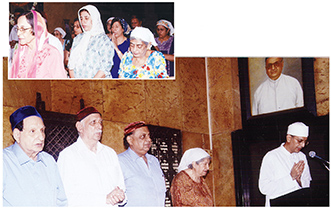
Devotees; Dadi Engineer, Bomi Hansotia, Homi Ranina, Mani Vazifdar and Ervad Yazdi Aibara
The function started with a Hama Anjuman Jashan. In his welcome speech, Homi Ranina, trustee, called Kookadaru the "last great dastur of the Zoroastrian religion” and bemoaned the increasing interfaith marriages in the community. He exhorted the youth to find happiness in India "with the blessings of the atash padshah sahebs who have been consecrated in our agiaries and atash behrams.” Religion and community are two sides of the same coin, he said.
A booklet titled Admonitions of Dastur Adarbad Marespand, published and printed for free distribution by the Seth Nusserwanji Hirji Karani Trust and Dasturji Jamshedji Sorabji Kookadaru Memorial Agiary Trust, was released at the function. The booklet was prepared from the translation of Pahlavi Andarz (Admonition Text) of J. C. Tarapore and reprinted from one of the last copies of the book provided by Nariman Mody of the Parsee Vegetarian Society. This 14 pager has 63 pointers in the form of advice from Marespand to his son Zarathusht and range from the practical ("Out of your wealth, do purchase water, fields and land, for if it does not bear fruit, the capital remains”) to the elementary ["Do not utter word(s) without thinking” and "Do not be greedy when eating”]. The Zoroastrian ethos of giving finds an echo in "Be charitable so that you might attain Garothman (eternal bliss).”
Dastur Adarbad Marespand was prime minister to the Sasanian emperor Shahpur II who ruled between 309 and 379 AD and is credited with the compilation of some Pahlavi and Pazend prayers like Do-a-nam-Setayeshne and Patet Pasemani. He was known to be a "very holy person and considered as a saint,” notes the publication. Marespand finds mention in the Chapter XXIII, (titled "The active propaganda of the faith”) in Zoroastrian Theology, from the earliest times to the present day by Dr Maneckji Nasservanji Dhalla. Quoting many sources such as the Dinkard, Dhalla states that "the great Sasanian monarch Shahpur II zealously worked for the restoration and promulgation of the faith among the unbelievers with the aid of his illustrious Dastur Adarbad.”
Ervad Yazdi Aibara, panthaky of the Karani Agiary ,in his closing remarks stated that Kookadaru’s spiritual guru was Dastur Azar Kaiwan Bin Azar Gushasp, and remarked that the birth of spiritual persons like Kookadaru is ordained by Ahura Mazda to guide the faith of the people towards religion and prayers. Aibara thanked trustees Ranina and Bomi Hansotia for their active support. A vote of thanks was given by Cusrow Baug resident Mani Vazifdar.
Kookadaru, who practiced at Kappawala Agiary, was born in Surat in 1831. He was known for his simple lifestyle and for paying deep religious respect to the rules of priestly purity. A photograph of a bespectacled Kookadaru, wearing a beard and a pugree is one of the most popular iconographical items among Parsis and many pray to him to bring the fulfillment of their wishes. This highly learned priest, whose portrait adorns most agiaries and atash behrams, was one of the nine priests who in 1882 performed the navjotes of nine persons aged between 35 and 77 and of two children, all of whom were products of interfaith marriages, in what is commonly referred to as the Mazagaon navjotes and widely reported in the Parsi Press.
◆ ◆ ◆
From the archive