
Parsi Controversies
The eighth atash behram – II
As naked egos wrestled with each other and tempers reached a boiling point, the enraged priests of Navsari and the blue-blooded Petits were resolute in their determination to consecrate the eighth atash behram, and that too a stone’s throw from the Wadia Atash Behram. Driving home their point in style. Many decades later, a popular Bollywood song’s lyrics summed up the situation: Ek ghar banaoonga, téré ghar ké samané (I will build a house just across the way from yours). However, making a house for God is never easy.
Consecrating the holy fire of the highest degree was a Herculean endeavor. The slightest deviation from ritual rigor was simply not permissible. Due to the opposition of the Wadias and the Jejeebhoys, donations dried up. Many devout were disinclined to contribute to what was termed an ego exercise. Others who were superstitious feared they may disturb the rule of seven. The perfect celestial balance of the number seven ought not to be upset and there cannot be an even number of atash behrams. However, the proponents were in no mood to eat humble pie. Every connection was used, every avenue was exhausted and every sinew stretched to complete the project. At the very end, there was no way left to raise any further money. A deficit of Rs 8,500 (that was 1894; today’s value around one crore rupees) was holding back completion. Only God can help now, they said. So they decided to meet the next best alternative to God.
Consecrating the holy fire of the highest degree was a Herculean endeavor. The slightest deviation from ritual rigor was simply not permissible. Due to the opposition of the Wadias and the Jejeebhoys, donations dried up. Many devout were disinclined to contribute to what was termed an ego exercise. Others who were superstitious feared they may disturb the rule of seven. The perfect celestial balance of the number seven ought not to be upset and there cannot be an even number of atash behrams. However, the proponents were in no mood to eat humble pie. Every connection was used, every avenue was exhausted and every sinew stretched to complete the project. At the very end, there was no way left to raise any further money. A deficit of Rs 8,500 (that was 1894; today’s value around one crore rupees) was holding back completion. Only God can help now, they said. So they decided to meet the next best alternative to God.
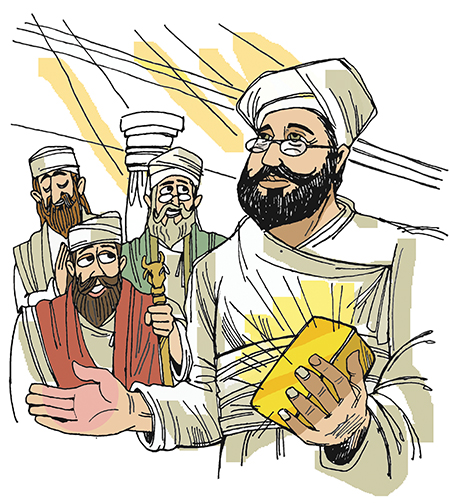
Illustration by Farzana Cooper
Jamshed Sohrab Kookadaru, the head priest of the Kappawala Agiary was, without doubt, a living saint. Pristine pure, compassionate, learned and possessor of many occult powers, the clairvoyant and clairaudient Kookadaru was a scholar [even he was miffed with the perpetually derided Bombay Parsi Punchayet (BPP) for not subsidizing a scholarly treatise]. More importantly, he was reported to be a healer, an excellent astrologer and a miracle man. It was said he would predict the exact moment of Queen Victoria’s death, as also his own. A ritual purist, after Dastur Azar Kaiwan of Patna and then the First Meherjirana of Akbar fame, Kookadaru was a spiritual powerhouse. He washed his own clothes, and was said to cook rice under sunlight by reciting a mantra. He drank a little milk for sustaining his body.
The promoters reportedly approached him regarding the fund-raising. He smiled at them when they asked for his help. "I only have this brick, but come tomorrow, I will try and do something,” he is said to have replied. Next evening, after the nine gongs had been struck to mark the Aivisuthraim gah, he pointed to the brick wrapped in cloth and told them to sell it. It was said to be solid gold which realized exactly Rs 8,500. Alchemy, the supposed science of turning base metal into gold, even for the noblest of causes, creates interference with the karma chakra and is said to demand a high price. And Kookadaru knew this fully well.
Finance was not the only problem. Aalaat or the consecrated nirang had to be brought to Bombay by a ritually pure priest who had to walk all the way from Navsari to Bombay. No mode of transport was permissible. The Bhagarsath Anjuman had an obvious choice. The Kotwal family was the traditional guardians of the aalaat. Ervad Adarji Kotwal thus carried the aalaat on foot. His great-grandson, Dastur (Dr) Firoze Kotwal, would become a high priest and a great scholar a century later. And his other great-grandson would serve the new atash behram as boiwala for 48 years; the first unmarried priest to do so, under a special dispensation granted.
Fires from 16 prescribed sources were collected, purified and stored. After countless liturgical rituals, on Sunday, October 17, 1897, Dastur (Dr) Jamaspji JamaspAsa, MA, Ph D, DIL, consecrated the eighth atash behram, christened the Anjuman na Atash Behram, amidst cheering priests and more than 10,000 Parsis, reported The Times of India in its edition two days later on October 19. Total project cost Rs 2,25,000, an astronomical sum 125 years ago.
Then the old order asserted itself.
In 1897, the bubonic plague broke out in Bombay. Many Parsis perished. A sudden gland in the armpit late evening; dead the next morning. On some days, each bungli at the Towers of Silence, had five paidusts simultaneously. Kookadaru’s young son was amongst the victims. We had warned you not to disturb the rules of seven and even, said the opponents with schadenfreude. This controversy did not die with the enthronement of the new atash padshah. It would fester and reverberate in the corridors of the Bombay High Court and also that accursed office of the BPP.
Berjis Desai, lawyer and author of Oh! Those Parsis, and recently Towers of Silence, is a chronicler of the community.
◆ ◆ ◆
From the archive