
Books
In memory of Aibara
Late Ervad Nadarsha Navroji Aibara blessed by Sant Dasturji Kukadaru Saheb by Dr Hilla Minoo Wadia and translated into English by Marzban J. Giara. Published in 2004 by Kukadaru Trust, Seth N. H. Karani Agiary, Cusrow Baug, Colaba, Bombay 400005. Pp: 120. Price: For free distribution.
To perpetuate the memory of the late Ervad Saheb Nadarsha Navroji Aibara who at the time of his death in 1989 was the panthaky of the Seth N. H. Karani Agiary at Cusrow Baug, the Kukadaru Trust has brought out a book Late Ervad Nadarsha Navroji Aibara blessed by Sant Dasturji Kukadaru Saheb.
The book in Gujarati by Dr Hilla Minoo Wadia was first published in April 2003 and a second edition followed almost immediately. To meet the desire of many devotees who could not read Gujarati, an English translation of the book was brought out by Marzban J. Giara at the request of Ervad Yezdi Nadarsha Aibara, the present panthaky of the Karani Agiary.
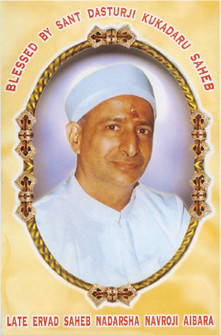
The book clearly demarcates each period of the late Ervad Nadarsha’s life, his early childhood, his services as a mobed and his struggle to earn a living from priesthood, his teaching career at the M. F. Cama Athornan Institute, his appointment as a panthaky of the Sodawaterwalla Agiary at Marine Lines where Sant Dasturji Kukadaru Saheb first appeared before him and subsequently guided all aspects of Nadarsha’s life to his appointment as panthaky of the Seth N. H. Karani Agiary and the establishment of the Kukadaru Trust. The late Nadarsha with his wife Nergesbanoo toured North America extensively in 1984 at the invitation of the Zarathushtis settled there and gave a series of lectures which were much appreciated. Thereafter they toured Iran. All this the author has narrated in a very lucid way.
Born in Surat on May 11, 1933 in a priestly family to Aimai and Navroji Aibara, Nadarsha was the youngest of their six children. The upbringing was most frugal. Nadarsha was made a navar at the age of seven and completed the martab ceremony at the age of 11. In the same year (1944) Nadarsha came to Bombay to practise as a priest. At that time there were many mobeds so there was no regular demand for priests but Nadarsha was neither interested in money nor in becoming a panthaky. He was content to be engrossed in prayers for hours on end.
Due to his indefatigable enthusiasm and faith, he got an opportunity to perform the lofty nirangdin ceremony at the Mithaiwala Agiary in Grant Road. He performed this difficult and long ceremony totally eight times during his lifetime. As he was performing a nirangdin ceremony in memory of Sant Dasturji Kukadaru, a miracle occurred and Kukadaru appeared in front of him and joined him in prayer. Thereafter, Kukadaru guided him throughout his life and gave him certain prayers (nirangs) to be given to people who approached him in distress.
As more and more Parsis came to know about the wonderful benefit of nirang, a large number of people would come every day to receive a talisman (tavij) along with the nirang and photos of Kukadaru and Shah Jamsheed. Those who had benefitted would offer him money and material gifts but he would politely decline them for many years. In fact, he did not even expect people to thank him! Ultimately his inner voice told him that his constant refusal to accept anything was tantamount to hurting the feelings of people who came to him for help. A suggestion was made to build a hall in memory of Kukadaru, and people who so wished could express their gratitude by contributing to the Dasturji Jamshedji Sohrabji Kukadaru Trust. After a struggle to get a suitable site, it was decided to build the hall in the Karani Agiary itself. But this work could be completed only after Ervad Nadarsha’s death in 1989.
The book also devotes considerable space to Kukadaru who was born in 1831 at Surat and who in turn was influenced by Dastur Azar Kaiwan Bin Azar Gushasp who lived 400 years ago. Azar Kaiwan had mystically helped Kukadaru and imparted knowledge of some miraculous nirangs to be given to Zarathushtis in distress. By reciting these nirangs Kukadaru had performed many miracles. Even today, Kukadaru’s portrait is to be seen in atash behrams, agiaries and various Parsi homes. Kukadaru was for many years the panthaky of the Kappawalla Agiary at Tardeo and passed away in 1900 at the age of 70. As mentions Wadia: "Such men cannot attain the status of saint in one lifetime. Kukadaru Saheb must have taken several births in this world and led a life based on righteousness and discipline. Only then his soul must have progressed and ultimately attained the status of a saint.”
Ervad Nadarsha’s good work of giving nirangs is continued even today by his good wife Nergesbanoo and the panthak is looked after by Yezdi. Nadarsha was essentially a quiet man but never failed to speak out when he saw some injustice being done. He served the M. F. Cama Athornan Institute in various capacities — first as a teacher for 15 years and later for 18 months as a joint principal of the Institute and also as a member of the managing committee. This was in addition to his responsibilities as panthaky of the Agiary.
The book consisting of 120 pages is very interesting and is distributed free by the Kukadaru Trust at the Karani Agiary.
RUBY P. LILAOWALA
◆ ◆ ◆
From the archive