
Politics and Policy
To pay or not to pay
The newly formed Atashbehrams, Agiaries and Religious Institutions Welfare Society strategizes on the best approach to tackle the enhanced Bombay Municipal Corporation property levies
Rather than risk incurring a penal interest of 24 percent per annum some members of the newly formed Atashbehrams, Agiaries and Religious Institutions Welfare Society (AARIWS) believe it is advisable to pay under protest the enhanced Bombay Municipal Corporation (BMC) property tax levies. The deadline for making payment is June 30, 2013. The BMC has amended the basis for calculating taxes from the ratable to the capital value of the property. Religious trusts are within the purview of this increased levy.
"If you pay under protest, you don’t lose your right to challenge” the amendment, said lawyer Homiar Vakil of Mulla and Mulla who represents several atash behrams and agiaries, and is instrumental in drawing up the legal brief challenging various aspects of the new law. Both Vakil and Kaizad Hazari, a lawyer and president of the AARIWS, informed those gathered at the Bombay Parsi Punchayet (BPP) office on May 17, 2013 that challenging the constitutional validity of the act would be difficult. Hazari believes, however, that the futuristic projections made by the BMC for the levies could be challenged.
"If you pay under protest, you don’t lose your right to challenge” the amendment, said lawyer Homiar Vakil of Mulla and Mulla who represents several atash behrams and agiaries, and is instrumental in drawing up the legal brief challenging various aspects of the new law. Both Vakil and Kaizad Hazari, a lawyer and president of the AARIWS, informed those gathered at the Bombay Parsi Punchayet (BPP) office on May 17, 2013 that challenging the constitutional validity of the act would be difficult. Hazari believes, however, that the futuristic projections made by the BMC for the levies could be challenged.
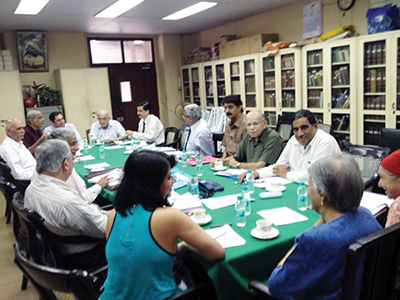
AARIWS meeting in progress
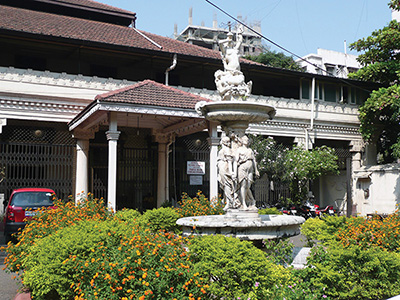
H. B. Wadia Atash Behram could face a Rs 64 lakh tax demand in future (Photo: Jasmine D. Driver)
The new taxes could result in fire temples such as the H. B. Wadia Atash Behram paying Rs 64 lakhs per annum in the future.
BPP chairman and AARIWS committee member Dinshaw Mehta said the issue of the enhanced levy would be discussed at the Samast Anjuman meeting to be held by the BPP at Rustom Baug on May 25, 2013. He noted that while the opposition by retailers and wholesalers to the local body tax (LBT) which is to replace octroi was substantial, agitation against the new municipal property levies was "nothing.”
Lamenting that religious institutions had "no source of income other than donations,” Mehta observed these establishments "will need funds” to pay the tax. In the case of residential and commercial properties, the enhanced levies could be recovered from tenants/licensees.
BPP chairman and AARIWS committee member Dinshaw Mehta said the issue of the enhanced levy would be discussed at the Samast Anjuman meeting to be held by the BPP at Rustom Baug on May 25, 2013. He noted that while the opposition by retailers and wholesalers to the local body tax (LBT) which is to replace octroi was substantial, agitation against the new municipal property levies was "nothing.”
Lamenting that religious institutions had "no source of income other than donations,” Mehta observed these establishments "will need funds” to pay the tax. In the case of residential and commercial properties, the enhanced levies could be recovered from tenants/licensees.
BPP trustee Yazdi Desai believed that some clauses in the AARIWS constitution were "draconian.” These, he alleged, gave the association power "to interfere in the activities of atash behrams and agiaries,” especially those "not faring well.” Mehta countered that any religious establishment "can withdraw” from the association if it felt so threatened. There is "no right to interfere,” he asserted.
But Desai observed that in the Federation of the Parsi Zoroastrian Anjumans of India (FPZAI) defunct anjumans had claimed interference in property matters. Observing that since only five members constituted a quorum in the AARIWS, there was a possibility of the clauses being "misused in future… Today all the members are well meaning.” Desai noted that in some fire temples "many trustees were weak” and could perhaps be cajoled or bullied to do the association’s bidding. AARIWS committee member Bomi Hansotia representing the Karani Fire Temple countered the "association works under the aegis of (its) constitution.”
The gathering, however, decided to add a clause that AARIWS "shall not interfere with the internal working of an institution unless specified by the trust.” Desai concurred, noting "the trust deed should prevail.”
When one of the participants commented on the BMC amendment taking them by surprise, Vakil observed the act was amended "one year ago” but no one objected then. Mehta noted that flats of less than 500 sq ft built-up area were exempted cleverly from the purview of the tax and hence no opposition was voiced by a large section of Bombay citizenry. For example the C and D buildings in Nowroz Baug which have smaller flats would not be affected by the enhanced levy, said Mehta. But some flats at widows’ chawls with more than 500 sq ft built-up area and a monthly rent of Rs 40 would have to pay the additional tax.
Hansotia believed the amendment was introduced "slyly.” A lesser amount is charged initially to lull people into complacency and then the charges are increased exponentially. He noted that the taxes varied from place to place and in the suburbs such as Borivli people are entitled to refunds on the charges! But Mehta noted that in some of the properties of the BPP in Andheri, the levies had increased considerably.
Noting the shortage of mobeds, Farokh Siganporia of Mazgaon Anjuman Agiary stated "go to any agiary you will only find chasniwallas there.” If you inquire as to where the priest is you will be told he has just stepped out. He also alleged non-Parsis masquerading as members of the community were entering fire temples and praying.
He believed clothing was a telltale sign. He referred to a woman in the Iranshah Atash Behram in Udvada wearing a pink top and dark trousers who was later seen smoking in a car. Mehta observed that many Parsi women smoked to which Desai recoiled with mock horror exclaiming "No!” Piloo Lalkaka representing the Ustad Saheb Behramshah Shroff Dar-e-Meher (USBSDM) — who sported a mathubanu — retorted that today "Parsi bairaao jaat jaat na kapraa pehréch (wear all kinds of clothes).”
The next meeting has been scheduled for June 10, 2013.
Others attending the meet were Aramaiti Vachha (Sorabji Thoothi Agiary), H. H. Santoke (USBSDM), Tehemton Karma (M. J. Wadia Anjuman Agiary), Sam Gotla (F. N. Patel Mazgaon Agiary), Kersi Ichhaporia (H. D. Saher Agiary Trust) and Rustom Balsara (N. C. Narielvala Agiary).
◆ ◆ ◆
From the archive