
Readers' Forum
“Feasts for the faithful”
In the article "Feasts for the faithful” (Parsiana, April 7, 2015) the word gahambar has been wrongly spelt. It should read gahambar and not gahanbar.
MARZBAN GIARA
marzbang@gmail.com
At Parsiana’s request London based independent researcher on Zoroastrianism Farrokh Vajifdar responds:
It may well be that Marzban Giara has relished the recent spate of bean-feasts, and doubtless earlier ones, and those to come, under the generic Parsi term gahambar. Parsi variations are ghambar, ghambhar — one now awaits gum-bar.! Think of Jarthos, Jarthosti, darbe-mehr, tandorasti, baname khooda, avashta, phelvi, jasan, yashna, yast and the absurd yatha zamyat, yatha afrinami. These versions are meant to be preservation of heritage, no doubt!
It may well be that Marzban Giara has relished the recent spate of bean-feasts, and doubtless earlier ones, and those to come, under the generic Parsi term gahambar. Parsi variations are ghambar, ghambhar — one now awaits gum-bar.! Think of Jarthos, Jarthosti, darbe-mehr, tandorasti, baname khooda, avashta, phelvi, jasan, yashna, yast and the absurd yatha zamyat, yatha afrinami. These versions are meant to be preservation of heritage, no doubt!
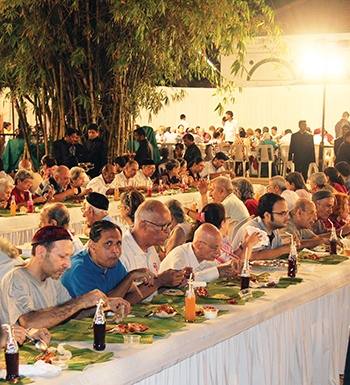
Zoroastrians partaking of a gahanbar meal
In Avestan the appropriate benediction has always been known as Afrin(gan) i gahaNbar. One can check this with Karl Friedrich Geldner’s Avesta whilst perusing the appropriate Yasnas for details. It is gahaNbar in every case.
The characters in book Pahlavi for nun (or waw) and (k)het = N, represented by a vertical stroke, are impossible to confuse with mem = M, looking rather like a 6.
Along came Dastur Firoze Kotwal with his edition of the Pahlavi Shayest ne-shayest. There, he correctly transcribed the Pahlavi as g’s’Nb’l, yet transposed it as gahaMbar in his translation.
Elsewhere I had suggested that a hastily written Gujarati N could, by its upward loop elongation, have yielded an M; thereafter copyists could have made the word to read gahaMbar. Just an idle guess, could one suppose?
It may even be that the perspective shift of gahanbar from its rigorously socio-religious seasonal commensality to a purely social (untimely) phenomenon has resulted in denial of the former and acceptance of the latter. Such are the ways of laxity, ignorance and willfulness.
◆ ◆ ◆
From the archive