
In Memoriam
Comrade Chandra
Died: Perin Romesh Chandra, 96, veteran Communist and peace activist who was general secretary of the All India Students Federation (AISF) and of All India Peace and Solidarity Organisation (AIPSO), on January 7, 2015 in Bombay.
"The greater part of her life was spent in the peace and solidarity movement, working tirelessly to champion the cause of internationalism and third world solidarity with anti-war and pro-peace movements everywhere,” noted a condolence message from the Coalition for Nuclear Disarmament and Peace (CNDP) of which she was a founder member. Whether it was the US occupation of Vietnam, the struggle to free South Africa from apartheid, the Palestinian movement, or agitations in India against communalism and caste discrimination, "Perin worked very actively with CNDP, particularly in our schools outreach program, to raise awareness about nuclear disarmament among young students.”
"The greater part of her life was spent in the peace and solidarity movement, working tirelessly to champion the cause of internationalism and third world solidarity with anti-war and pro-peace movements everywhere,” noted a condolence message from the Coalition for Nuclear Disarmament and Peace (CNDP) of which she was a founder member. Whether it was the US occupation of Vietnam, the struggle to free South Africa from apartheid, the Palestinian movement, or agitations in India against communalism and caste discrimination, "Perin worked very actively with CNDP, particularly in our schools outreach program, to raise awareness about nuclear disarmament among young students.”
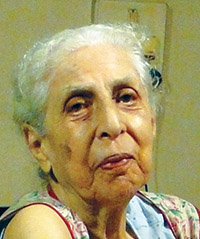
Perin Chandra: passionately pro-peace
Chandra being a member of the national council of the Communist Party of India (CPI), and a founder and all India general secretary of the Party’s student wing, the AISF, the central secretariat paid its "most respectful homage” to the Comrade, as noted a communiqué from the general secretary S. Sudhakar Reddy. "She dedicated her life for the progressive and people’s movements. Like Bhikaiji Cama she was a socialist throughout her life… Perin needs to be honored by the Parsi community for her life committed towards the oppressed people of India and the world,” fellow Communist Kobad Ghandy who is presently detained in Tihar Jail sent Parsiana a tribute he had penned for the lady.
"As a student leader Perin was very stern and known to be a hard taskmaster. She did not hesitate to severely reprimand those who wasted time gossiping in the coffee house,” recalls Primla Loomba, vice president of the national Federation of Indian Women. When Loomba was an undergraduate at Lahore’s Kinnaird College, Perin was already a Communist leader motivating a small band of young ladies to select mohallas and bastis where they could work amongst women to raise their political consciousness and draw them into the freedom struggle. She further remembered Perin’s "passionate, anti-imperialist speeches which were nevertheless simple enough for the people to relate to” and the Communists’ appreciation of art and culture "not only as a weapon of struggle but also to draw inspiration and strength and to develop a vision of life and work.”
"Perin was like an elder sister to a host of activists in various fields,” reminisced A. B. Bardhan, former general secretary of the CPI in The Indian Express of January 13, 2015. He referred to the period post World War II when the colonial chain started to break and newly independent countries began to emerge. "The imperialists tried to thwart this development. Armed conflicts loomed over the horizon. The Vietnam War was the most vicious and prolonged. Against this background, the AIPSO sprang up. It required the organizational ability of capable leaders and Perin was a natural choice. For several decades she worked as its general secretary. In the course of the job, she displayed diplomatic flair in dealing with the ambassadors and leaders of many countries.”
In the context of Chandra being assigned different responsibilities post Independence, Loomba wrote, "I have heard it being said that a person of Perin’s caliber and capacity to work was wasted by putting her on the Peace front.” At a time when the CPI was banned and several comrades, including Chandra, imprisoned in Arthur Road Jail for a total 14 months, her spirited role was brought back to public memory by The Times of India of January 19, 2015. Chanting "Yeh azaadi jhoothi hai (this is a false victory),” the women showed their strength. Being political prisoners they were allowed to cook their own food. Saving on their supplies of red chilli powder, on the day the inspector of jails visited them, the ladies greeted him with a lal salaam (red salute) with the chilli powder hitherto concealed in paper cones in their bras being flung at him! "As ringleader, Perin was punished with three months’ solitary confinement during which she was not allowed to speak to anyone and given no reading or writing material. She told her family she had to use every ounce of will power to stay sane,” reported the Times, adding that a scene in Ketan Mehta’s Mirch Masala where actor Smita Patil and women workers throw red chilli powder at the subedar, actor Naseeruddin Shah, was inspired by Chandra’s protest.
In the 1940s, both Perin and her husband Romesh Chandra devoted their lives to the Left movement and stayed in a simple commune with several other illustrious Communists. Although temporarily dislocated during the Partition, they migrated to Bombay from Lahore and then to Delhi. With both the parents being on meagre wages, son Feroze who is a freelance journalist assumes the Party must have financed his education whilst sister Shobha was brought up by her maternal grandparents. Shobha currently works for a major retail outlet in the UK.
Born in Chaman (undivided Punjab), Perin’s father Col Phiroze Bharucha was a surgeon general in Lahore (see "Braving the Battles,” Parsiana, March 21, 2015) and mother Pilloo had started the blood bank. Perin was the eldest of three daughters. Drawn to the freedom struggle as a teenager, she joined the women’s wing of the Congress and was subsequently influenced by Marxist ideology. She wore khadi saris to college and became one of the finest debaters at Punjab University where she met Romesh, the son of an Indian Civil Service officer whom she married in 1942. Romesh subsequently became chairman of the World Peace Council.
The socialist’s "contribution to the peace movement was priceless,” summed up Kamal Chenoy who appreciated that she "took us all under her wing (and) when Perin thought she could not contribute anymore and that younger activists should take over, she gracefully stepped down.”
Describing her as "an important figure in the peace movement,” Dr Zuhal Okuyan of Baris Dernegi, the Peace Association of Turkey added, "May her struggle and deeds lead us during these days where world peace and struggle against imperialism is mostly needed.”
Being an atheist, she wanted no after death prayers or ceremonies. In keeping with her wishes, her family donated her body to the Grant Medical College where her father had studied.
The champion of communists is survived by her husband Romesh, daughter Shobha, son Feroze, and sisters Roshan Christensen and Rodabeh DeSouza.
Researched by Mehroo Kotval
◆ ◆ ◆
From the archive