
Bawa Musings
The early libertarians
Like semi ripe mangoes, the sweet sour tales of Navsari are worth savoring
A 100 years ago, Navsari (a town in Western Gujarat) was pristine pure Parsi. Though orthodox and proper (an interfaith marriage, even 50 years ago, was as sensational as a bank dacoity), its many mohollas (localities), also called vads (streets) housed some of the most colorful and vibrant characters. Mumbai (yes, much before Balasaheb Thackeray, they referred to it as Mumbai, not Bombay) was a different planet — its inhabitants might be richer and cleverer, but were not to be envied. Some of these tales may sound fictional but we can swear on our sudreh and affirm that they are true to the smallest detail.
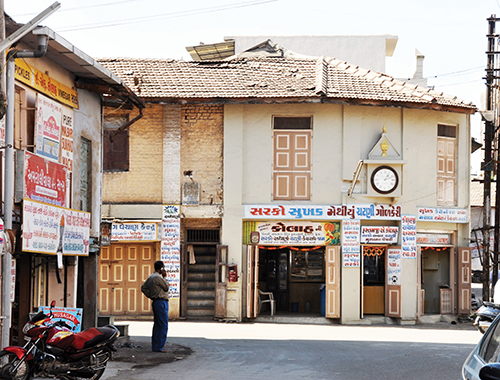
A Parsi vad in Navsari
.JPG)
Kusti-weaving, a source of income
Desai Vad, the moholla in which our ancestors were born and died, was quite a stuffy place. Revenue officials and rent collectors for the Gaikwads of Baroda (who also ruled Navsari), they relinquished their original surname — Seervai — for the government position they enjoyed. Until 50 years ago, the order of protocol in Navsari gave a pride of place, at weddings and other formal socioreligious functions, to the Vada Dasturji from the venerable Meherjirana family; and thereafter to the Vada Desaiji (not a hereditary position, but appointed by consensus) from the first of the three Desai family branches — pompously called "Sarkaar” — its most illustrious member, Khurshedji Desai, having built the Navsari Atash Behram. So the Desais had more than a bee in their bonnet (something like: "I am Lord Nathaniel Curzon; a very superior person”). In this conservative ghetto of Desai Vad there resided a bachelor popularly called Muncherji Derki (meaning a small female frog). Derki must have been well provided for, since he did not work a single day of his long life. Every morning, immaculately dressed in starched dagli and pugree (Parsi coat and cap), he would saunter to the Navsari railway station and board the train to Surat, an hour’s journey, in the second class (in those days, trains had three classes). Alighting at the Surat station, he would walk in measured steps to a tiny shop and have his shoes polished. The man would lavishly spread the Cherry Blossom black boot polish from a small round tin having a picture of a grinning monkey. Shoes shining, Derki would board the next available train to Navsari. He followed this routine religiously for over three decades. However, Derki does not find pride of place in this column for this eccentricity. As soon as he would enter his spacious Navsari house, where he stayed alone, he would discard all his clothes. Even during the freezing Navsari winters Derki never wore a garment inside his house and was not too fussy about using curtains or closing the many windows through which generations of children returning from school would peep at this first authentic Parsi nudist. The despairing Desai elders could not do much about Derki who was otherwise an exemplary neighbor and a thorough gentleman. Our father had told us the reason why he had been christened Derki, but that cannot be shared in a respectable journal like this publication.
In those days — and on a much lesser scale even today — ladies supplemented their income by weaving kustis. Many a kitchen fire was fuelled on the strength of making kustis and selling them to Zoroastrians all over the world. Rusi, a bachelor residing in Baria Vad, hit upon the brilliant idea of getting the non-Parsi ladies serving as domestics in Parsi households to weave kustis. Like a mini cottage industry, half a dozen of these chattering ladies produced kustis faster than their Parsi counterparts, without much regard to the religious tarikats (observances) to be followed. Rusi sold these kustis at a massive discount, nearly ruining the market. A delegation of enraged Parsi ladies (which included one of our grandmothers) knocked on Rusi’s door to admonish him. After much shouting, Rusi held the door slightly ajar and told the shocked ladies that there was nothing illegal or irreligious in non-Parsi ladies weaving the kusti. (Had he done this today, like the Russian navar aspirant in Sanjan, he would have been given a severe drubbing.) Thereupon, one of the ladies demanded that Rusi permit them to enter his house and discuss the matter. Rusi simply replied: "I am a devout Zoroastrian and always wear my sudreh and kusti; but that is all I am wearing now.” The delegation dispersed in disgust. This episode occurred before World War I, which makes Rusi a man ahead of his times.
Another outstanding character was a gentleman named Vakil, a sort of mofussil lawyer; suave, sweet and a bit of a smoothie. His principal client was a rich Parsi widow many years his senior, and the Navsari grapevine had it that their relationship was not only that of lawyer and client. Vakil soon lost interest in his ageing client, who consequently accused him of stealing a Chinese lamp. The charge was found to be baseless and Vakil counter-sued for defamation. The great Sir Pherozeshah Mehta would come down from Bombay, along with a large pot containing drinking water (a sensible precaution) and stay in a bungalow called "Dhadaka no bungalow” at Lunsikui. Mehta appeared pro bono for Vakil and, of course, won the case. Within weeks of the judgment Vakil had reconciled with his old client, but the "Lamp Case,” as it came to be known, provided much salacious gossip in the dusty by-lanes of Navsari.
Prudish looking towns have their little secrets too. This is borne out by the story of a lady (long deceased) whom we shall call Dina, a very young widow and then a very young grandmother at 46. She resided with her mother in a two-storeyed house, typical in Navsari mohollas. One of our cousins, her neighbor, then a child of eight, was very fond of Dina Aunty who would always treat him to some delicacy or the other prepared by her mother. During summer vacations Dina would require the child to "guard” the house, as she would retire to the second floor to take tabla lessons from a youngish Gujarati ‘master,’ as he was called. Dina and the tabla master would descend from the second floor, ostensibly enthralled by their musical sojourn, and reward their little guard with a paavli (a 25 paise coin, enough to buy snacks plus a Kolah ice-cream). One day our little cousin asked Dina Aunty why he could hear the tabla being played for only the first 15 minutes. Without losing her composure, the witty Dina replied that Masterji would first physically demonstrate a tabla lesson and the rest of the time would be spent by lecturing her on the nuances of the raga, laya and taal. When Osho (then known as Bhagwan Shree Rajneesh) first came on the scene, Dina became one of his disciples in Navsari.
And the final tale, at least for today’s column (if the editor consents to print further tales) is quite touching. A certain Ms P, then young and attractive and known for her Bohemian lifestyle, befriended a much older gentleman of great wealth — Mr K, who was already married. The pair would meet at K’s sprawling residence in the unbearably hot Navsari afternoons. One such afternoon, K suffered a massive heart attack — a classic case of too much passion. Ms P had every reason to dress up quickly and slink away from the back door (every Navsari home has one, called paachhlubaar). She did not. Instead, she ran out screaming for someone to save her K’s life, as shocked neighbors gawked at her clothes-less form. Alas, K perished. However, for years after that most men silently admired the integrity of this daring lady, whilst dunking large batasa biscuits in small glasses containing milky mint tea.
Berjis M. Desai, managing partner of J. Sagar Associates, advocates and solicitors, is a writer and community activist.
◆ ◆ ◆
From the archive