
Navsari Tales
How orthodox was Navsari?
1957. A pretty Parsi girl contracted a civil marriage with Morarji Desai’s nephew. For those who came in late, Desai was then chief minister of Bombay State. He was greatly detested by the community for his prohibition policy which brought ruin to the Daruwalas, Toddywalas and Pithawalas. The girl’s mother, a widow at 27 with four children, resided in her father’s home at Navsari, taught at a local school and was a life-long Theosophist. She was asked by the school to leave immediately. A Parsi gentleman, from a hard core priestly traditionalist family, who witnessed the marriage registration, was severely reprimanded. Within a span of five years, all was forgiven and forgotten.
1965. A high priest attended Indian classical music concerts, sat in the front row and expressed his ecstasy with loud wah wahs when the singer reached a crescendo. He hummed a thumri (light romantic Indian classical music) by Gauhar Jaan on his way to the Atash Behram, confabulated with sadhus and fakirs about tantra; romanced his equally unorthodox wife, and was a liberal if not a libertarian. The Anjuman squirmed and shook its head in dismay. He enjoyed his full tenure of nearly half a century. Although he was highly learned and a polymath, orthodox history ignored his role.
1965. A high priest attended Indian classical music concerts, sat in the front row and expressed his ecstasy with loud wah wahs when the singer reached a crescendo. He hummed a thumri (light romantic Indian classical music) by Gauhar Jaan on his way to the Atash Behram, confabulated with sadhus and fakirs about tantra; romanced his equally unorthodox wife, and was a liberal if not a libertarian. The Anjuman squirmed and shook its head in dismay. He enjoyed his full tenure of nearly half a century. Although he was highly learned and a polymath, orthodox history ignored his role.
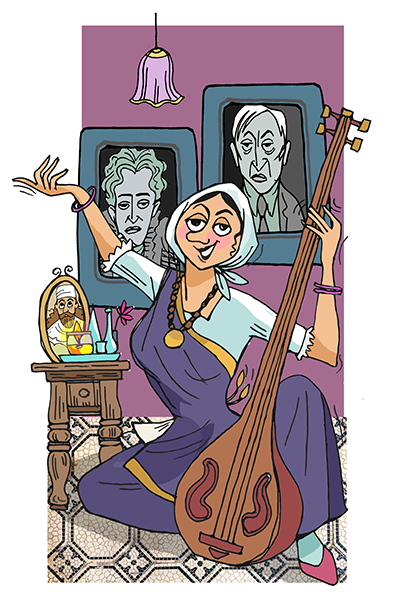
Illustration by Farzana Cooper
1970. A principal of the local girls’ school who was in a live-in relationship with a male teacher from the school organized Meher Baba bhajans every Friday at their residence located in one of the snootiest vads and cocked a snook at Navsari traditionalists. Disgusting, said the elders, but just looked the other way. The bhajans continued merrily.
1950. Two spinsters left Navsari to settle in the Pondicherry Ashram of the sage Sri Aurobindo and his French disciple who was called the Mother. Gradually, the extended family too became adherents of the sage whose large portrait was garlanded alongside that of Zarathushtra. The sisters visited Navsari occasionally and nonchalantly merged into the milieu. They once invited their sister-in-law from Navsari to visit the Ashram and expressed a desire to enjoy some traditional Parsi delicacies. The visitor promptly obliged, only to be told later that she ought not to spend so much of her time in the kitchen instead of meditating and reading the books written by the divine couple.
In a rare display of daring entrepreneurship, a Parsi bachelor in Navsari undercut the market for kustis by purchasing many jantars (weaving looms) and employing half a dozen Adivasi women to weave kustis in the privacy of his residence. He was oblivious to the odium heaped upon him. When a delegation of enraged Parsi ladies went to rebuke him, he dispersed them by appearing before them donning only the sudreh.
A young widow, in the late 60s, who loved her music and the juddin music teacher with equal fervor, became the prime disciple of Bhagwan Shree Rajneesh alias Osho and organized the first of his provocative lectures at Lunsikui. She encouraged many Parsis to follow the libertarian guru who would later shock even the West with his antics.
Despite being in close proximity to the majestic Atash Behram and the four agiaries, few Parsi ladies were regular in visiting or praying there on a daily basis. On the other hand, extra-religious worship was endemic. Amulets for protection acquired from visiting fakirs are called taawiz and from temple poojaris, maadalyu. A black charcoal mark was made on the cheeks of fair complexioned children to thwart buri najar or the evil eye; black beads were fastened on their tiny wrists. A lemon tied to chillies was moved around pretty heads and then flung onto the streets in the belief that bad luck would be transferred to the wretch who stepped upon it. Pregnant women were made to sleep throughout an eclipse. Few stepped out on Kalichoudas, the night before Diwali, as it was widely believed that the tantriks performed unmentionable rites at the burning pyres and evil forces were propitiated to obtain boons.
Navsari Parsis had great faith in a generation of Lal Vaids, self-taught doctors dressed fully in red, who administered potions made out of some questionable substances. Within a week of a child’s birth, the grandmother would rush to Hareshwar Joshi, the royal astrologer in the court of the Gaekwads, and ask him to prepare a janam chitthi (basic horoscope); and after the navjote, a detailed horoscope called tapko [bucho navjote ni péhla tapki gayo, tau no tapko (no detailed horoscope required if the child should die before his navjote)!].
Even orthodox Parsis of Navsari were greatly impressed by Dr Annie Besant, a follower of Madam Blavatsky who founded the Theosophical Society. Besant turned vegetarian and a teetotaler. Many teachings of the Masters (evolved beings) of universal love and open temple doors were not exactly pleasing to the fundamentalist sections. Dastur Khurshed Dabu, a very pious and learned priest from Navsari, was a tremendous influencer and many followed him into Theosophy.
Unlike the Parsis who had migrated to Bombay and were insulated in baugs and colonies, Navsari Parsis interacted constantly with non-Parsis, particularly the Gujaratis, resulting in Hindu rites and customs creeping into the Parsi way of life. Navsari, called dharam ni tékdi, a bastion of conservatism and doctrinal purity, was not therefore as orthodox as it was projected to be.
Berjis Desai, author of Oh! Those Parsis and The Bawaji, occasionally practices law.
◆ ◆ ◆
One reader wrote
Request to increase font size or give us option to do same.
From the archive