
Zoroastrians Abroad
Attendance for Armistice
At the National Service of Remembrance, seven additional faiths were invited to honor soldiers who lost their lives in war
For the first time Zoroastrians were invited to participate in the National Service of Remembrance at the Cenotaph in London on Armistice Day, November 11, 2018. This year being the centenary of Armistice Day that marked the end of World War I (WWI), representatives of seven additional faith and belief groups — Zoroastrians, Coptic Christians, Jains, Baha’is, Humanists, Spiritualists, Mormons – joined in the Service to commemorate British and Commonwealth soldiers who died in the War and later conflicts.
Hereafter they will be included alongside the 15 faith and belief denominations, like Christianity and its various offshoots, Judaism, Islam, Hinduism, Buddhism and Sikhism, that have traditionally been represented at the ceremony when Queen Elizabeth II followed by other political and religious leaders lay wreaths at the Cenotaph.
Hereafter they will be included alongside the 15 faith and belief denominations, like Christianity and its various offshoots, Judaism, Islam, Hinduism, Buddhism and Sikhism, that have traditionally been represented at the ceremony when Queen Elizabeth II followed by other political and religious leaders lay wreaths at the Cenotaph.
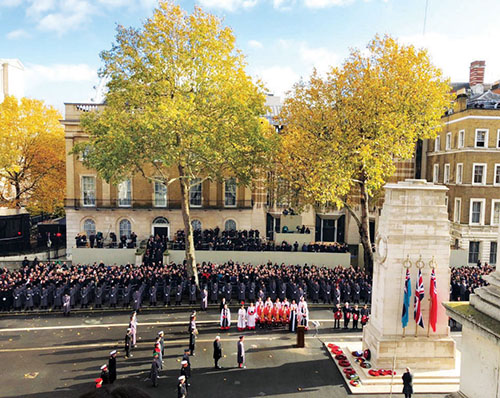
Ceremony at the Cenotaph
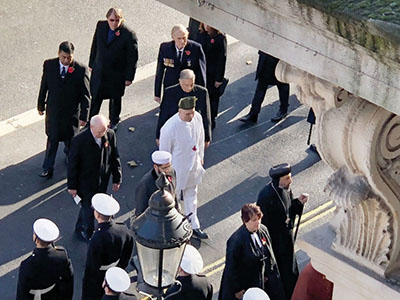
Malcolm Deboo (in pugree) representing Zoroastrians
The inclusion of the seven new groups in "this country’s greatest Service to remember and honor the heroes of our past (makes) the National Service of Remembrance more reflective of modern Britain… (and) the significant but little known contribution made by minority ethnic communities to Britain’s war efforts. It also sends a strong signal throughout Britain and the world that this country values the contribution of its diverse communities,” notes the Government website, www.gov.uk.
The minister for faith Lord Bourne of Aberystwyth was quoted on the website, "One hundred years ago, men and women of all faiths and beliefs made huge sacrifices for our freedom in WWI. It’s absolutely right as a modern, multifaith society that we step up our efforts to honor those people of other faiths for their contribution. It’s because of their bravery and selflessness that we are afforded the privileges and luxuries we enjoy today. Their sacrifices should be honored through the ages.”
Each of the seven new groups earned a brief introduction on the website. For Zoroastrians, it was explained, "The contribution of the Zoroastrian community to Britain’s war effort greatly exceeds their small size. There have been notable Zoroastrian servicemen in both World Wars and the Falklands conflict, including Col Phirozshah Byramji Bharucha of the 14th Ferozepore Sikhs who was the first Indian to be awarded the Distinguished Service Order. The loss of the lives of Zoroastrian servicemen in WWI also came at great cost to the faith which relies on the male line to continue the faith, from which it never fully recovered.”
"For a tiny faith community, the Zoroastrians have punched well above their weight and contributed immensely to Britain in both World Wars. At the outbreak of WWI, thousands volunteered from Britain and India to serve as soldiers and doctors and many were decorated for their bravery and sacrifice. Sadly, many also lost their lives and a Zoroastrian War Memorial was erected in their memory in South Bombay in 1926 where they are remembered annually,” stated Malcolm Deboo, president of the Zoroastrian Trust Funds of Europe (ZTFE). Zoroastrians donated large sums for the war effort, and their properties, including hospitals in India and houses in Britain were used to treat the wounded, he added.
Representing the Zoroastrian community at the National Service of Remembrance along with Lord Karan Bilimoria of Chelsea, Deboo noted that ZTFE was able to make "a successful breakthrough after over two decades of lobbying” and could achieve its "objective in getting recognition for our community serving our nation in both World Wars.” He gave credit to Bilimoria for "constantly creating awareness of our role at every opportunity, whether in the House of Lords debates or outside.”
A week prior to Armistice Day 100 when members of the Lords, including a former Chief of Defence Staff and international relations experts debated the centenary of the Armistice in the House of Lords on November 5, Bilimoria remarked, "Today the British Asians make up the largest ethnic-minority community in the UK. This is an opportunity for the whole nation to recognize, appreciate and thank these individuals. That would strengthen the wonderful multicultural, pluralist, tolerant nation which Britain has become — a Britain that celebrates its diversity. This ethnic-minority contribution is the greatest strength of this tiny country, no longer with the empire it had during WWI but still the fifth largest economy in the world.
"One of my earliest childhood memories was walking into our Zoroastrian Parsi fire temple in Hyderabad and seeing a portrait of an army officer. I have since realized that officer was Capt Firoz Bapuji Chinoy who served in the British Army Medical Corps during WWI and died in Iran in 1918… Another Parsi medical officer Capt Hiraji Cursetji was awarded the Distinguished Service Order for his bravery during the final stages of the campaign in Mesopotamia, now Iraq.”
Cursetji’s citation states, "Throughout the operations he displayed the greatest zeal and disregard for danger while tending the wounded under heavy fire, working unceasingly for 48 hours. He has previously rendered excellent service and once was severely wounded.” He retired as major general from the Indian Medical Service.
"Except for the medical officers, the 1.5 million Indians who served in WWI were not allowed to become officers; and it was only after WWI that the British allowed from 1922 to 1932 eight Indians per course at Sandhurst to become officers. They were called King’s commissioned officers and my grandfather Brig Noshire Bilimoria was one of them,” continued Karan, reminding his fellow Lords that "some 74,000 Indian soldiers were killed on the battlefields of Europe, Africa and the Middle East but the part they played in the war has largely been whitewashed from history.”
At the Remembrance Service on November 11 at 11 a.m. hymns were sung, prayers said, two-minute silence observed, and wreaths laid on the steps at the Cenotaph before war veterans marched past as a gesture of respect for their fallen comrades.
There were a series of memorial events throughout the day where Zoroastrians were represented. In the afternoon Bilimoria, ZTFE honorary secretary Rohinton Munshi, resident priest at the Zoroastrian Centre Ervad Yazad Bhadha, and Deboo participated in a service of thanksgiving and prayers for peace at Southwark Cathedral. In the evening Deboo attended yet another national service of thanksgiving at Westminster Abbey.
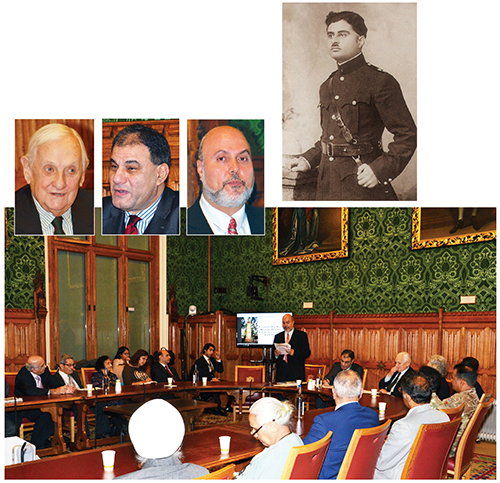
Above: At the Zoroastrian All Party Parliamentary Group meeting in the House of Lords;
inset (from l) Field Marshal Sir John Chapple, Lord Karan Bilimoria, Deboo Photos: Raj Bakrania;
top: Capt Firoz Chinoy
Whilst Bilimoria and Deboo were invited to the Cenotaph, Munshi and ZTFE trustee Rusi Dalal represented Zoroastrians at the Harrow Council Service of Remembrance at the War Memorial, Harrow Town Hall.
ZTFE had also opted to participate in "A Nation’s Thank You” including the bell ringing at places of worship across the UK to echo the actions of British citizens 100 years earlier. Bhadha recited the Stum no Kardo (prayer for the souls of the deceased) invoking the names of Zoroastrians inscribed on the War Memorial at Khareghat Colony and performed a thanksgiving maachi to mark the centenary of Armistice.
The annual general meeting of the Zoroastrian All Party Parliamentary Group in the House of Lords on December 3, 2018 too commemorated Zoroastrians and Indians in WWI when Field Marshal Sir John Chapple, accompanied by Lady Annabel Chapple, graced the occasion as did other political dignitaries and members of the armed forces. Considered a leading authority on Indians in WWI, Chapple mentioned in his talk that when his grandfather as a pilot in the newly formed RAF (Royal Air Force) in WWI received a bullet injury in his testicle, he was brought to Basra, and later shipped to Bombay where he was treated at The B. D. Petit Parsee General Hospital which was commandeered during WWI. He further referred to his own long standing relationship with India which started when he was the commanding officer of the British 1st Battalion, 2nd Gurkha Rifles regiment, where he met Karan’s father Faridoon who was commanding the Indian Gurkha regiment. Both families retained a close bond with Chapple serving as the second chairman of the Cobra Foundation, Lt Gen Faridoon being the founder chair.
Deboo who took the opportunity to share with the audience the speech that he had earlier made at the 11th World Zoroastrian Congress in Perth (see "Image and bridge building,” Parsiana, August 21, 2018) expressed his gratitude to the UK Government, Lord Bourne, and Lord Aston, under secretary of state for digital, culture, media and sport, for all their cooperation.
◆ ◆ ◆
From the archive