
Coping with change
An archaic election system restricts voter participation in the Iranian Zoroastrian Anjuman activities
As Navroz is a day when Irani families visit one another, the IZA’s Jamshedi Navroz functions are not held on March 21, the New Year day, but on one of the 11 days that comprise the spring festival, observes Gaiv. As there is no census of Irani Zoroastrians (they are clubbed with Parsis in the Government of India census), the trustees estimate there should be around 3,000 to 4,000 in Bombay, Dahanu and surrounding areas. These include those Iranis who live partly abroad and in India. "Many Iranis have dual citizenship,” says Gaiv.
Several migrated to Iran during the regime of Mohammad Reza Shah Pahlavi but when the Iranian revolution occurred in 1979 with the return of the dictatorial Ayatollah Ruhollah Khomeini, most either migrated to the West or came back to India. Some had sold off their properties, restaurants, bakeries in India and therefore had nothing to look forward to. "They are now repenting,” says Khodadad. "The largest number migrated” to North America. "Even today Zoroastrians are migrating to Canada,” opines Sarosh.
Khodadad estimates there are at present around 20 to 25 Irani run restaurants in Bombay and around 40 bakeries. His family runs Wibs, one of the leading bread manufacturers in the city. The 72-page IZA souvenir and annual report for 2012-13carried amongst others around 19 advertisements from restaurants (Jimmy Boy, Lord Irwin, Café Mondegar, Café Military, Café General, Café Universal, Roshan, New Rezashah, Britannia, Hotel Atithi, Right Place, Mocambo, Café New York, Lucky, Byculla, Cecil Hotel, Chung-Fa, Leopold) and 14 bakeries (Wibs, Bimbo, Ahura, Super,Yezdani, Daryush, City, Irani Bakery, Daily Bread-N-Foods, Merwan’s, Deli Fresh, Agnee, Roshan, Spenta). Some establishments are both eateries and bakeries.
Other businesses include builders (Rustomjee), ice factories (Chirag), distillers (Meher), florists (Afreen), poultry (Zorabian, Bombay Poultry), pharmacy (Byculla, Farmacross), clearing and forwarding (Sky Shipping, Combi Ocean Lines), logistics (Kainaz Associates, Venus), Meron (security), importers and exporters (Handdekor), internet (Chit Chat Net), wine shop (Peekay), glass (Adaro), caterers (Cheron), stores (Britannia), garment export (Bell Russ), silver plating (Tirandaz) and professionals (actor Boman Irani).
The number of cafes and bakeries has lessened as also Iranis in agriculture. "The young crowd prefers to go into other businesses or professions,” says Gaiv.
The annual report shows the total income of the IZA to be Rs 53,99,103 (US $ 87,082) with around Rs 36,00,000 being given for education, medical, poverty amelioration and donation to "other institutions.”Around 64% of the income (Rs 34,66,473) is derived from investments and 26% (Rs 14,05,852) from agricultural income from the vast Palghar lands.
The 963-acre plot which propelled the Anjuman into the public limelight and jettisoned the proposed sale to Viva Builders Private Limited is still a sore point with the trustees. "The idea was to sell the land and use the money” for the charitable objects of the trust, says Khodadad.
"We gave advertisements in all the Indian papers. Everything was very transparent. Everyone came to know about it,” explains Gaiv. "With the exposure given I was expecting a boom” in responses, confesses Khodadad. But "even people who made offers did not bid,” says Sarosh. The highest offer received was from Viva for Rs 723 crores (around US $116,612,670) or Rs 75,00,000 an acre. "The second highest offer was 42,00,000 per acre,” adds Sarosh. He notes people suggested the land be given to the Tatas or Godrejs for redevelopment. "But Tatas never gave an offer and Godrejs wanted a joint venture but did not want to pay any advance.”
The 999-year leased land is classified as "grassland” and to obtain a non-agricultural (NA) certification would entail "a very high cost. It goes into crores” of rupees and entails considerable work, says Khodadad. "We wanted the developer to do everything,” states Gaiv.
After the outcry over the proposed sale and the allegation that Viva Builders had ties with the notorious Bhai Thakur, Viva opted out, noting "we have 10,000 acres. We don’t need” your property. "You all have made us out as criminals,” Gaiv quoted the upset party.
There is a concern that the Oil and Natural Gas Corporation (ONGC), a public sector undertaking may acquire the land. ONGC has "given notice to the Charity Commissioner not to do anything (with the land) until they give their consent,” points out Khodadad. As regards the compensation of four times the official registered selling price which the government has to pay when acquiring land, the trustees note that in agricultural land sales only 20 to 25% is paid officially; the rest is cash. "No one pays the full amount by cheque,” says Khodadad. Thus "the last recorded” price on the registers would show a low value, possibly resulting in the government paying less than the true market value for the acquired land.
At present the contract for cutting the grass growing on the land is given to "a reliable” contractor who also safeguards the property, says Khodadad. But due to the paucity of agricultural labor in Dahanu district and the consequent higher wages, there are not many offers for the grass and the income has declined from Rs 24 lakhs (US $ 38,710) to around 18 to 20 lakhs (US$ 29,032 to 32,258). Chikoos are cultivated on around 12 acres and yield a return of around Rs 1,50,000 per annum, says Khodadad.
Despite the Iranis numbering much less than the estimated 60,000 Parsis in India, they have eight trustees and 44 General Committee (GC) members from whom 29 are elected to the Working Committee (WC). In contrast the Bombay Parsi Punchayet (BPP) has only seven trustees. The IZA trustees meet "any time” as required and in between the files are circulated. The WC meets around once a month, the GC meets "when required.” The WC and GC comprise "a cross section of the entire Irani community,” reveals Sarosh. A clause permitting Iranis to donate Rs 25,000 (now raised to a phenomenal one crore rupees) to obtain a seat and/or nominate a person on the WC and GC has been further amended with the WC/GC having to approve the suitability of the applicant!
Attendance at the WC and GC meetings however is low and sometimes even getting a quorum is difficult. Sarosh mentions the apathy in the community and how difficult it is to even convince relatives to register as voters.
"Gender bias”
The IZA election scheme is archaic. Voter registration is permitted only three months prior to the election. The voter registration list is in shambles with only around 374 voters listed with addresses and 846 without. The total list of 1,220 includes the names of many deceased members. The trustees are in a quandary how to correct these anomalies. The rules permit women to vote but not stand for election. They can however be co-opted and at present Jasmine Bastani serves on the board.
Earlier money was sent to Iran to financially assist the Zoroastrians there. "That is why we have representatives from the cities/villages (there are 18 representatives from 28 towns) on the WC and GC,” explains Gaiv. That may also explain two of the curious and especially outdated clauses in the IZA "Miscellaneous powers and provisions” which state, "the changes in the memorandum will not differ from the regulations in Iran” and matters of the "Anjuman with other anjumans formed outside Iran will take place after informing the relative department in Iran.”
Following Iranian laws based on Islam would be in direct conflict with the secular nature of the laws in India and the Indian constitution. Gaiv feels the particular clause refers to following Iranian regulations when remitting money from India to Iran. This today is problematic with the monetary and other sanctions imposed on Iran because of its nuclear development program and support to terrorist groups.
The rules barring women from contesting the elections have resulted in a suit filed on September 26, 2014 before the Deputy Charity Commissioner (DCC) by Benafshay Irani, erstwhile IZA president Mehrwan’s wife, against the IZA. She claims the clauses restricting the right of women to contest are "ultra vires the constitution of India,” display "gender bias” and "discriminate against women.” Benafshay alleges the co-opting of Bastani was "a premeditated act… to show the empowerment of women…when the rules” do not permit such co-option. She also objected to the advertisements pertaining to holding of the elections being printed in Gujarati papers as "70 % of the Irani community do not subscribe to the papers.”
Benafshay asked the DCC to "issue instructions…to allow the applicant to contest the elections.” An attempt to get the DCC to postpone the elections was turned down on the grounds the DCC did not have the powers to do so, Benafshay informed Parsiana at the election venue. An attempt to get the police to stop the elections by other disgruntled elements failed after the trustees put up stiff resistance and complained to the Azad Maidan police station (see "Excitement at IZA elections,” Events and Personalities, Parsiana, October 7, 2014).
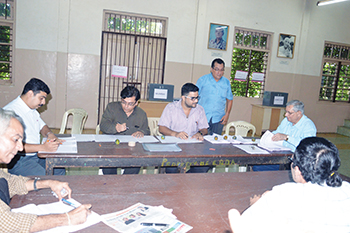
The total voter turnout for the September 28 election day was a meager 204. To ensure impartiality in the process, the BPP staff was roped in to check voter identification and counting of ballots was under the watchful eye of the presiding officer Farokh Shokri, one of the partners of Kyani Restaurant.
In his Written Statement (WS) on behalf of IZA, Gaiv replied the advertisements were placed in the Jam-e-Jamshed and the Mumbai Samachar as per the provisions of the Memorandum of Association and Rules and that "all Irani Zoroastrians” read these papers. Further, the notices were published in English. The WS notes the rules "clearly make provisions that only male members are required to contest the election.” Gaiv also states the IZA rules allow for co-option of women and that Benafshay herself had been co-opted once.
The trustees state an effort had been made to allow women to stand for election but the proposal was turned down by the GC. They plead their hands are tied. The other trustees are Dara Devlaliwalla, Parvez Irani, Hemavand Namderian and Viraf Irani. Keki Kanga is the secretary and treasurer.
Around five years ago when Parsiana made inquiries about the elections the then president Mehrwan refused to divulge any details and instructed his co-trustees and committee members not to talk to Parsiana. But at the September 28, 2014 trusteeship elections Mehrwan, no longer a trustee and at loggerheads with his erstwhile colleagues over the sale of the Palghar land, invited Parsiana to cover the event!
Khodadad has no hesitation in talking about the IZA and is quite as ease with the Press. At the elections when he and others invited the Parsiana representative to partake of the lunch ordered for the office bearers, he jovially observed there were no strings attached. However having partaken of the sandwiches offered to all present, the thoughtful offer was declined by Parsiana.
Mehrwan initially favored the land sale to Viva but subsequently had a rethink and the issue came to the fore at the January 2013 Federation of the Parsi Zoroastrian Anjumans of India meet in Bombay with a heated discussion between Mehrwan on one side and Khodadad and committee member Parvez Irani on the other (see "Line of control,” Parsiana, February 7, 2013).
Overnight the reclusive body, whose origins can be traced back to 1941, was in the limelight with front page and other write-ups in the general Press.
But despite the bitterness that resulted in an appeal before the DCC, there was a fair amount of bonhomie among the disparate gathering at the elections.
Allowing that most Iranis are related, perhaps this is not so surprising.