
Institutions
A repository of knowledge
The Vice President of India Mohammad Hamid Ansari visits the K. R. Cama Oriental Institute
Aside from providing copies of one’s passport, PAN (permanent account number) card and photographs, the K. R. Cama Oriental Institute (KRCOI) trustees also had to provide a letter stating the Parsiana representative who was to cover the visit of the Vice President of India Mohammad Hamid Ansari to the center on February 2, 2015 "was not a terrorist.” At the venue the invitees had to pass two sets of security personnel, the first finding Parsiana’s name on the list but not the second. After some confabulation, the matter was sorted out and admission granted.
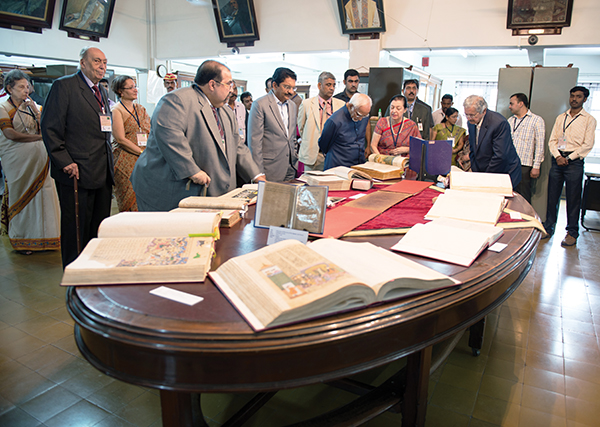
At the KRCOI library trustee Homai Modi explaining text to Mohammed Hamid Ansari.
Ext l: KRCOI trustee Nawaz Mody, Eddy Khambata, Shehernaz Nalwalla and Muncherji Cama
(Photo: Devki Dhuldhoya)
Two days prior the meticulous chairman of the KRCOI Muncherji Cama had called all those invited to a "rehearsal” to discuss the questions that could be raised in the 25-minute window they would have with Ansari who would be accompanied by the governor of Maharashtra, Chennamaneni Vidyasagar Rao and the Maharashtra minister for industries Subhash Desai. The VVIPs would arrive at the Institute set up 99 years ago in memory of the renowned Oriental scholar and social reformer Kharshedjee Rustomji Cama at 4.20 p.m. They would proceed upstairs to the library to view the manuscripts and talk with the trustees. At 4.40 they would descend and at 5.05 depart, leaving a window of 25 minutes for discussion with the invitees. Men were preferably to be attired in suits and the women in saris. For the occasion Muncherji, a gourmet, had ordered high calorie, delectable snacks from reputed chef Shireen Adenwalla.
Ansari strode briskly into the ground floor Sir J. J. Modi Memorial Hall to meet the scholars and others at 4.43 pm. A former chancellor of Aligarh University and current chancellor of Punjab University, he was very comfortable in the academic surrounding, answering the questions put to him with consummate ease and speed.
When informed by Muncherji that there were 26,000 rare books in various languages and nearly 2,000 manuscripts in Avesta, Pahlavi, Zend and Persian at the KRCOI that are used more by the foreign scholars than the domestic ones, Ansari noted that this is "not a good commentary on our interest in these matters… India is a repository of innumerable civilizations… (It) is a treasure house of not just manuscripts or books but also ideas and traditions.” He added however, "As a people we have neglected some of our old treasures. Old manuscripts have not been given the attention they deserve. The world is very proud of our past and they know what is available in India.”
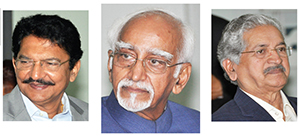
(L to R): Chennamaneni Vidyasagar Rao, Ansari and Subhash Desai
The scholars informed the Vice President of their areas of interest and the difficulties they faced. Any request for funding would be "a difficult idea to sell to government,” cautioned the Vice President. "We need to go beyond government for funding.” He believed more people should come forward to finance studies and that there was a "need to raise awareness” about the benefits of research.
To a question regarding the neglect of the study of Persian and a shortage of people well versed with the language to translate texts, Ansari stated that "at least for 800 years (Persian) was the language spoken in a good part of India. You will not be able to access records without a knowledge of Persian. It was the official language. Subsequently Hindi became the language.”
When the role of teachers was raised by one of the participants, Ansari described a teacher "as a friend, philosopher and guide… A teacher tells you where to look” to locate sources that would otherwise be difficult to find.
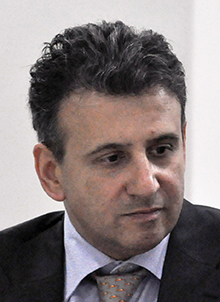
Sir Dinshaw Petit
Parsiana wished to raise a question about the dismal working conditions for scholars at the Maharashtra state archives library in Elphinstone College. Scholars have complained about the inadequate lighting on the ground floor of the archives where the old newspapers are stored on shelves; sometimes the vintage newspapers are dropped from the top shelves to the floor instead of being carefully handled; the bathrooms are dismal and not always functional and there is no soap.
But the issue could not be raised as Muncherji, a stickler for punctuality, noted the time had elapsed and as Ansari pointed out the traffic outside had been held up awaiting his departure.
◆ ◆ ◆
From the archive