
Heritage
Conservation’s changing technologies
INTACH director Anupam Sah conducted a conservation workshop at the K. R. Cama Oriental Institute to share knowledge with other institutions
A funds crunch, a building in need of repair, dwindling support from an aging community, vociferous criticism of their policies. The trustees of the K. R. Cama Oriental Institute (KRCOI) have trumped them all. No less an authority than the renowned INTACH-ICCI — the Indian National Trust for Art and Cultural Heritage with the Indian Council of Conservation Institutes — is providing the expertise for restoring and preserving its 2,000 Persian, Arabic, Pahlavi manuscripts, most of them in the 400+ year age group. The Holy Name Cathedral is currently the only other institution in Bombay chosen by INTACH to share its expertise.
The year long project — that’s as far as the resources may stretch — began last August. By mid December 2003 folios had been individually treated in an in-house laboratory established in the rear of the Library in five days. Hence it was the Library’s responsibility to prioritize items for preservation which increased their workload, as noted Anupam Sah, director (projects), INTACH-ICCI. The expert was impressed that "all books and manuscripts were precisely documented. It made it so easy to access them, even for conservation.” The KRCOI team "knew the importance of each item,” Sah told Parsiana, though the contents of all the manuscripts are not known. Since it is important to know the content and significance of each manuscript Sah said people from the recently launched National Mission for Manuscripts (NMM) would be available to plug the lacuna.
Launched by the Prime Minister in August 2003, the NMM is a five-year exercise commissioned under the Government of India department of culture to search, document and conserve India’s lost manuscripts — a kind of manuscripts census. Institutions with collections of manuscripts are expected to do likewise, create conservation laboratories and share financial and technical support so that these treasures can be digitized and stored on microfilm, Sah informed the audience.
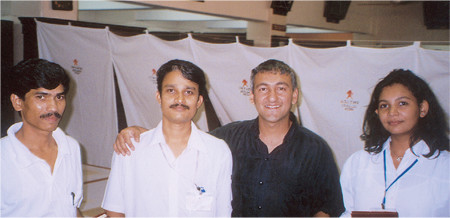
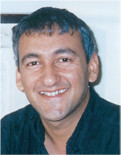
Sah (top) and (above) with his team at KRCOI (L to R) Subhas Chandra Baral, Anant Shelke and Madhura Joshi
That such a small institution can look after its collection "shows the community’s concern for things of intrinsic value... It reflects on how you look after these memories of human progress,” Sah expressed his appreciation. January 2004 was expected to be devoted to treating the KRCOI’s "extremely valuable collection of illustrated Shahnamehs, worth thousands of pounds sterling, according to Sah.
Having benefited from INTACH expertise, the KRCOI decided to share the favor with other institutions and libraries in Bombay and Poona. Over a dozen librarians from schools, colleges, museums and institutions like the Bombay University and the Tata Archives accepted the invitation from KRCOI trustee and honorary secretary Homai Modi to participate in a full day workshop to learn "inexpensive methods of preserving and maintaining their libraries and collections” at the Sir J. J. Modi Memorial Hall on December 12, 2003.
Established in 1984, INTACH works to preserve three grades of heritage — material heritage which includes manuscripts, books, paintings, works of art and all variety of artifacts; architectural heritage and natural heritage which encompasses the environment. It also has an active communications wing.
Introducing the audience to the work of INTACH-ICCI, Sah noted that their work had begun with small projects. The INTACH laboratory in Bhubaneshwar, Orissa initially concentrated on palm leaf manuscripts. Their emphasis has been on using their own personnel to train local people. They then expanded to the preservation of murals in temples ("you touched the plaster and whole blocks of painting fell down”), and metals conservation to restore and maintain old armories. Simultaneously the Trust has been training traditional crafts people to attain a high minimum standard of work. It has been a time-consuming process, involving much commonsense and a lot of personal attention and care, notes Sah, adding that their goal was to make it "accessible to everybody.”
Instead of supinely accepting western standards, INTACH has been researching indigenous materials and techniques to suit local environmental conditions. Four-month-long training programs are conducted by INTACH in Bhubaneshwar where the participants come from various countries of South and Southeast Asia. Being experienced professionals — they have included staff from national museums in Sri Lanka, Indonesia and other countries — their participation provides for much interactive discourse and mutual enrichment. The accent is on training them to pass on the expertise to other members of their respective teams as well as to people with their own private collections so that they can maintain their possessions in better shape.
Sah emphasizes that conservation is an evolving discipline which requires its votaries to keep up to date with techniques and ethics around the world. In Indian villages, people prefer to drown broken statues rather than restore them, is an example of how ethical issues differ in different countries, he notes.
In the effort to revive mural painting traditions in a village in Orissa adopted by INTACH, it has evolved six types of lime plasters and mortars. Traditional craftsmen whose skill was dying out have been revived and for the first time ever women have come forward to do these paintings, said Sah. Lauding "the media’s important role in our activities,” Sah added that the publicity led to the provision of facilities to the village like roads, primary and high schools, electricity and water. INTACH has trained a new generation of manuscript writers and "millions of old manuscripts are being rewritten round the country.”
The question-answer session and the actual workshop where the participants learnt to first identify the cause of deterioration and then to suggest ways of treating the specimen were an "exercise in sensitivity building.” The frequent condition of old books is the deteriorating spine, broken and brittle pages, where the suspects could be the quality of the glue, the highly acidic machine-made paper which "will continue to degrade... Where the paper was made also has a bearing because different areas have different qualities of water,” says Sah. Sunlight/ultra violet light, the quality of ink, the practice of dog-earing, all contribute to the decay. Well-intentioned repair itself becomes a source of future trouble, egged on by climatic conditions like Bombay’s humidity which adds fungus to a librarian’s woes, breeds microbes, leads to the sticking and wrinkling of pages. In illustrated manuscripts certain paints burn the paper. Certain shades of green are suspect. As for insects, according to Sah, silverfish and termites don’t make deep holes, cockroaches are untidy eaters. They make a lot of mess.
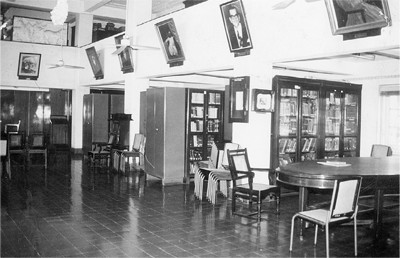
The KRCOI library
When asked how long the 400+ year INTACH treated manuscripts of the KRCOI will endure, Sah noted that conservation treatment "arrests the damage but does not ensure that the object will survive for hundreds of years.” He used the metaphor of mosquito nets to prevent the onset of malaria and chloroquine tablets to cure the patient. People who look after the collection need to do basic things like regularly inspect and clean them, just as one maintains special clothes to pass on to one’s grandchildren.
The first step is to be aware of what the collected items are. The second step is to recognize the symptoms of deterioration. Careful storage is so important, there is a course available on the subject with UNESCO in Lucknow. It is imperative to maintain the building housing the collection as dust is enemy number one, carrying fungus spores and iron. Dust attracts moisture and moisture attracts dust. Collections are also best maintained away from light for light leads to photochemical degradation as well other aspects and cycles of microbial life. Fumigation is a popular means of fighting insect attacks but its efficacy depends on the variety of insect and the stage of its lifecycle. It works only on the live organism, so insect attack one week after fumigation is normal. Besides unnecessary fumigation can harm the documents.
DDT, once so commonly and liberally used, is banned today, yet is still used. Sah suggested that the chemical be brushed off palm leaf manuscripts and wooden objects and vacuumed out. Then "throw away the paper bag,” he cautioned. Among the Nizam’s collection in Hyderabad conservators had found mushrooms growing on books. They had to be removed with scalpels and vacuumed. Some people use chemical solutions to clean the mess but the stains may not go and bleaching can destroy objects, he noted.
One popular method of preserving documents was lamination, but it is an irreversible process and will eventually get brittle. The better option according to Sah is encapsulating them page-by-page between black paper in plastic. "Never keep sheets directly in plastic because moisture forms within. Also, all plastics release acid... Cover books with brown paper, not plastic... especially not in Bombay,” he cautioned.
Different types of paper are used for conservation. The Japanese tissue for interleaving is available from the Asiatic Society, but one can make acid free paper for the purpose by dipping it in diluted limewater and leaving it to dry, said Sah. As for the comparative storage value of steel and wooden cupboards, well-seasoned old wood acts as a buffer against temperature changes, but if infected, could put the entire collection at risk. Maps need to be checked and cleaned regularly to prevent fungus infection, he added.
Photographic transparencies are prone to attack from silverfish (which "love the gelatine which coats one side of the transparency”) and fungus which thrives on darkness and enclosed spaces. Sah suggested that they be opened to light and air in a dust free environment. The fungus can be removed but the quality of the transparency suffers.
Sah addressed the relative merits of CD Roms and microfilms in the preservation of intellectual heritage. CDs are very good for transfer and transportation purposes as well as for dissemination and retrieval of material "but one scratch and your information goes.” Though the manufacturers claim a lifespan of 50 to 100 years, this is yet to be proved. It is a delicate technology, easily corrupted in storage. "You need backups, need to allow for resources to cope with changes in technology... Duplication becomes an integral part of the process if you have a CD library.” However if it is newspaper storage in question, digitization is meaningful as newspapers are highly acidic.
As for microfilming, the documentation could "turn to vinegar” as microfilms are cellulose acetate based. They need a dry environment and need to be opened and unspooled every four to five months. They are "also highly explosive.” For preservation on microfilm, archival quality microfilms are needed.
Speaking to Parsiana at the end of the workshop Sah narrated the experience of the Saundariya Vigyan Kendra when the entire library was flooded in Hyderabad. The books were all retrieved by hiring a cold storage for a year and freezing them. Thereafter a thermal vacuum driven machine was used to sublimate the ice to vapor.
Sah said he was a 13-year-old studying in class VIII in Naini Tal when he read an article on the Rome based Central Institute of Restoration in an old magazine. He wrote to them. They answered his questions. "I wanted to study everything — the humanities, microbiology, physics... This profession allowed me to deal with all these disciplines. In addition, I can work in the field with my own hands!” After graduating in science he got his masters in art conservation from Delhi’s National Museum Institute, the first such course in India. When he returned in 1995 after further specialization at the International University of Art, Florence, INTACH director Dr O. P. Agarwal welcomed him into the fold.
"To discover a new horizon you have to lose sight of the shore,” Sah notes in the idiom of the sailor. "There is so much work to do, it’s awe-inspiring. There’s a tremendous shortage of people. It is a very fragmented profession. Unless we bring our energies together, the profession cannot do justice to the work that needs to be done.”
New blood is energizing the Indian Association for the Study of Conservation of Cultural Property. Hitherto lacking in sufficient interaction and communication, a team building strategy is at work at two levels — to train hundreds in preventive conservation and simultaneously to train hundreds of traditional craftsmen to enhance their skills. "We need solid people and systems in place plus the right attitude. Then the world is your playing field!”
A Directory of Conservation Architects in India that Sah had alluded to, was formally announced by INTACH vice chairman S. K. Misra in Delhi, notes a report in The Indian Express (April 12, 2004). With names, areas of specialization, addresses, contact numbers, the Directory will be available free to the public by the year end, notes the Express.
In the meanwhile, as KRCOI chairman Muncherji N. Cama told the assembled librarians in his welcome address, "Leave here wiser and more capable of serving our various libraries more efficiently.”
◆ ◆ ◆
From the archive