
Zoroastrians Abroad
Passion and perception
"I bring students to problems that need analytic solutions or need creativity, or even what we might call practical intelligence. I like allowing them to linger in the uncomfortable space that requires confronting their own limits. I like providing them with the discovery that collaboration can solve many hard problems. Above all, I set standards for learning that are higher than they could have imagined for themselves.” Dr Mahzarin Banaji’s comments were included on the harvard.edu website on her recently being conferred the honor of "Harvard College Professor,” a five-year appointment that recognizes the "passion” she brings to the classroom to inspire her students. "It’s the opportunity to learn from faculty like these, that makes the Harvard College experience so unique,” remarked Michael Smith, dean of the Faculty of Arts and Sciences (FAS). Currently 58-year-old Banaji is Richard Clarke Cabot Professor of Social Ethics in the Department of Psychology at Harvard University plus senior advisor to the Dean of FAS on faculty development.
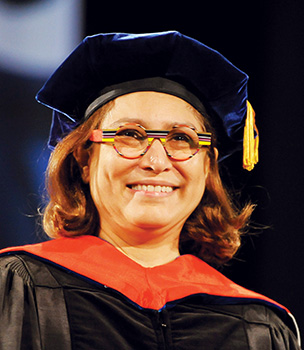
Dr Mahzarin Banaji: "be fairer to those around us"
Whilst acknowledging the role of the Internet and other new technologies to democratize the learning process, Banaji believes they will never totally supplant the hands-on personal teaching of the classroom. Enjoying her time with students inside and outside the classroom, Banaji remarked, "Some of my teaching has involved working with individual freshmen in independent study and watching their neurons pop as they consider some ideas for the first time. Some of my teaching involves working closely with more seasoned undergraduates, and teaching them about the nuts and bolts of understanding how minds work, using the methods of experimental psychology.”
Entitled to a semester of paid leave or summer salary, Banaji is considering devoting some time to her research on how the mind perceives the self, and another part to developing an online course or teaching module, aiming to understand the nature of talent and how we recognize it.
Yet another recognition conferred on this social scientist in May 2014 was the Barnard College’s Medal of Distinction. The citation hailed her as a "social psychologist, celebrated researcher, esteemed Harvard University professor. We recognize the face of brilliance in you.” The citation further summarized her intellectual progress from a five-year-old who taught those junior to her at her mother’s school at home, graduated in liberal arts from the Nizam College in Hyderabad, in general psychology from the Jawaharlal Nehru University in Delhi, a PhD from the Ohio State, postdoctoral work at the University of Washington, 15 years at Yale, and since 2002 at Harvard "to continue your revolutionary work and your undeniable influence on scores of students, mentoring undergraduates and young women in science.” This Medal, felt Banaji, placed her in a privileged league "especially because of the other amazing people who were recognized alongside: Patti Smith, the rock star, Cecilia Richards, the head of Planned Parenthood, and Ursula Burns, the chief executive officer of Xerox.”
Last year, her book Blindspot: Hidden Biases of Good People, co-authored with Anthony Greenwald, won encouraging reviews for being "written with simplicity and verve” to help the reader think smarter and more humanely. The book further questions "the extent to which our perceptions of social groups — without our awareness or conscious control — shape our likes and dislikes and our judgments about people’s character, abilities and potential… By gaining awareness we can adapt beliefs and behavior and ‘outsmart the machine’ in our heads so we can be fairer to those around us.” The Implicit Association Test (IAT), which over the last decade must have measured the hidden associations of millions of people, was jointly developed by Banaji, Greenwald and Brian Nosek.
As she conveyed to Parsiana, "It is of interest to me that work to understand human minds we did as basic research with no application in mind, ended up being of such interest to a broad group of people who saw its application to the worlds of business, education, medicine, law, etc. It speaks to the value of basic research which needs to be pursued and supported irrespective of what it may deliver. Funding agencies, listen up!” As she further explained, when her research that began in the early 1990s became well known "the demand on my time to give lectures rose exponentially and I was unable to oblige given my commitments to research and teaching on campus. That’s when we decided to write a popular book that could serve to communicate the message.” Yet another book that she co-authored last year was Navigating the social world: What infants, children and other species can teach us.
For her foray into academics, Banaji realizes she needs to give credit to "my father Rustom Banaji for having taught me the delights of the printed page; my mother Coomi, and my cousin Visty Banaji (who lives in Bombay) for nudging me in the direction of higher learning when I was resistant; my feminist husband Bhaskar (a Tamilian) who made many choices in our lives as a couple that favored my intellectual growth.” They chose not to have children because Banaji feels fulfilled interacting with 400 of them on campus.
In an interview with Parsiana a decade ago (see "How rational are we?” August 2004), Banaji had expressed, "I know of no other major religion that closes its doors to individuals who might wish to enter. I find this attitude to be just as offensive as religions at the other extreme, i.e. those that proselytize. My own sense is that the solution lies in the broadest ‘giving away’ of the religion and ethnic practices to anybody interested enough, for any reason, in adopting them.”
Besides winning scholarships and grants from different institutions, she has been elected Fellow of several prestigious organizations like the American Psychological Society, American Psychological Association, Society for Personality and Social Psychology, Rockefeller Foundation, American Association for the Advancement of Science, Japanese Society for the Promotion of Science… After serving as George A. and Helen Dunham Cowan Chair in Human Dynamics at the Santa Fe Institute from 2011-2014, Banaji is currently on the Institute’s external faculty.
When Parsiana was in correspondence with her in November, Banaji was busy preparing the Kopf Lecture on Neuroethics at the Society for Neuroscience when she was told there would be 9,000 in the audience!
With her academic diary for 2015 already getting filled in, among her many engagements outside of Harvard will be the Distinguished Scholar Lecture under the auspices of the Minnesota Psychological Association, the Johnson Lecture at Macalester College and the keynote address at the Japanese Psychological Association.
◆ ◆ ◆
From the archive