
Cover Story
Negotiator of cultures
Harvard University Professor Homi Bhabha is among the world's most prominent figures in post-colonial studies and cultural theory
"First thing in the morning as I was dressing in my state room, I would hear through the bulkhead my Parsee Dubash jabbering about the Patna with the steward, while he drank a cup of tea, by favor, in the pantry,” wrote Joseph Conrad in Lord Jim (1968).
Post-colonial theorist and Harvard professor Homi Bhabha explains that Conrad’s portrayal of the Parsi on board the Patna ship, represents how non-Parsis commonly viewed the community at the time — the Parsi is well-informed, bringing the latest news on board for the passengers. As his name Dubash (do-basha) suggests, he is someone who can speak two languages, parleying with the Europeans and Indians. And most importantly he sits over a cup of tea, a beverage much loved by the community. Interestingly one notices similarities between Conrad’s Parsee Dubash and Bhabha himself. While being interviewed by Parsiana, on a visit to Bombay, he sipped his morning chai, [regretting it lacked fudina (mint)] and spoke of his keenness for Bombay gossip. His mother’s maiden name was Dubash, and who better than her son as negotiator of cultures!
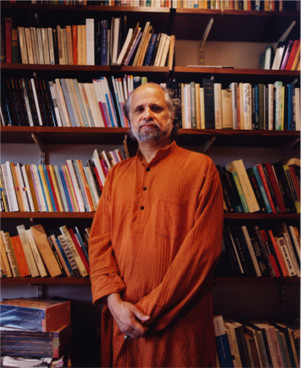
Bhabha:"Parsis have no problem with cultural mixing.”
Currently holding the title of Anne F. Rothenberg Professor of English and American Literature at Harvard, 52-year-old Bhabha "is one of the world’s most prominent and influential figures in the fields of post-colonial studies and cultural theory,” says Lawrence Buell, chair of the Department of English and American Literature at Harvard. "We view the appointment of Prof Bhabha as having a University-wide significance in strengthening humanistic inquiry in the areas of cultural migration, globalization and human rights.” Bhabha’s two books Nation and Narration (edited with introduction and essay, 1990) and The Location of Culture (1994) are considered seminal texts in the fields of literary theory and cultural criticism. Says Nobel Prize winner Toni Morrison, "Bhabha is one of that small group occupying the front ranks of literary and cultural theoretical thought. Any serious discussion of post-colonial/postmodern scholarship is inconceivable without referencing Bhabha.”
How do his theories then apply to the Parsi minority? Bhabha states that as compared to other minorities, say Jewish and Black, the Parsis are a largely unpersecuted group. We haven’t been burdened with historical and institutionalized marginalization like the former. That’s not to say that everyday prejudices, like not being considered "Indian enough” do not exist, but they are of a milder nature. Bhabha recounts an incident when he wrote an article on Indian contemporary literature for a publication. An eminent Indian poet then wrote to the editor saying, not so boldly but to the effect, that Bhabha, being a Parsi, didn’t quite have what it to takes to comment on the subject. But by and large Bhabha feels Parsis don’t really have to fight a stereotype.
When asked to comment on authors who having left their home country still write about it as if they were native informants, Bhabha notes that he’s "not a great fan of the authenticity argument.” He says that one doesn’t have to experience everything himself before he can write about it. What is the creative imagination of an artist for then? He elaborates that writers have written with great insight and clarity about events that happened hundreds of years before they were born. What is needed is a real sympathy and a genuine interest in the society one wishes to write about. "In my view authenticity is less about the origins of the writing impulse and more about the effect you can produce by the writing.”
Bhabha informs us that the idea of cultural authenticity and tradition is basically a 19th century discovery. In the 1800s and 1900s the ‘past’ became very important for the nation-building and conquering west. It was by referring to and celebrating their own glorious past that the colonizers justified their great and expanding empires. For the colonized, like the Parsis on the other hand, the 19th century was a period more of cultural assimilation rather than a cultural revival. Bhabha says we cannot really point to any great Parsi literature or art or music in this period but the relative vacuum worked to an advantage. "It opened them (the Parsis) up as cosmopolitans and global thinkers,” Bhabha remarks. The fine balance between an acute sense of individuality and the ability to innovate and absorb from other cultures is a result of this vacuum. This, coupled with the fact that Parsis were not hampered with a caste system, made their experiences as colonial subjects different from those faced by other Indian communities.
Bhabha mentions that there are three aspects of Parsi culture which he has found to be extremely helpful and productive. Firstly, "Parsis have no problem with cultural mixing and cultural hybridization. They are very open to the best in other cultures and very creative in translating what is best in other cultures for their own community and for their own individual lives... while refusing to have anything imposed on them.” Secondly "In the traditions of the Parsis I know there is a deep sense of secular tolerance. The experience of hybridization (as a creative courageous way of living) creates a sense of tolerance and powerful liberal values.” And thirdly, "Parsis have a fine and subtle sense of tact in both personal and public matters which allows them to be very effective without being arrogant or overbearing. This is a fine principle of coexistence in a country as diversified as India.”
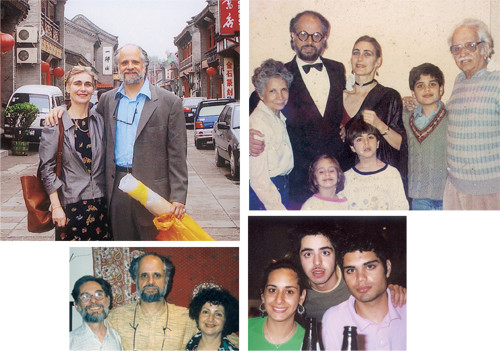
Clockwise from top left: Jacqueline and Homi Bhabha in China; Naju, Homi, Jacqueline, Ishan, Khurshedji, Leah and Satya (in front); Ishan, Satya and Leah; Maneck, Homi and Sorab Bhabha
Bhabha illustrates with an example from Rohinton Mistry’s novel Such a Long Journey. The practical behavior of the protagonist of the novel includes all three of these aspects in perfect harmony — To protect the wall that separates his courtyard from the street Gustad Noble strikes a deal with an itinerant artist. The wall, which was used as a urinal, is transformed into a religious mural that becomes a public shrine. "That’s a perfect Parsi solution,” Bhabha exclaims. This ingenious solution best illustrates the shrewd, intelligent and strategic conduct adopted by the Parsi minority in order to coexist. Noble’s is not a closed life — he is happy to have a mural of various Gods (whom he also respects) covering his street wall. He has participated in making Bombay ecologically beautiful. The overpowering stench that existed when the wall was being used as a latrine does not remain. And it is the ideal solution for the street artist who benefits from the offerings made to this new shrine. Bhabha emphasizes that this kind of characteristic practicality of the Parsis "is a virtue.”
However Bhabha cautions that the Parsis he refers to in these cultural aspects are the ones he knows and has known. Others of orthodox thinking may not side with his analysis. He says, "Let’s not be naive. Historical truth is always a struggle...Who are your historians who establish for the community the authentic history of the Parsis?” Our arrival in Gujarat, the relationships we nurtured, the adoption of certain Hindu rituals, the "everyday life and survival which is a glorious testimony to the Parsi past should be given as much attention as it possibly can, at a time when in religions all over the world those who are orthodox want to assert their dogmatic authority.”
Sukhad and loban were a part of daily life in Bhabha’s formative years. Ingredients that sweetened his "blessed childhood” included visits to his grandmother Dinbai Dubash’s home on Nepean Sea Road, attending Adi Marazban nataks (plays) on Navroz and Pateti, in which his mother Naju acted for several years, spending time with his relatives Nadir and Hilla Dinshaw and their daughter Nali from Karachi and feasting on falooda and pattice from Star Bakery. With the Bakery’s closing down "one of the great culinary institutions has died,” regrets Bhabha. His childhood was spent with his parents Naju and Khurshedji and siblings Maneck and Sorab at their Cuffe Parade home. Though Bhabha schooled at St Mary’s, Byculla much of his education especially his love for English litera-ture was inculcated by his mother at home. They read the English classics, modern poetry, that both seduced and fascinated them. Bhabha says in regard to modern poetry that it’s "good to read something that you don’t fully understand” since it eventually expands your view. His father, Khurshed, was a lawyer under whom Fali Nariman and Soli Sorabjee trained. When his parents suggested furthering his education in London, Bhabha’s love for Bombay made him decline the offer. He preferred graduating from Elphinstone College. It was here that stalwarts like Kamal Wood, Mehroo Jussawalla and Homai Shroff nurtured his love and understanding of the language. An MA, MPhil and DPhil from Oxford followed his years at Elphinstone.
Chair of the Program in History and Literature at Harvard University, and visiting professor in the Humanities at University College, London, Bhabha has also served as faculty advisor for the World Economic Forum. His forthcoming publications include two books — A Global Measure from Harvard University Press and The Right to Narrate from Columbia University Press. He is on the editorial board of Critical Inquiry and October, and is a regular contributor to Artforum. One of the most sought after speakers on the academic lecture circuit he has delivered the Amnesty Rights Lecture at Oxford, the Wellek Library Lectures at the Critical Theory Institute, University of California, Irvine (2001), the inauguration lecture of the Democracy Unrealized platform of Documenta 11 in Berlin (2002), and the Clarendon Lectures at Oxford University. Profiled in such publications as Newsweek which named him one of "100 Americans for the next century,” Chicago magazine, The Chronicle of Higher Education, and the New York Times, his name merits an entry in the new Norton Anthology of Theory and Criticism.
His wife Jacqueline, a lawyer, is executive director of Harvard Law School’s Human Rights Committee. At Oxford, when Bhabha was introduced to Jacqueline, he did not know that theirs was a long and intertwined history. Jacqueline’s parents were German-Jewish refugees who had made the unusual decision to settle in India. Bhabha’s aunt Amy Bhabha was their pediatrician and thus the families were acquainted. When Bhabha and Jacqueline visited Bombay several years later Amy took them to her old consulting room where she had kept a picture of Jacqueline and her brother when they were children.
"Our children are very much the center of our lives,” notes Bhabha. Ishan, 22, completed a degree in government (i.e. political science) from Harvard and having done very well in his law exam, is soon to join the Harvard Law School. Satya, 20, is "absolutely committed to the world of drama.” Studying, acting, directing at Yale, he has traveled to Ireland, Japan and London in theatrical pursuit. His name however, his father explains, is a misnomer, since it is truth (satya) he must distort as an actor. Leah, 16, goes to school outside Boston. She is a budding journalist; her articles appear frequently on the front page of her school newspaper. Leah like her father is interested in family stories and Bombay gossip. All three children, like their mother, are serious musicians. They perform with the Chicago Symphony Youth Orchestra. Bhabha’s sister Maneck is based in London and his brother Sorab is the anchor who stays in Bombay, as does his mother. His ties to Bombay being so strong, Bhabha often visits the city, his schedule cramped with interviews, guest lecturing and other personal and literary appointments. He is happy though that he has not settled in Bombay, otherwise with his love of Parsi food, he could have been 25 kg heavier. Bhabha says he cooks everyday. A wide range of cuisines are made at home including Parsi. He confesses that sometimes his dhansak has only four of the seven required dals, but he gets by.
"Advice,” says Bhabha, he has "little to offer.” It is mainly through experience that one learns. To budding academicians and theorists he explains that the map of the world is always changing and more rapidly in less privileged countries. We tend to be "over impressed and intimidated by what we see as being a canonical center of what is excellent or actually important.” It is those who are marginalized that invest such exaggerated authority in the canon. People should therefore find their own ways and attend to their own independent voices. "Listen deeply to the problem you want to work on. Ask yourself why something bothers you. Dedicate yourself. There must be a real commitment to what bugs you and bothers you and wakes you up in the middle of the night.”
◆ ◆ ◆
From the archive