
Zoroastrians Abroad
How rational are we?
Harvard University Professor Mahzarin Banaji has been researching the genesis of prejudice and its social impact
Mahzarin Banaji sparkles. Her face belies the responsibility of simultaneously holding two endowed professorships at Harvard University — as the Richard Clarke Cabot Professor of Social Ethics in the Department of Psychology and the Carol K. Pforzheimer Professor at the Radcliffe Institute for Advanced Study. Her figure is almost girlish in its contours. Her voice bubbles with enthusiasm for pure research in social psychology, with experiments that demonstrate how personal experience and the ideas that prevail in our social milieu influence decisions and judgments that we fondly but mistakenly believe to be fully rational.
Banaji says that unconscious processes of thought such as stereotyping and prejudice color much of our social judgments so that good human beings inflict harm on others without realizing that they are doing so. "What social psychology has given to an understanding of human nature is the discovery that forces larger than ourselves determine our mental life and our actions — that chief among these forces are our individual learning histories and the power of the social situation.” Banaji says that though this concept is willingly accepted in its abstract form, "It is difficult to see the power of the situation in oneself when the outcome is unpalatable, just as it is difficult to see the influence of any cause that is not immediate.” She blames this inability to accept the responsibility for our own thoughts and behavior on an exaggerated notion of consciousness — the attribute that supposedly distinguishes humans from their animal brethren.

Banaji: "sitting on the intersection of different fields”
There is a difference between thoughts of which we are fully aware and those which are prompted by past experience or family and community history — ideas drilled into our minds over the years, of which we are no longer conscious but which surface in the form of instinctive preferences. Common forms of prejudice are those that lead one to favor individuals belongings to one’s own community or socio-religious-academic background and disfavor those belonging to other groups, resulting in social injustice. The pro-white anti-black racial bias of the western world was demonstrated not only in the history of racial segregation in the southern states of the US. The public response to the website launched by Banaji and fellow psychologists demonstrating the impact of attitudes, beliefs, political preferences, etc, has evinced the deepest interest in demonstrations of race prejudice, she notes. Hence, in addition to current lab and web-based work, she says they have begun collaborations with police departments, lawyers, legal scholars and community activists to make them aware of the not-so-ordinary consequences of the ordinary errors in their social perceptions.
To address the "new American dilemma” — a yearning for fair and equal treatment for all citizens which remains in uneasy partnership with prejudice and discrimination "not only in our history and in our laws, but our minds and brains as well,” Banaji spoke to the west coast judges in San Francisco in July this year. Among them was Sandra Day O’Connor, one of the two women on the bench of US Supreme Court. In the course of a two year sabbatical granted by the Radcliffe Institute, Banaji, who says she is "happiest when sitting on the intersection of different fields — see the commonalities, forge the alliance,” is working to bring together a number of psychologists studying this type of bias with legal scholars to challenge the way the law thinks about human behavior. Other professions on the anvil are doctors, businessmen, educationists. There are disparities in the way the medical and health fraternity treats patients, she says. As for businessmen, "being fair-minded would also be a smart move: it would help you hire the right people!”
The past three to four years have seen two new lines of work for Banaji. Using a technique to image the brain (known as fMRI) the subject, a person under the MRI cylinder, is shown a variety of pictures/words etc which provoke him to think. The machine can measure the blood flow to the two regions of the brain — the older, sub-cortical region which produces intuitive, non-rational responses and the prefrontal brain regions which control conscious thought. The part of the brain that is involved in thinking consumes more blood. This enables the research team to see the origin of actions, see the tension between the sub-cortical and the prefrontal neurons, explains Banaji.
The second innovative field of study is the observation of young children, watch the emergence of bias/prejudice. "The interest in my work is to see how early children show the same biases as adults do and when they begin to use rules of fairness and justice. We are currently doing a study in which young children (ages four-12) see a video of a child (black or white) be rewarded with either one cookie or two cookies. The question is this: Do they (when they have the opportunity) replicate the same behavior or do they adjust to make the outcome more fair? So we give them three cookies and ask them to distribute these to the two children they had previously seen get one or two cookies.” As Banaji’s student Kristina Olson will report at a conference this year, younger children simply do what they see as the pattern of distribution. Older children are more likely to exert norms of fairness, including breaking a third cookie in half to distribute more equally or giving more to those who got less. As Banaji notes, "The hope is of course, to eventually understand these processes sufficiently to develop methods for training children not to replicate the (unjust) patterns of society and to be critical of the way their elders do business!”
The Rockefeller Foundation has offered Banaji a fellowship that entitles her to a month’s stay in August at the Rockefeller Institute at Bellagio in Italy where, on the picturesque shores of Lake Como, the prospect of thinking and writing, undistracted by the banalities of cooking and cleaning, has her in transports of joy!
Not that Harvard has stinted in providing a suitable working environment. Named the William James Hall after the famous psychologist, it consists of a "wonderful” suite of labs and offices on the 15th floor with a view of Cambridge on one side and the Boston skyline on the other, she notes happily. She arrives there around 11 a.m. after about three hours of writing at home, working on to 9 p.m. or until her husband Dr R. Bhaskar, a PhD in computer science with qualifications in law from Yale University who practices computer law, calls to ask if she intends coming home tonight! — a seven-days-a-week routine, she smiles contentedly.
Every week Banaji meets with her students informally. The group, comprising two post-doctorals, six to seven PhD students, 12 undergraduates working on research in the lab and two staff members, gathers over wine and cheese as one of its members presents his/her work while the rest provide the feedback.
There was a time when she strummed the guitar and had even taken lessons in classical renditions. Now, the favorite way to unwind is to sit with close friends, talking and arguing about the world. She is an avid listener of jazz and blues, enjoys cooking up some spicy Indian food and speaks nostalgically of a mango pickle from Hyderabad called toku. Now living in a beautiful area of Cambridge, she finds peace walking around Fresh Pond and in the scenic Mt Auburn Cemetery where a number of famous scholars and writers are buried. With 63 colleges/universities in and around Boston it is "the closest to heaven for a scientist,” she laughs, adding, "Everyone is connected with higher education. It’s a very liberal town, jokingly called ‘The People’s Republic of Cambridge!’”
Though she has been on the mailing list of ZAGBA (Zoroastrian Association of the Greater Boston Area) Banaji says she is not particularly involved with the affairs of the community. Recently however, fellow professor at Harvard Dr Cyrus Mehta got her to meet a group of Zoroastrian students in the Boston area which was "sufficiently fun” for her to organize a meeting for them later this year with Professor Stanley Insler, the renowned Gatha scholar and friend from her earlier 16 years at Yale University. There is every likelihood that this involvement with the community in the area will increase.
On e-mail and a personal interview in Bombay during her brief visit to the city at the end of June to participate in her brother Rukhshad’s wedding, Parsiana sought her opinion as a psychologist whether the declining Parsi population in India was an attitudinal problem and what social psychology may project about the community’s future. Here’s what she had to say: "Attitudes are certainly one place to analyze the phenomenon of Parsi population decline. For reasons that are historical and cultural, Parsis have come to have a particular orientation towards marriage and children (they are not keen on either). Why this attitude exists is not easy to diagnose, but because it is an attitude, or orientation, it is something that can be transformed should the community take a different position than it currently does. What is most intriguing to me is that each Parsi seemingly makes this important decision of marriage and children for herself or himself. Yet, we know that this choice reflects more than an individual’s decision because it appears to reflect an orientation of the social group as a whole. This is a social psychological issue — individuals believing that they are the makers of their destiny, and yet, as social science evidence reveals, group membership subtly but decisively shapes individual preference and decision-making.
"To overcome any problem, the first step is awareness that a problem exists. For those Parsis who choose not to be aware of the data on the rapidly changing demographics of the community, there is nothing to change. So let’s put them aside.
"Among those who recognize the problem there appear to be two main camps. Those who give priority to "blood” as the basis of membership in the group and those who give priority to affect and cognition — that is that knowledge about the group, understanding its religion, laws, culture and practices and adopting them should be the basis of membership. Any argument based on "blood” (can lead) to other dangerous theses such as those prevalent in Nazi Germany and other ethnic cleansings in Europe in this century. Any belief in the superiority of a particular blood line is both ignorant and eventually fatal.
"I know of no other major religion that closes its doors to individuals who might wish to enter. I find this attitude to be just as offensive as religions at the other extreme, i.e. those that proselytize. My own sense is that the solution lies in the broadest ‘giving away’ of the religion and ethnic practices to anybody interested enough, for any reason, in adopting them.”
We ask her for a psychological assessment of the repercussions of continuous controversy and infighting on the community. "Argument is my life blood,” says she. "Healthy argument stretches the mind and creates the cognitive basis for change. But this argument (about intermarriage, who is a Zoroastrian, etc) is not fruitful because the (orthodox/liberal) groups are ideologically so opposed, they will never see eye to eye. When there are no shared assumptions then it’s not debate but bickering — counter productive at best. Maybe a younger generation will decide the outcome when the demise of the Parsi community is nearer at hand, with 50 years to go instead of 100!”
The eldest daughter of Coomi and the late Rustum Banaji, Mahzarin grew up in Secunderabad along with her sister Bella (now married to Bombay-based businessman Nitin Lodha) and brother Rukhshad (now an information technology professional in Pondicherry), living close to the community in the area around the Agiary. She remembers hearing the orthodox-liberal debate, the fights in the audience, since the age of five or six. As she grew up her mind questioned the inherently sexist definition of Zoroastrians as the children of Parsi Zoroastrian fathers. After schooling at St Ann’s Banaji says she was so hooked to the idea of living an independent life, she opted for a secretarial course. Mother Coomi, with the innate wisdom of women who had missed the privilege of a college education but knew its worth, persuaded her daughter to give it a try for just one semester, after which she could decide for herself. Even before the first term at Nizam College, Hyderabad, had ended, life as a secretary had been forgotten. Graduating with English, philosophy and psychology she pursued a masters degree at Osmania University in general psychology with a National Merit Scholar Award.
Dissatisfaction with the approach to the subject at Osmania led Banaji to seek admission to the Jawaharlal Nehru University (JNU) in New Delhi for an MPhil program where she also received a University Grants Commission Fellowship which covered tuition, paid a decent stipend and provided Rs 1,000 annually for the purchase of books. As Banaji described the impact of the JNU in an account of her career to the Guggenheim Foundation, "The campus, even from my short experience of it on the interview day, buzzed with an excitement I had not encountered in my sleepy hometown, and I skipped all the way from New Delhi to Secunderabad and back. JNU, quite simply, blew me away. I took courses for two years in sociology, (while pursuing) history and social science more generally. But it was outside class that a more genuine learning occurred. It was my group of peers, the diversity of whose perspectives and depth of whose intellect opened my mind and sharpened the thoughts that tumbled out...Those two years remain the most dramatically transformative of my life.”
Eventually Banaji joined the Ohio State University in Columbus acquiring her PhD, specializing in social psychology and cognitive and quantitative methods. Here she met the mentors, Professors Anthony Greenwald and Tom Ostrom who had a decisive impact on her academic career, as also her husband. Hours away from accepting a job at a small teaching school in upstate New York, she decided in favor of an assignment as a post doctoral fellow at the University of Washington and, a year thereafter, landed as assistant professor at Yale University where she remained for 16 years, earning the Lex Hixon ’63 Prize for Teaching Excellence and eventually occupying the Reuben Post Halleck Chair as Professor of Psychology. In 2002 Banaji shifted to her present assignment at Harvard. Awards, honors, fellowships, grants (including those from the Bombay Parsi Punchayet and the Tata Endowment which were crucial in enabling her to go to the US) too numerous to mention here have their legitimate place in her bio data.
Fellow of the American Association for the Advancement of Science, of the American Psychological Society, the American Psychological Association and a host of others, Banaji has the publication of so many papers in professional journals, so much administrative work to her credit, one wonders if her greatest asset is not a wizardry in time management. The unasked question is answered in her article for the Guggenheim Foundation where she notes that the visualization and presence of women in science is one of her dearest goals: "I take the role of being a woman in science seriously, even though it often entails accepting administrative positions beyond the call of duty...”
In the course of her study of human behavior as much as in her own life Banaji has found a recurring theme — that "small and seemingly transient events can produce noteworthy effects on social outcome...I have prospered from the amazing minds that make up my most immediate environment...The successes I have enjoyed are deeply a function of the persons and institutions I have encountered.” It was her mother who did not give up on her own dream of seeing her daughter through college; the father, who worked for the Income Tax department but loved western music, especially jazz and classical music, had a broadminded and modern view of the world and enjoyed reading the works of Ernest Hemingway and William Faulkner, all of which influenced Banaji as she grew up; her husband who has placed her mental satisfaction and joy of academic pursuit above any traditional notion of wifely duties. They as well as her professors and students have contributed to her growth, Banaji acknowledges with much love and humility. Nor does she forget the Randelias of Nagpur, her mother’s father and brothers who worked in the Empress Mills. Uncle Homi Randelia, who joined the trade union movement is still active in his chosen field of social welfare though he is now in his 80s, she notes with pride.
It is not people who are good or bad but circumstances which make us so, avers Banaji — an argument that refutes the theory of people being born with particular attributes and blood based notions of superiority. "Americans as a group believe in the ability to control destiny. But be aware that we are not the objective, honest, careful judges we think we are,” she cautions. Fellow psychologists are intrigued with cultures which claim to be able to control thought, so they have invited Buddhist monks and even the Dalai Lama to their labs. This has led to a new collaborative arrangement with the University of Andhra Pradesh where Banaji’s old school friend is teaching yoga. Can yoga practice beat the test that measures uncontrolled reactions? The result will show whether the human mind can be truly disciplined, says Banaji. Having often guessed wrong about the results of tests in the past, she is not hazarding any predictions!
Elavia: enjoying his work
"I never looked at being successful and chasing it, but always wanted to enjoy what I do and do it to the best of (my) ability,” notes Kurus Elavia, chief operating officer (COO) of the New Jersey firm Gateway Security. With over 2,500 employees and nearly $ 40 million sales, the 25-year-old firm founded by Louis Dell Ermo is the state’s number one provider of people solutions, primarily in the security and safety arena, Elavia notes in an email to Parsiana. Its clients include the three New York airports, a number of airlines and finance companies.
Elavia, 38, was selected by njbiz, a New Jersey business publication among its 40 under 40 men and women who have established a record of solid achievement. "Their success at an early age shows how much talent, grit and initiative can accomplish,” notes the magazine (March 1, 2004).
Son of Hilloo and the late Jimmy Elavia, Kurus is an alumnus of Bombay’s Don Bosco High School and Lala Lajpatrai College. While working for his chartered accountancy with a black belt in karate he migrated to the US where he initially sought to teach karate in Ohio. A few months later he moved to New Jersey. He says that the wisdom and discipline he had imbibed from his teacher Vispy Kapadia has always inspired him to do his best.
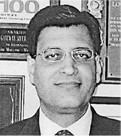
Elavia: "success must ensue”
Elavia also ascribes his success to his wife Purba Pal whom he first encountered on the Internet seven years ago. Though she then lived in California, he says she became his life’s anchor. "We met when I was struggling and she has been there with me through thick and thin... My success is largely due to her support and confidence in me,” writes Elavia. They were married three years ago.
Though Elavia notes candidly that he is "not really” involved with the Zoroastrian community in North America, he believes "it needs to broaden its horizons and accept some realities of interfaith relationships. It will always survive; I don’t know if it will flourish.”
Elavia’s sister Shernaz works for the British foreign office; his brother Farookh is a qualified accountant resident in New Zealand. Each of them has a son — Kayan and Rohan respectively.
Elavia shares with us his philosophy of life: "Success, like happiness, cannot be pursued; it must ensue, and it only does so as the unintended side effect of one’s personal dedication to a cause greater than oneself or as the by-product of one’s surrender to a person other than oneself. Happiness must happen, and the same holds for success: you have to let it happen by not caring about it. Success will follow you precisely because you had forgotten to think about it.”
◆ ◆ ◆
From the archive