
Briefs on the brain
WZCC Day on the eve of the XVI North American Zarathushti Congress offered delegates a blend of new sciences and commerce
"The brain is the seat of all activity, even spiritual... Having barely scratched the surface as yet, we can only fantasize the working of the brain in the next 200 years,” declared Dr Jamshed Bharucha, principal speaker at the evening symposium on "New Sciences and Commerce” organized by the New York Chapter of the World Zarathushti Chamber of Commerce (WZCC) on August 1, 2012, a day prior to the start of the XVI North American Zarathushti Congress (NAZC). Visits to the New York Federal Reserve and Financial District, a meeting of WZCC organizers and leaders of different chapters to share ideas and strategies, a book signing session with "Mr Motivator” Nozer Buchia and a contributory dinner were the other events scheduled for the WZCC Day.
"How the structure of the brain plays into our lives… How we should be leading our lives with special emphasis on Zoroastrianism,” was the prime concern of Bharucha, president of the prestigious educational institute, The Cooper Union for the Advancement of Science and Art. Among the first Zarathushtis to serve as the president of a North American university, prior to his current post Bharucha had worked in academic leadership positions at Dartmouth College and Tufts University. Joining Bharucha on the panel was Ervad Poruz Khambatta who recently graduated from the University of California at Berkeley where he studied cognitive science and served as president of Berkeley’s Cognitive Science Student Association. A member of the Zoroastrian Association of Greater New York, when occasion demands he officiates as a priest for the community.
 Bharucha referred to a recent study requiring MRI mapping of the brain which undergraduates happily participated in so that they could email pictures to their parents as visual proof that they "had brains after all!” While it is known that the brain responds differently when there is active learning as against sitting in at a lecture that is extremely boring, Bharucha has been keen on studying how the brain responds to music.
 There are huge individual differences in brain circuits. The pitch of music is lateralized on the left side. Timing and coordination is controlled by the cerebellum. When there is a change of cords with music keys, it is the prefrontal cortex at work. If music is accompanied by dance and movement, the cortex of the brain does the processing, Bharucha shared his findings.
He referred to "The Mozart Effect” that is believed to make an individual smarter if he/she listens to Mozart. In an experiment he cited, the spatial IQ of a group exposed to Mozart music for 10 minutes showed an elevation as compared to the control group that sat in silence. Morphing the results, the media speculated that playing Mozart music to unborn babies would make them smarter, inspiring the governor of Georgia to distribute CDs to expectant mothers, reported Bharucha.
In another study one group was made to listen to Mozart’s Sonata for Two Pianos in D Major as against another group that heard Mozart decomposed (where they took one note and flattened it out). The experimenters wanted to establish whether the group that heard the correct version showed an improvement in spatial IQ.
To lead a spiritual life it is necessary to align thoughts that cannot easily be controlled. It is the cortex that has the power to align words and deeds with thoughts. There is a constant conflict between reason and emotion. The resolution of conflict, the leading of a spiritual life are all linked to the human brain that is different because of the cortex that internalizes culture, stressed Bharucha.
Brain, which is the center of consciousness, has 100 billion nerves, reminded Khambatta. Weighing around three pounds, it controls our thoughts and desires. It is the left side which controls language and hence damage to this area during a paralytic stroke can greatly impair an individual, he added. Neuroscience, the study of the nervous system, advances the understanding of human thought, emotion and behavior. It observes the development and functioning of the brain, and tries to determine the role of genetics in the functioning of individuals given the same environment.
 Theoretical knowledge that was being shared became more meaningful once the audience started asking questions. Do Indian students have a genetic component that makes them bright in mathematics and science? Responded Bharucha, "We have to be careful about linking genetic traits to nations and communities. There are too many variables. We don’t know enough.” Another query was in connection with many Indians winning the "Spelling Bee” contest where Bharucha reiterated, "I don’t think there is anything unique except the culture,” more so since the English language has "no defined phonetics and is one of the most idiotic languages in terms of weird spellings.”
Would genetics or education have a greater role to play in the growth of an individual? Referring to genetic divergence and environmental influence, Bharucha conveyed that "children of the same parents don’t have the same genes unless they are identical twins... Pressures are different on siblings.” At public schools in US the state finances education for kids up to a certain level. "Develop other skills instead of concentrating on science and math,” he suggested. Khambatta pointed out that math is "taught without consideration of application... Teach them math so that they are engaged with it.”
Is there a genetic predisposition among criminals? This enquiry made Bharucha comment, "We have an insanity defence. Then may come the brain defence” with the defence attorney flashing an MRI of his client’s brain to show that because of the deformity he is helpless.
What triggered the Colorado shooting? Is it easy availability of powerful weapons? As explained, "Throughout history, maximum acts of violence have been committed by males in puberty and in their early twenties... It takes a while for adolescents to understand right from wrong and understand the implications of their actions.” Pointing out that human behavior is "complex and multidetermined,” where a single action could have arisen from several preceding causes, Khambatta felt that those susceptible should be dealt with empathy and taught how to change.
With the Dalai Lama being open to experiments on how the brain reacts to prayer, meditation, chanting, Bharucha was hopeful that new findings will emerge from such studies.
"How can people intrigued with the growth of knowledge move ahead professionally, in academic work or commercial entrepreneurship? What special imports from Zarathushti themes affect the search for knowledge and new science?” These vexing questions raised by WZCC’s New York Chapter and sought to be answered on WZCC Day were carried in the NAZC souvenir. As pointed out Chapter chair Natalie Gandhi, those who get credit for building landmarks should ask themselves, "How much has society helped me to build?”
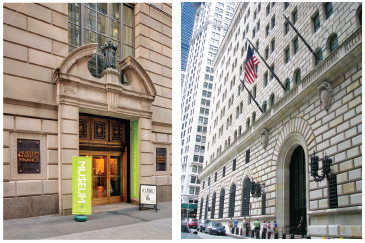 Financial flavor
Although keen to learn about the role of the New York Fed and the wider Federal Reserve System in setting monetary policy, promoting financial stability and serving communities to advance economic growth, the motley WZCC group had to forego a guided tour that would have included an overview of the Federal Reserve System as well as an exclusive visit to the gold vault. By the time the delegates boarded the bus with Subway lunch boxes courtesy The Jamshidian Group and necessary personal documents to gain entry to these high security institutions, it did not leave them with enough commute time to reach The Federal Reserve Bank of New York ahead of the scheduled 12 noon slot assigned to the group.
They had to content themselves with FedWorks that gives visitors an opportunity to learn about the central banking functions of the Federal Reserve System through an interactive multimedia exhibit that allows visitors to participate in a monetary policy simulation and to learn about the Fed’s role in the economy. The WZCC delegation was exposed to drachmas, doubloons and dollars where the history of money in the form of shells, coins and paper currency across the continents is traced with more than 800 exhibits courtesy the exhibition co-sponsor, the American Numismatic Society.
 The second scheduled halt that was given the miss was the Federal Hall National Memorial on Wall Street where George Washington took the oath of office as the first President and the site served as home to the first Congress, Supreme Court and Executive Branch offices. The current structure, a Customs House, served as part of the US sub-treasury before it was converted into a museum and memorial to the first President and the beginnings of the United States of America.
Compensating for the earlier disappointments was a guided tour of the Museum of American Finance showcasing the richness of American financial history and providing the delegates a deeper understanding of financial markets and the nation’s economy. Permanent exhibits on the financial markets, banking, money, Alexander Hamilton and entrepreneurship offered insights into their system of checks and balances, America’s first IPO, financial crimes, credit crisis…
Time projection went awry on the return journey too as the New York traffic was not willing to make way for a busload of Zarathushtis happily bonding and jesting until they returned to Hotel Hilton Westchester, the venue for the evening deliberations where an informal book signing session with Buchia set the tone for the subsequent discussion on the impact of new fields of cognitive psychology, the human brain, collective action... that are poised on the threshold of new discovery. An internationally acclaimed author of revelatory books like Why Entrepreneurs Really Fail, The Road to Success...Always under Construction, the entrepreneur-speaker’s passionate pleas are known to empower people to pursue their goals.