
Awards
Dhanvantari dream
For his contribution to the field of gynecology for over six decades, Dr Rustom Soonawala has been honored with medicine’s “most coveted award”
"As a recognition of your unending and unremitting contribution to gynecology and innate gentleness, humility and professional demeanor, it is our proud privilege to present to you the 42nd Dhanvantari Award,” read the citation accompanying the honor presented to Dr Rustom Soonawala at the hands of the governor of Maharashtra Ch Vidyasagar Rao at the Crystal Room of the Taj Mahal Palace on November 16, 2014.
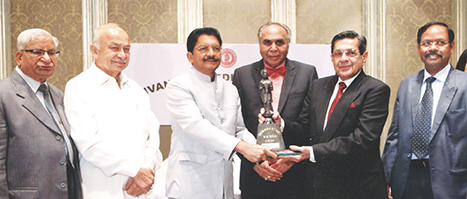
(Below from left): Dr Jivraj Shah, Sushilkumar Shinde, Ch Vidyasagar Rao, Dr B. K. Goyal,
Dr Rustom Soonawala and Dr Arun Jamkar
Describing 86-year-old Soonawala as "a genius with several surgical instruments named after him,” the founder president of the 43-year-old Dhanvantari Medical Foundation (DMF) Dr B. K. Goyal mentioned that their association promotes networking among practitioners of different systems of medicine. Each year they select one or two recipients to be conferred "the most coveted award of the medical profession in our country,” noted a write-up by Goyal in the souvenir published on the occasion. When addressing the audience, Goyal, a cardiologist, declared that "70% of all ailments will be cured even if you don’t approach a medical practitioner.” With doctors liberally prescribing third generation antibiotics for ailments that can be treated by common remedies, he referred to his annual endeavors to create a common pharmacopeia for common ailments.
"When I started my gynecology profession in 1956, there was nothing but a stethoscope and fetoscope (a funnel shaped instrument to listen to the foetus’ heartbeat)… I won’t be surprised if in another five years doctors become redundant and the whole scene is managed by robots,” declared Soonawala when accepting the Dhanvantari Award. The senior gynecologist who was honored with the award that he had been "dreaming of…for the last 10 years,” further observed that medicine which was "once a service has now become a business.” The advancement of a country depends on its healthcare and education facilities and not rockets, added the former professor and head, Department of Gynecology at the Seth G. S. Medical College and Wadia Maternity Hospital that was his alma mater. He was also chancellor of the Mahatma Gandhi University of Medical Sciences and Technology, Jaipur.
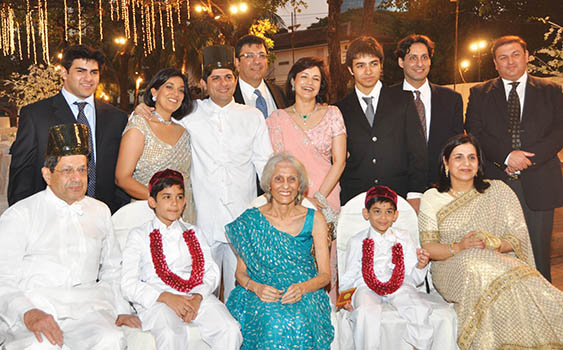
Dr Rustom Soonawala (sitting far left) with three generations of the family
To keep pace with the rising life expectancy at birth, the popular gynecologist recommended "bare essentials that human beings should aim for.” Citing the importance of maintaining physical health from the prenatal period, the founder president of the Indian Society of Prenatal Diagnosis and Therapy asked rhetorically, "If you don’t look after yourself, what will you do with the extra years?... A lot of diseases in adult life are created during the intrauterine period.” Equally important are mental and occupational health. A passion and commitment to one’s career will ensure that sacrifices are willingly made. "Having burnt my fingers three times” on receiving wrong advice Soonawala stressed that financial health and sound planning of investments is essential. He jokingly told the gathering that people assume all doctors are rich. "They are not.” He clarified though that "greed is killing human beings. If you have adequate, you are lucky. If you have plenty, give it to the poor and the needy.” More important than wealth is health and happiness, he reminded the audience.
The popular doctor who has been conferred the Padma Shri, the Lifetime Achievement Award by the Federation of Obstetrics and Gynaecological Societies of India and the Von Graffenberg Medal by the University of Kiel, West Germany, also believed that "social health” depends on the time you set aside for family and friends as also traveling. It has brought him to the realization that "Indian culture is the best in the world and in the long run we are superior to any other country.” Convinced that spiritual health "is a necessity if you want to be happy,” Soonawala who believes in God revealed how he invariably says a prayer before starting surgery, or seeks divine guidance when he feels he has goofed up.
Congratulating Soonawala for being conferred the "coveted honor and having joined the league of distinguished professionals,” Rao described him as a "brilliant scholar academician (who) has contributed immensely to the growth of gynecology in India.” Commenting on the paucity of doctors "willing to serve the rural and tribal areas that compels people to turn to superstition and quacks,” Rao opined that there is need for "women centered health care… to reduce maternal mortality.” With critical operations being conducted in an unsanitary environment, declining standards of medical education, a rise in lifestyle diseases and diabetes, Rao recommended, "We need to create awareness… We need cooperation and guidance of experts to make healthcare affordable.”
Former chief minister of Maharashtra and erstwhile governor of Andhra Pradesh Sushilkumar Shinde who was introduced as the patron of the Foundation referred to Soonawala training doctors in Pakistan, Bangladesh, Nigeria and his microsurgery skills earning him appreciation from the World Health Organisation that appointed him a member on their expert panel.
Giving an overview of the DMF named after the Hindu god of medicine, trustee Dr Lekha Pathak alluded to the past 41 recipients of the award, eight of whom were Parsis (Dr Rustom J. Vakil, Dr Minocher Mody, Dr D J. Jussawala, Dr Dara Karanjawala, Dr Jehangir Jussawala, Dr Eddie Bharucha, Dr Farokh Udwadia, Dr Noshir Wadia). She gave credit to Soonawala for being "very, very popular” and enjoying the distinction of having "very many high profile people take birth at his hands in this country.” Prof (Dr) Arun Jamkar, vice chancellor of the Maharashtra University of Health Sciences commended Soonawala for making India proud, having developed the first intrauterine contraceptive device in 1963 and having sustained the country’s family planning efforts through tubectomy and subsequent progress to laproscopy.
Serving as master of ceremonies for the evening function was Dr Twinkle Sanghvi whilst Sandhya Jain rendered an invocation, Dr Jivraj Shah proposed a vote of thanks and Ranbaxy Laboratories sponsored the high tea for the gathering.
◆ ◆ ◆
From the archive