
Books
Regal regaling
The Kidnapping of Amir Hamza retold by Mamta Dalal Mangaldas and Saker Mistri. Published in 2007 by Mapin Publishing (10B Vidyanagar Society I, Usmanpura, Ahmedabad 380014, tel: 91-79-27545390/91, e-mail: mapin@mapinpub.com) in association with HarperCollins Children’s Books (HarperCollins Publishers, 1A Hamilton House, Connaught Place, New Delhi 110001). Pp: 56. Price: Rs 295.
It is not only children who enjoy stories. Even the Mughal emperor Akbar was drawn to a make-believe world. His interest in fiction was fuelled by his favorite storyteller Darbar Khan who would accompany the king even on his expeditions. One of the most popular epics of the Mughal period was the Hamzanama (the story of the Persian warrior Amir Hamza) which came to be enjoyed in Iran, Central Asia as also in Indonesia and may well become the favorite of the present generation in India too, with one of the episodes presented in a fetching manner by Saker Mistri and Mamta Dalal Mangaldas in their book The Kidnapping of Amir Hamza. Interested in history, allured by art, fascinated by museums and drawn to children, Mistri and Mangaldas seem to have enjoyed reliving the Hamzanama, replete with giants, demons, dragons, heroes and beautiful princesses.
To regale Akbar, the adventure stories of yore would be related largely from memory, with a little bit of creative licence, around camp fires and in the courts. Such tales can now be enjoyed in the comfort of the lounge or the bedroom thanks to the initiative of the present authors. Besides being a museum educator, Mistri, currently based in Bombay, is a speech pathologist, notes an introduction to the authors in the book. During the 25 years she spent in the Middle East, Europe, South-east Asia and the US, Mistri developed museum programs for children and contributed to travel and art publications. Mangaldas too has conducted museum workshops to introduce art to children. She has an MBA from the London Business School and has participated in online courses at the Harvard Graduate School of Education, always keen to understand how children learn.
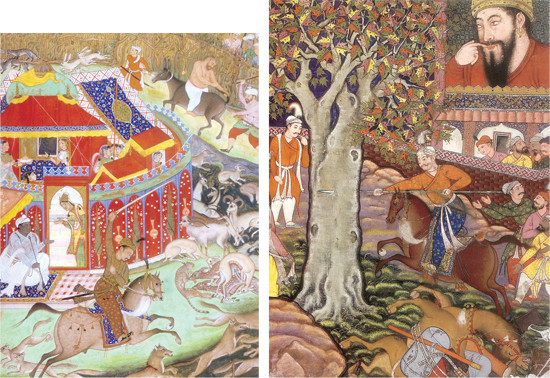
Top (left): Illustration from the Akbarnama, circa 1590 (Victoria and Albert Museum, London) and (right) from the Hamzanama, circa 1570 (MAK — Austrian Museum of Applied Arts/ Contemporary Art, Vienna)
In The Kidnapping the valiant hero Hamza serves as an idol who fights against the wicked and the mercenary, and protects the good and the innocent. Unable to bear his popularity, some jealous fiends dragged Hamza off his horse, tied him with chains weighing 11,000 kg, forced him into a boat and set sail for Takaw in the east where he was imprisoned. When the giant Zumurrud Shah ordered Hamza to bow before him, the warrior refused saying, "I am a nobleman, the head of all the armies in Persia. I will only bow before God.” Depending on the reader’s frame of mind he/she may feel awed or entertained when told that Hamza’s kick bettered the physical strength of 400 men who could not heave the rock that blocked the dungeon where he was to be imprisoned. Or that Hamza’s three-eyed horse with splendid wings and a shiny crimson coat had a fairy for a mother and a demon for a father! Ultimately Hamza’s brother Ayjil, son Alamshah, and loyal friends Umar and Tul Mast succeed in rescuing him and conjointly defeating the wicked rulers.
Impressed with the original narrative, Akbar had directed that the Hamzanama be written down and illustrated by scribes and artists skilled in their job. It is said that 100 artists took over 15 years to complete the mammoth manuscript that included over 1,400 very large and intricately detailed paintings illustrating 360 tales. "These paintings remained in the Mughal Imperial Library at the Red Fort for nearly 170 years till the Persian ruler Nadir Shah looted Delhi and took away the magnificent Peacock Throne… the Kohinoor and the beautiful Hamzanama paintings,” it is recalled in the introduction penned for The Kidnapping by Milo C. Beach, retired director, Freer Gallery of Art and Arthus M. Sackler Gallery, Smithsonian Institution, Washington. He further adds, "When one of the last rulers of the Mughal dynasty, Muhammad Shah sent a special request for the return of the Hamzanama paintings, Nadir Shah said, ‘Ask but the return of all your treasures, and they are yours — but not the Hamzanama!’”
During Akbar’s reign the 14 volumes of the manuscript were kept in large wooden boxes in the Kitab Khana or the Royal Library and taken out when the King chose to be entertained with one of Hamza’s escapades. Today, after nearly 450 years, only about 200 of these paintings are known to exist, the largest group being preserved in the MAK — Austrian Museum of Applied Arts/Contemporary Art, Vienna from where permission was sought to reproduce 10 of the masterpieces in this book for the benefit of enquiring minds.

Mamta Dalal Mangaldas and Saker Mistri: re-spinning Hamzanama for children
Aspiring artists would be delighted with the information contained in the sections on "Akbar’s Painting Workshop” and "Mughal Colour Palette” where the uninitiated learns that a group of three or four artists worked together on one painting under one master artist. While some artists specialized in battle scenes, others in facial expressions, landscapes or animals. The colors used in the paintings were made by the artists themselves from plants, metals, stones, insects or even cow’s urine with a clamshell serving as a palette and the hair of squirrel, rabbit and other animals being used as a paint brush.
The best portion of the book is reserved for the last where the reader is given tips on how to study a painting: Important people are often drawn larger or put in a place where they can be easily seen. The background and the actions of people reveal where and what is happening in the story. The clothes the men wear and their weapons indicate when the episode occurred. The colors, the movement of the people and their expressions together make up the mood of the painting. Besides children, even adults could benefit from the various website links listed in the book for those interested in seeing more paintings from the Hamzanama or learning about Mughal India.
It is not only films like Jodha Akbar that are evocative of the majestic past. By re-spinning this yarn of Hamzanama, Mistri and Mangaldas too have succeeded in creating a fresh tapestry, a magic carpet to entice the younger generation.
◆ ◆ ◆
From the archive