
Books
Shahnameh for the young
Firdausi Toosi’s Shahnameh of Ancient Iran Comes Alive in The Saga of the Shahanshahs by Adi F. Merchant. Published in 2017 by Bharatiya Vidya Bhavan, Kulapati Munshi Marg, Bombay 400007; email: bhavan@bhavans.info; website: http://www.bhavans.info. Pp: xxxvi + 250. Price: Rs 675.
 Disinterest is the biggest enemy of Parsi Zoroastrians. Quiz one of our brighter teenagers about Firdausi Toosi (born Abu Qasim Hasan) and you will get a blank look. Toosi’s legendary epic poem, the Shahnameh, comprising of some 60,000 couplets, penned a 1,000 years ago, narrates the saga of the three principal dynasties of ancient Iran. Many English translations of the Shahnameh abound. From James Atkinson in 1832 and Alexander Rogers in 1907 up to Prof Dick Davis’ brilliant translation in 2006, the list is impressive. Most of these translations have been in prose; few in verse, and some a combination of prose and verse. In the late ’80s, Dr Baman Surti and Marzban Giara published a complete English translation in prose. The Kutar brothers’ (Ervads Framroze and Mahiyar) translation into Gujarati verse (1914-18; 10 volumes) is memorable. In Parsi schools of Navsari, Persian was compulsory; and competitions (betbaaj), to recite the Shahnameh in Persian as well as in Gujarati, were common. Learned commentaries on Shahnameh by scholars have been published in many languages.
As a proxy war is being waged in Yemen and other places in the Middle East between Shia Iran and Sunni Saudi Arabia, there is a revival in liberating Persian heritage and culture from invasive Arab influence. Toosi strived to avoid any Arab words or concepts in the Shahnameh. As Zoroastrians, we cannot forget that we became refugees, following the Arab invasion of Persia.
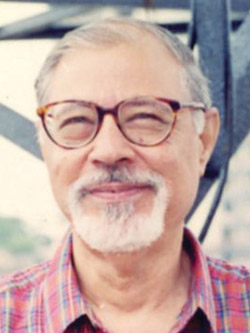
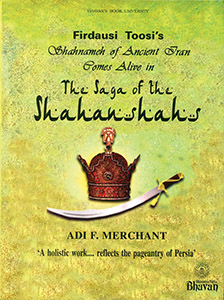 Against this impressive backdrop, Adi Merchant’s (pictured) book, The Saga of the Shahanshahs, may, on first blush, appear to be a bit presumptuous. In fairness, however, it does not claim to be a scholarly work. The author does not even claim to know Persian. The erudite Ervad (Dr) Ramiyar Karanjia, in his foreword to the book, does state that "this book, apparently, is especially meant for young readers in the age group of eight-12 years.” He is indeed correct. It is a series of tales in plain vanilla form, mostly about the battles and conflicts waged by Persian kings against the forces of evil. The following two typical extracts are illustrative of the nature and limitations of this book:
"Thus 960 evil years passed, and when Zohak had only 40 years to live, one night he saw a dream. The king woke up in a fright, his forehead bathed in sweat. Next morning, he called his royal astrologers and ordered them to explain the meaning of his significant dream. Among the astrologers was a wise and honest man called Zirak who told the king that his throne would be taken by one whose name was Faridoon, but he was not born yet; that he, Zohak, would kill Faridoon’s father, and that Faridoon himself would take revenge; that he would kill the nurse of this young man (the cow, Biryanama) and in vengeance he will brandish an ox-head mace. Zohak, when he heard this, fainted on his throne. On recovering, he made it his life’s mission to seek out Faridoon in whichever part of the world he may be.”
"Gushtasp went back to Hishwiand Ahraan, and told them how he had killed the dragon. He also instructed Ahraan never to tell anyone that he, Gushtasp, had done the deed. Later, Ahraan gave him costly presents but Gushtasp took only a sword, a lasso, a bow and 10 arrows, and gave the rest to Hishwi; on his return he went to meet Ketayun. In the meanwhile, Ahraan got a bullock-cart and several men, and had the dragon’s carcass put in it and conveyed to the royal court. Seeing this, Caesar gave his third daughter in marriage to Ahraan. For a long time the "deeds” of Ahraan were talked about throughout the kingdom. Both of them played polo with their respective teams which delighted Caesar no end.”
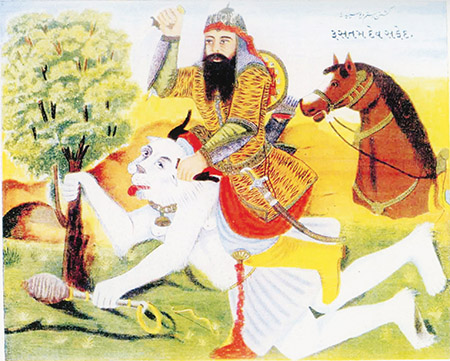
Rustam killing the Div-I-Safed Photo courtesy: S. J. Tarapore
It would be inappropriate to critically comment about the style or contents of this book. Nevertheless, the book ought to have stated, on the face of it, that it is essentially designed for the age group of eight-15, instead of creating an impression (may be, unwittingly) that it is a monumental work or an authentic translation. The illustrations are indeed well selected. The book will, however, serve a purpose, if it can fire the imagination of our young by introducing them to legendary tales (like Rustom and Sohrab, Faridoon and Zohak), which illustrate our rich Persian past. This may lead, at least a few, to become familiar with our rich heritage and glorious past. Such interest is the key to our survival.
BERJIS DESAI
Desai is a lawyer in private practice and a part-time writer. He considers himself an unsuccessful community activist.
◆ ◆ ◆
From the archive