
Book Notes
Ritual retold
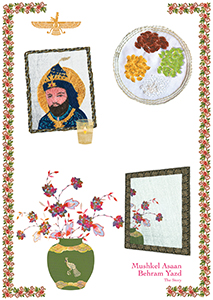
Mushkel Asaan, Behram Yazd, The Story retold by Heta Pandit. Published in 2013 by The Heritage Network India (www.heritagenetworkindia.com). Pp: 8. For free distribution. Copies available at Tehmi Terrace, 74, Turner Road, Bandra, Bombay 400050.
It was Heta Pandit’s "job to arrange everything for the recitation [of Mushkel Asaan (MA)] — the stool, mirror, the fruits and flowers” for her bapaiji (paternal grandmother) Tehmina Patell as she sat down to recount the story of MA (literally, reliever of difficulties) every Friday and Bahram roz. Pandit continues the tradition and is especially steadfast after her mother Manijeh fell ill, encouraging her to leave her sick bed. How the recounting got fixed for Fridays is unknown but scholar Ervad (Dr) Ramiyar Karanjia believes that Friday was selected as it is a holy day in Iran. "Tuesday is the more probable day to perform this ritual as it is related to the planet Mars (mangal) which is varharaan i.e. Bahram in Pahlavi. In fact Karanjia claims that in Iran the MA ritual is done on Tuesdays.

Pandit has brought out a booklet relaying the story of the woodcutter Mishkin and his daughter, whose pleas for a meal were answered by five yazads — Ardibehesht, Bahman, Bahram, Meher and Srosh — saving the woodcutter’s family from starvation and penury by timely divine intervention. The story goes that Bahram Yazad gave three fistfuls of "dirt” to the woodcutter for safe keeping with the understanding that if Mishkin’s life improves, the family must recount the tale to as many people as possible. The "dirt” metamorphosed into three gemstones. In the comfort of their new-found wealth, the daughter discontinued narrating the story and offering chana (roasted chickpeas), flowers and fruits, forgetting their promise despite the benediction.
Misfortune befalls the daughter as she is accused of stealing the princess’s jewels, entrusted to her care when the princess went bathing in the river. Another chance is given when a few coins are bestowed on the family, to fulfill their promise of offering chana, flowers and fruits. This time Mishkin devoutly spreads the story to villagers, some of whom also find an end to their travails on recitation of the story. At the palace meanwhile, the royal rooster spews the gem, absolving the young girl of the charge of theft. As a reward for this injustice, Mishkin’s daughter marries the prince.
Heta Pandit: recounting a tale
This story of devotion is illustrated by Pandit with motifs garnered from heirloom garas and other saris in Patell’s possession. "What fascinated us is that some of the illustrations were already there! We simply plucked them out, the woodcutter, horse, figures in the boats, the palace and trees. These were all there in the borders just waiting to fit into our story.” Pandit and Nina Sabnani, professor of Industrial Design at the Indian Institute of Technology, Bombay "saw the potential of what can be done with cloth and embroidery” and Pandit presented Manijeh with this booklet as a birthday gift, stitching it all up together.
Karanjia clarifies at our request that MA does not contain prayers. "It is not clear as to what point of time the practice of this ritual started in India.” He reckons it travelled to India at the beginning of the 20th century from ladies in Iran, who in turn seem to have adapted it from a similar ritual performed by Shia Muslim women. "We also found that there are people in Turkey and Iran who recite the story (with some variations in the versions). The yazad is called Mushkel Gusa or Gusha. So you see, the story seems to have universal appeal,” Pandit maintains.
◆ ◆ ◆
From the archive