
A haven of sanctity
Poona’s recently refurbished Sir Jamsetjee Jejeebhoy Agiary celebrated its 175th salgirah
"That was the philosophy Sir Jamsetjee lived by,” recalled Sir Jamsetjee Jejeebhoy, Eighth Baronet, at a dignified function held at Poona’s Sir Jamsetjee Jejeebhoy (J. J.) Agiary on November 29, 2019, to mark the fire temple’s 175th anniversary. Sir J. J. Agiary, the largest in Poona, and a haven of sanctity in the city’s bustling Camp area, has recently undergone a complete refurbishment. The prayer halls, dadgah, muktad rooms, banquet hall, otla and Maneck Baug — a lodging facility for Parsis, located within the compound — are in pristine condition.
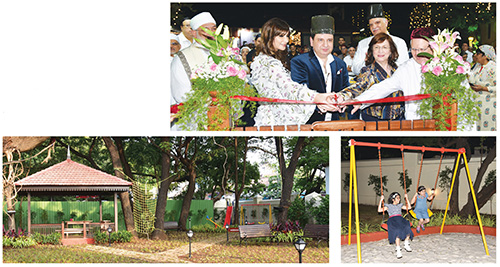
A new addition to the Agiary, a garden with a play area for children donated by the Yohan Poonawalla Foundation, was officially inaugurated at the anniversary celebration. Poonawalla and his wife Michelle cut the ribbon while his parents, Zavaray and Behroze, unveiled the plaque. The Poonawallas will maintain this newly laid garden as well as the existing gardens in the Agiary compound for the next 20 years.
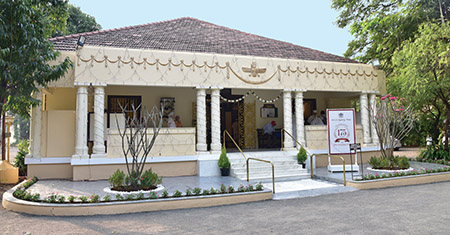
Sir J. J. Agiary in Poona
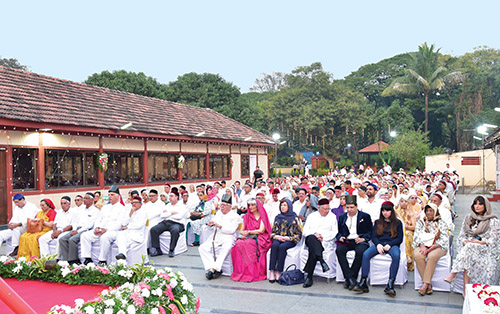
Audience at the 175th salgirah of the Sir J. J. Agiary in Poona
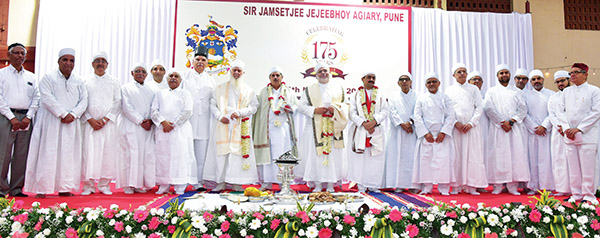
"As a Zoroastrian and a Parsi I have always wanted to support and give back to the community,” Yohan told Parsiana. "When the opportunity arose to renovate the Sir J. J. Agiary garden and compound and to maintain it thereafter, I was very pleased to help and be part of our Agiary’s 175th year celebration. I hope our children take a cue from this and take forward the Poonawalla family’s charitable legacy. Our religion advocates good words, good thoughts and good deeds and I am a firm believer in this.”
In 2011, Dr Cyrus Poonawalla had paid for the renovation to the Poona Kadmi and Shehenshai Anjuman Dar-e-Meher (also known as Komra ni Agiary) (see "Patrons in Poona,” Parsiana, January 7, 2012).
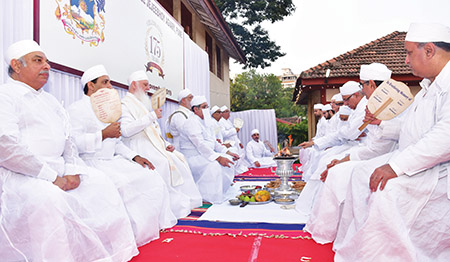
Nearly 300 community members attended the 175th anniversary jashan led by Ervad Kaipashin Raimalwalla, panthaky of Sir J. J. Agiary, alongside Dasturs (Dr) Firoze Kotwal of Bombay, Khurshed Dastoor of Udvada and Cyrus Dastur of Surat. The four were joined by 13 other priests whose prayers rang out on a balmy evening under a dark sky with a sliver of a new moon hovering high above the stage.
In his welcome address, the Eighth Baronet thanked the three High Priests for accepting the Agiary’s invitation to grace the anniversary celebrations. He praised Raimalwalla for his "commitment, devotion and dedicated service to the Agiary. He has also been a pillar of strength for the Parsi laity in Poona.”
Raimalwalla’s connection with the Agiary dates to 1984, when he served as a part-time priest while working for Godrej and Boyce’s appliances division. He became the Agiary’s panthaky 10 years ago, and has been a dynamic leader, immensely popular with worshippers. "If I do my duty well, then I will receive support and cooperation from the community. That is very important for me,” he says. "Over the last four decades, I have seen tremendous changes for the better under the leadership of Sir Jamsetjee. The Agiary now has two permanent and five part-time priests available for various ceremonies. We have a steady flow of visitors, some of whom come to the Agiary nearly every day. We also have a lot of youngsters coming to the fire temple, which is very encouraging.”
Raimalwalla graciously acknowledges his wife Perviz and mother-in-law Roda Dastur’s help and support in answering phone calls, interacting with visitors to the Agiary, acting on feedback and so on. He also credits a band of young volunteers led by Yezdi Mehta who, three or four times a year, thoroughly spring clean the Agiary.
Barring "the first four days,” prayers for Parsis who have opted for cremation or burial are performed at the Agiary. "That goes against the system and we have to maintain some decorum,” Raimalwalla notes. "At least 35 weddings and navjotes are performed here during the year,” Jejeebhoy says. The other trustees of the Agiary are Burjor Antia, Hector Mehta, Noshir Kasad, Arsheesh J. Wadia, Jehangir Jejeebhoy, Mehli Golwala and Kekoo Colah.
A revered name
Paying tribute to his illustrious ancestor, Jejeebhoy stated, "Though Sir Jamsetjee came from modest beginnings and lacked a formal education, he had the foresight and vision to realize that his contributions merely as religious benefactions were not sufficient. He believed that he could provide greater help to the community by dispelling the darkness of ignorance and by fighting the spread of sickness and disease. To achieve this twin end, he strode like a colossus in western India and went about establishing several schools and madressas and endowing hospitals and dispensaries.
"Today, as we commemorate the 175th anniversary of Sir J. J. Agiary, we also pay homage and reverence to a man who spent his money most wisely. And that is precisely why Sir Jamsetjee’s name generates respect. The fact that his name is still revered 160 years after his demise lends credence to his belief that what we do for ourselves dies with us, but what we do for others remains immortal.”
Building of a fire temple is believed to be one of the greatest deeds a Zoroastrian can perform in his lifetime. The First Baronet considered it his duty to construct fire temples, which he did in towns and cities across South Gujarat and also paid for repairs to be undertaken at houses of worship that needed refurbishment.
According to a report in Pune Diary, in 1842, a group of prominent Zoroastrians from Poona requested Sir Jamsetjee to construct a fire temple in the Camp area. Readily agreeing to their request, Sir Jamsetjee advised the community to serve Ahura Mazda, adding, "If you visit the fire temple and pray daily you may rest assured that you shall prosper in life.” Sir Jamsetjee always maintained that his faith and following the principles of Zoroastrianism were the keys to his success.
The Agiary was consecrated on November 29, 1844, with nearly all the local Zoroastrians attending the inauguration ceremony along with prominent Parsis from Bombay. In addition to the main prayer halls, wells and dining halls, residential quarters for the priests were also constructed in the compound.
At the entrance to the prayer hall, two boards plastered with plaques list the names of those who have contributed to the Agiary fund. A Platinum Board, which was recently introduced for the 175th anniversary, lists those who have donated more than five lakh rupees. Jejeebhoy stressed the importance of collective responsibility of the community to its institutions. "If we can contribute to the nation, why can’t we then, as Parsis, also extend the same courtesy to our community?”
All three Dasturs addressed the gathering and applauded the contribution of the Jejeebhoy family. In his address, Kotwal noted that during his lifetime, the First Baronet was personally involved with 146 charities, not all of which exist in the present day. Kotwal also commended the hard work and dedication of Raimalwalla, the current panthaky, and quoted a few verses from the Gathas regarding the preservation and conservation of the religion.
Khurshed Dastoor lauded the Jejeebhoy family’s large-heartedness and commitment to charitable causes. He added that the refurbishment of Iranshah was under way and the community would be well pleased with the final result. Dastoor also highlighted the plight of priests and priestly institutions that are being neglected by the community. He pointed out that members of the younger generation are reluctant to enter the priesthood. "It’s sad, but it is the truth,” he stated.
Cyrus Dastur reminded the audience about the proper way of offering benedictions as stipulated in Zoroastrian scriptures. As an example, he pointed out that worshippers in the sanctum sanctorum who stand in front of the door or at the windows facing the fire should cover their mouths with a cloth mask to avoid desecrating the sacred fire with their breath or spittle. He added that after saying the kusti prayers, the habit of tucking the shirt into one’s trousers is proscribed for reasons of hygiene.
Architect Khushru Irani and interior designer Firdaus Chindhy were presented tokens of appreciation by Jejeebhoy for their assistance with the Agiary’s refurbishment and renovation. On behalf of the Agiary, Jejeebhoy presented Yohan with a plaque as a token of gratitude for his contribution to the Agiary. As the evening’s program ended with Meher Anklesaria, chairman of the local managing committee of the Agiary, proposing the vote of thanks, the guests headed home with Jejeebhoy’s closing remarks ringing in their ears:
"In happy moments, praise Ahura Mazda/In painful moments, seek out Ahura Mazda/In quiet moments, worship Ahura Mazda/In confusing moments, trust Ahura Mazda/And in every living moment, thank Ahura Mazda.”