
Books
Capital concerns
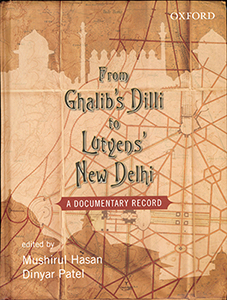 From Ghalib’s Dilli to Lutyens’ New Delhi edited by Mushirul Hasan and Dinyar Patel. Published in 2014 by Oxford University Press, YMCA Library Building, 1 Jai Singh Road, New Delhi – 110001; email: Publicity.IBHO@oup.com. Pp: xliii + 296. Rs 1,395.
The creation of the new capital, now a vibrant metropolis, was spread over two decades and cost the taxpayer a pretty penny. The British wanted to leave behind a colonial legacy that was appropriate to their view of themselves as an imperial power. New Delhi would embody that sense of grandeur.
During the grand durbar of 1911, the King-Emperor George V himself made the announcement of Delhi’s new status. From then on the subsequent viceroys and governors-general and their administrations would be engaged in raising resources and appropriating land to establish the imperial capital.
The authors Mushirul Hasan and Dinyar Patel have culled some fascinating documents between 1911 and 1914 that provide the rationale for the project as well as highlight the trials and tribulations the English rulers faced in implementing it. The letter from Lord Crewe, Secretary of State for India, to Lord Hardinge, Governor-General of India reads thus: "You point out with truth that many of the circumstances which explain the selection of Fort William in the second half of the 18th century as the headquarters of the East India Company cannot now be adduced as arguments for the permanent retention of Calcutta as the capital of British India, with certain new conditions and developments seem to point positively to the removal of the central Government to another position.”
During the grand durbar of 1911, the King-Emperor George V himself made the announcement of Delhi’s new status. From then on the subsequent viceroys and governors-general and their administrations would be engaged in raising resources and appropriating land to establish the imperial capital.
The authors Mushirul Hasan and Dinyar Patel have culled some fascinating documents between 1911 and 1914 that provide the rationale for the project as well as highlight the trials and tribulations the English rulers faced in implementing it. The letter from Lord Crewe, Secretary of State for India, to Lord Hardinge, Governor-General of India reads thus: "You point out with truth that many of the circumstances which explain the selection of Fort William in the second half of the 18th century as the headquarters of the East India Company cannot now be adduced as arguments for the permanent retention of Calcutta as the capital of British India, with certain new conditions and developments seem to point positively to the removal of the central Government to another position.”
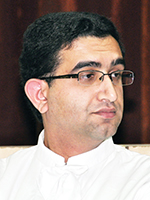

Dinyar Patel (left) and Mushirul Hasan
Soon after the King-Emperor’s announcement in person at the durbar on December 12, 1911, the various government agencies got started on demarcating the area that would comprise Delhi, which included notifying provincial governments to part with land. Punjab was the main target and it did not take kindly to having to part with its territory. A letter from H. P. Tollington, chief secretary of Punjab to the secretary, government of India notes querulously: "It has come as a surprise… that before this momentous decision was arrived at, the local government was not given an opportunity of expressing its views. The location of the new capital is, of course, a matter of imperial interest, but the cession of a whole district is a matter which intimately concerns the province in which the district is situated, as well as the population residing within its limits who have hitherto been under the direct administrative charge of the local government. This is especially the case when the district contains the commercial capital of the province and a city that has been especially made over to the Punjab after the Mutiny of 1857 in recognition of the great part which the province has played in the reconquest of Delhi.”
The acquisition of land in UP (then United Provinces) too posed problems and the home department, Delhi wrote to Lord Crewe arguing that the residents of the province will not be negatively affected: "…we have ascertained that the connection of the people affected with the neighboring centers in the UP — Ghaziabad and Meerut — is mainly for the purposes of litigation and revenue transaction; their interest in respect of family ties, trade communication and means of livelihood are towards the side of Delhi, and this fact will materially lessen any dislocation of business and social relations which might otherwise have been apprehended.”
The two famous Delhi colleges feature in a letter from C. A. Barron, chief secretary, government of Punjab to the commissioner, Delhi division in the course of site selection as well as providing residential and office space for the central government staff: "A minor point is that a site should be allotted as soon as possible for a new St Stephen’s College outside the walls. The number of students will be 250 with eight European professors and 10 or 12 acres will be required. The present buildings and the adjoining buildings of the Hindu College may be useful to the Government of India for offices.”
There was much debate on the expenditure being incurred on the capital. At first the Indian elite, supporting the Raj, was all in favor, but over time became less enthusiastic about the project, not least because its members began to notice that the British were dragging their feet on letting go of India, giving it its freedom. The letter from the honorary secretary, European and Anglo-Indian Defence Association to the secretary of the government of India, home department, opposing the shifting of the capital notes: "The expenditure entailed by the new capital has been reckoned, on what grounds is not apparent, at £ 4,000,000. The Council fear an estimate which placed the total expenditure at between £ 12,000,000 and £ 15,000,000 would prove nearer the mark. That a huge burden of this dimension should be cheerfully undertaken, at a time when the treasury is called on to bear the loss of the opium revenue, and not many months after the finance member at a banquet debate avowed his determination to overhaul expenditure…”
While appointing Edwin L. Lutyens to the Delhi Town Planning Committee, the under secretary makes the following offer to him on March 9, 1912:
" Payment of your passage to India and back, including first-class sleeping car accommodation between Calais and Marseilles
" Payment of your travelling expenses
" Subsistence allowance at the rate of one pound ten shillings a day
" A fee calculated at the the rate of 300 guineas a month for each month.”
This was a couple of years over a century ago; the government had sure figured out all the possible contingencies.
Lord Hardinge seemed to be unhappy with the angular deployment of the city, all straight lines, a form of town planning that the British (and Northern Europeans) picked up from the Romans. The comments on his behalf by Sir J. H. DuBoulay makes this plain:
"Another point capable of improvement is the existence of numerous long lines of perfectly straight roads. We must have straight roads for direct communications, and a city served by a series of numerous curving streets would be an impossibility: so far the aim of the Committee is laudable; but the massing of so many straight roads is, particularly in India, a mistake, and a combination of curves and straight lines is more pleasing.
"It would appear that, if this layout were adopted without alteration, we would add one more to the long list of cantonments and civil stations in India… Only extraordinary efforts of localized architectural elaboration can save a series of this kind from an impression of monotony.”
Hasan, professor of history at New Delhi’s Jamia Milia Islamia University who was confered the Padma Shri, and Patel, Harvard University PhD candidate in the Department of History provide a historical perspective on the city of Delhi. This volume is a welcome addition to the extant literature — fiction and non-fiction — on this great metropolis, the latest being Capital by Rana Dasgupta, and some of the notable ones being by the late Khushwant Singh and William Dalrymple.
◆ ◆ ◆
From the archive