
“Come here and stay”
The Iranshah Udvada Utsav popularizes the charm of the seaside land
The apprehensions that the crowds over three days would swamp the hamlet were never realized as the visiting devotees appeared to melt into the bye lanes and houses.
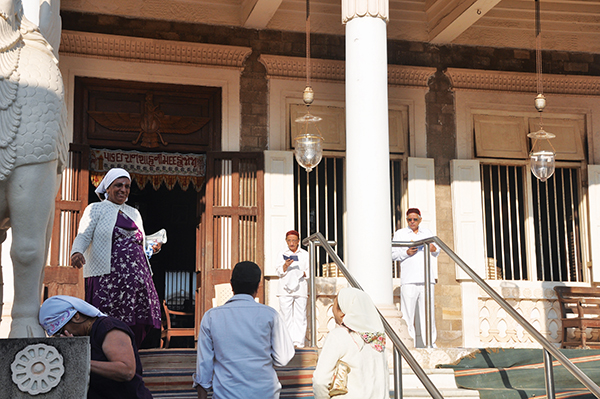
Devotees at Iranshah foyer
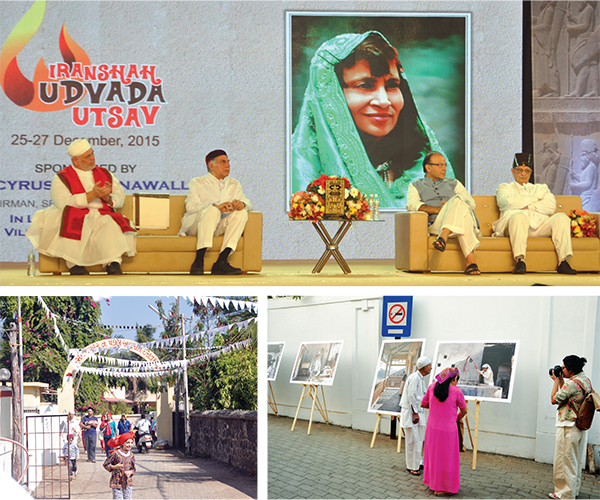
The Iranshah Udvada Utsav (IUU) was a time for the community to come together, work together and stay together, said Dastur Khurshed Dastoor addressing a gathering of the faithful on the Gymkhana grounds adjacent to the beach at the December 25 inauguration. "All is still not well in Udvada,” he cautioned. He was probably alluding to the spate of robberies that took place over the past month and the threat of modernity to the town’s unique architectural heritage. "But we have Iranshah on our side. What we need is the support of the community.”
The IUU which was set ablaze by a maachi and a jashan was under the joint auspices of the Foundation for Development of Udvada (FDU), supported by the Department of Tourism, Government of Gujarat and the Udvada Samast Anjuman. It is the "brainchild of Prime Minister Narendra Modi” who made the suggestion when he visited the town in 2011 while chief minister of Gujarat, stated Dastoor, one of the two high priests of Udvada. Modi had convinced Dastoor that holding an annual or biannual festival would draw people. The Prime Minister "has always supported the community...he has a love for our community,” added Dastoor.
He acknowledged his wife Havovi as the prime mover to host the function and put in the hard work necessary to make the event a success.
In his message carried in the IUU brochure, Modi wrote, "May this festival further underscore the great philosophy of Humata-Hukhta-Hvarshta — that humankind is designed to evolve towards perfection through good conscience; cultivated with good thoughts, goods words and good deeds.”
When Modi was chief minister of Gujarat, he had acquainted his cabinet colleagues with the community and apprized them of his visit to the town decades earlier on a scooter, stated the evening’s chief guest, Gujarat minister of finance, energy and petrochemicals, mines, minerals, cottage industries, salt, printing and stationery, planning, tourism and civil aviation Saurabh Patel. Otherwise the cabinet of ministers would not have been as knowledgeable about the community’s history and contribution to India. "He (Modi) still loves Parsis,” Patel spoke of the rich value system maintained by the House of Tatas such that " kaaro daago laagyo nathi (no black spot has besmirched them).”
He lamented the empty houses he saw in the hamlet: "Which other village has such nice houses?” and advised, "the younger generation to come down here... and stay… It is easy to reside in London and sell your property in Udvada.” For those who did not wish to occupy their homes he advised, "If you are rich enough, give it for some community purpose. And if you sell it, sell it only to a Parsi (loud applause).”
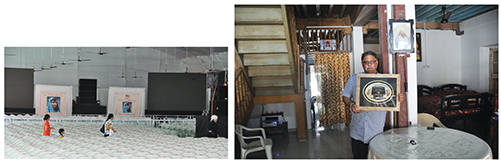
Seating arrangements at the venue; Yazdi Kasad of Navsari with plaque for Tata
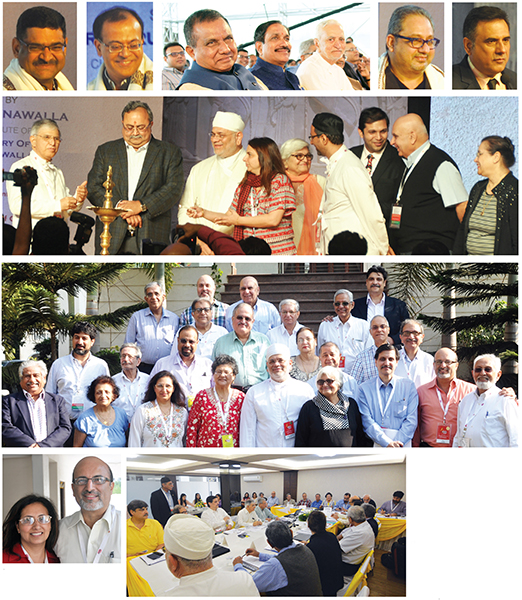
He wanted tourist guides to be trained with knowledge of the hamlet and the rich culture of the community as well as closed-circuit television cameras installed. The government would contribute to these expenses. The Gujarat government had sanctioned Rs 1.4 crores out of a total of 20 crores (US $ 3,017,013) earmarked for the development of Udvada which included a gateway to the town with Persian inscriptions. The minister announced he had given instructions to the sarpanch that no high-rise buildings should be given permission for construction in the heritage precinct henceforth. The effort to make Udvada an attractive tourist destination has to be "a continuous thing...I am with you completely...the most important thing is your participation.” He termed the community "very sporting, very loving...Parsi friends make you laugh...I pray to Iranshah that your vasti vadhé (population increases).” Modi had urged the late hotelier Jehangir Cama of Ahmedabad to "develop something in Udvada. Show the history, culture” of the place, recalled Dastoor. The FDU was created and an existing structure was purchased and converted to The Zoroastrian Information Centre (ZIC) while maintaining its architecture form.
Preserve the urban form
One of the highlights of the Utsav was heritage walks along the lanes in proximity to the Iranshah, the suggestion of conservation architect Jamshid Bhiwandiwalla who serves on the heritage panel of the Udvada Area Development Authority along with architect Pankaj Joshi. They have been making strides to preserve the town’s unique architecture and environs. The 45-minute tour highlighted the hamlet’s treasures and also the dangers that threaten to obliterate them. "The urban form is still maintained,” said one of the tour guides, Preeti Nayak, a student of architecture who is working on her architectural thesis. She along with another architecture student Delnaaz Kharadi took the 9 a.m. batch of 10 or so around the quarter. They pointed out the charms of the earlier architecture that created community space where people could interact with each other. These spaces "created elements of surprise.” There is little respect for " gaonty” or vernacular architecture as it is sometimes referred to which allowed for the weather conditions, the terrain, the preservation of the precious ground water. There were no compound walls separating public and private areas. These were shared spaces. Every house had a well or shared one and all the wells had sweet water, despite Udvada being on the sea front. "Water is a community resource,” observed Nayak "…Neighbors could keep an eye on each other’s well-being; ‘eyes on the street’” was a phrase coined by urban planning writer Jane Jacob.
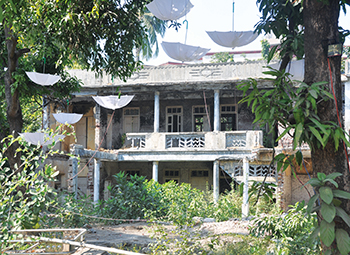
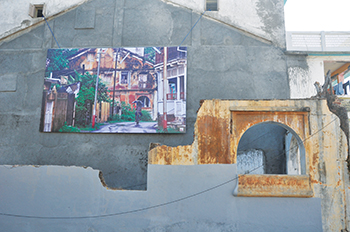
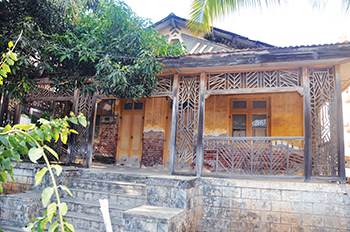
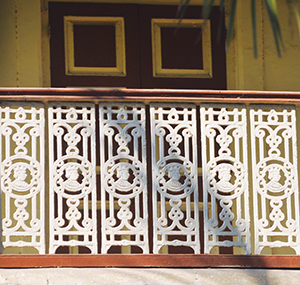
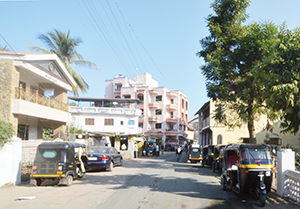
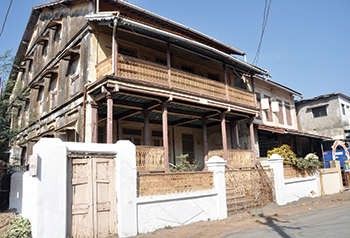
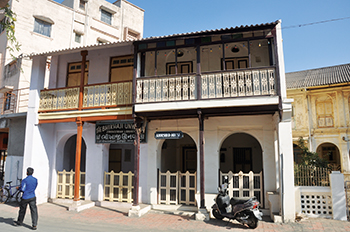
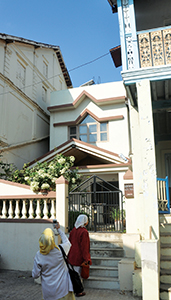
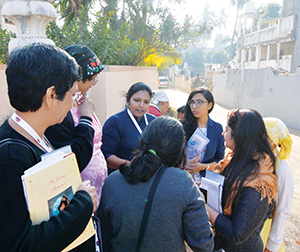
Heritage walk guides Preeti Nayak and Delnaaz Kharadi with participants
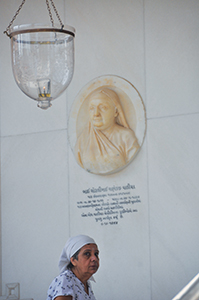
Freize on Iranshah facade
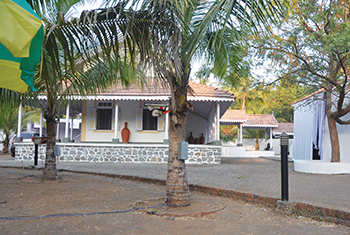
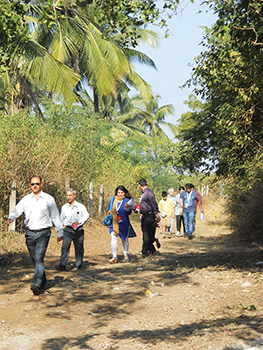
Treasure hunt
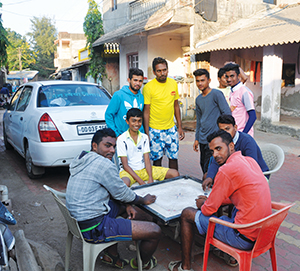
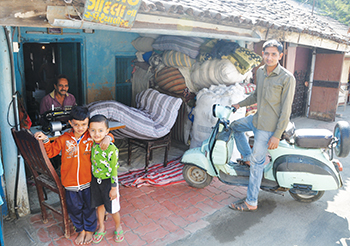
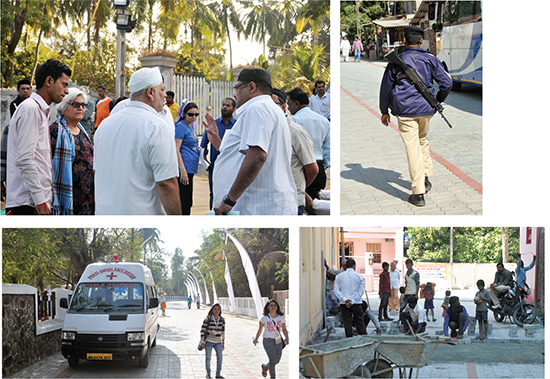
Street scenes
The modern structures which the guides politely said catered to the "aspirations” of their occupants were unmindful of the town’s urban heritage being lost. For example the house where the Iranshah fire was first lodged after making the journey to Udvada was torn down and a modern structure has replaced it. A similar fate awaits the building that featured on the cover of Shantanu Das’ photography book Udvada. The structure has been demolished and the house that replaces it may not bear any semblance to the original architecture of the village. Laws to enforce adherence to conservational norms are still to be introduced. The old structures had load bearing walls so the need to create deep foundations was not required. The newer building supported on frames required strong foundations, the digging for which damaged the lower crusts and permitted seepage into the ground water resulting in contamination. "The water is slowly getting saline,” Nayak lamented.
A treasure hunt commenced from ZIC and sent 40 teams of five, chasing clues all over town. To evidence visits to the various spots, teams had to take selfies with all five members present. The youngest participant was five and the eldest, 74 years old. Event consultant Hoshaang Gotla, whilst giving detailed instructions, urged the 200 odd people to maintain the sanctity of Udvada, where this sort of activity was being run for the first time "so no colorful language, please.”
Words of wisdom
Following the heritage walk and treasure hunt on December 26, talks by prominent members of the community were held. Ervad (Dr) Ramiyar Karanjia dwelled on the ancient ties between Iran and India, noting the two were neighbors for thousands of years with Afghanistan once belonging to Iran and Pakistan to India. Lawyer Firoze Andhyarujina spoke on what the young should and should not do and recommended the energy of the young be "channelized to the
healthcare of the aged.” Bombay Parsi Punchayet trustee Noshir Dadrawala who enlightens Parsis on their tours of Iran spoke on the five Iranian dynasties. Knowledge of one’s roots "gives you a sense of pride,” he observed.
Darius Khambata, former advocate
general and senior counsel mentioned tomes he has read on the religion and added that these same studies of the religion led him to believe: "You cannot endeavor to save our ethnicity or
Parsipanu at the cost of Zoroastrianism. Some of us attempt to suggest that the religion belongs only to Parsis. Zoroaster was not born a Zoroastrian. Allow schools of thought to contend. Talk to each other — not at each other. It’s our responsibility to preserve this.”
Khambata reiterated the same theme that he had taken up at the 10th World Zoroastrian Congress in Bombay (WZC) in December 2013, namely the notion that "religion belonged only to a racial” group was a gross distortion of what Zoroastrianism stood for. He urged the audience not to expend energies on "petty squabbles on who can go to our fire temples and Doongerwadi...What is this great obsession with race? It is not part of our religion. There is no bar to (entry) into our religious fold.” Our common goal should be to save Zoroastrianism.
"Why do so many lawyers talk about religion and so many priests study trust deeds?” Khambata inquired. "The term Parsi Zoroastrian does not come from religion or history but from trust deeds drawn up by lawyers.”
The solution to the issue of liberal versus conservative lay in the law. According to the
Saklat vs Bella judgment, trust property can be used for others as long as the original beneficiaries specified are not disadvantaged. So while scholarships, housing, medical assistance may be used only for Parsis, the use of fire temples and Doongerwadi by others does not deprive Parsis of any benefit. Also the entry of non-Parsis into a fire temple "will never dilute our religion or our fires. The fires are too powerful.”
The 12-minute talk by Khambata raised the hackles of several in the audience who even booed him as others applauded. It energized one blond haired woman,
Gordafrid
Aresh to stand up in the VIP section and lambast him. Dastoor to his credit defended Khambata but as
Parsiana was seated much behind could not hear what either was saying but knew both were agitated. The Times of India (TOI) intrepid reporter Nergish Sunavala also seated with
Parsiana however approached the duo and reported their sentiments.
Aresh told TOI: "If the gentleman is of the view that we should open our
agiaries and
atash
behrams, I would recommend that he makes his own
agiaries and
atash
behrams. Someone who wants to follow Zoroastrianism is most welcome to do that in the privacy of their home but entering a place of worship, which has been consecrated for
Zarathustis, I and many other Zoroastrians find that intolerable. If Parsis had opened their doors to other religions, their unique identity would have vanished long ago.”
Dastoor was quoted by TOI that Khambata’s "‘Opinions don’t make him less of a Parsi. He spoke at the WZC and got a standing ovation… We can’t hide from the fact that intermarriage is taking place. Why should we shy away from the problem?’ Dastoor also condemned the hypocrisy of allowing children of Parsi men, who marry non-Parsi women, into the faith. ‘Many parents have come to me and cried, I have only one daughter and she’s marrying outside. I say Well what can you do? Is the boy nice? Is she happy? Then go ahead.’”
The next speaker astrologer Bejan Daruwalla said Khambata would make "a fine solicitor general of Ahura Mazda.” The 85-year-old genial Ahmedabad resident who said he had "chicken
farcha and dhansak in my blood” is inspired first by Zoroaster, then Ganesha,
Christ and the river Ganga. He predicted that in "2017 there is a good chance of world peace.” This state of affairs would continue till 2027. For what lay beyond 2027, he had "no answer… This is hope. Without
hope you become a dope.”
Shernaz Cama of Parzor that initiated the Jiyo Parsi campaign spoke of four illnesses that afflict the community: heart disease, cancer, loneliness in the form of depression and diabetes. She also addressed the flak
Parzor got for their advertisement campaign. A film on the Jiyo Parsi scheme was shown that dealt with advocacy and financial subsidy to the beneficiaries.
Aide de camp to Field Marshal Sam Manekshaw Brig Behram Panthaki and wife Zenobia talked of their association with the military leader. Zenobia relayed a story of Manekshaw’s cook Swamy who cut his pottering employer to size when he once told off the Field Marshall "out of my kitchen… go look after your army.”
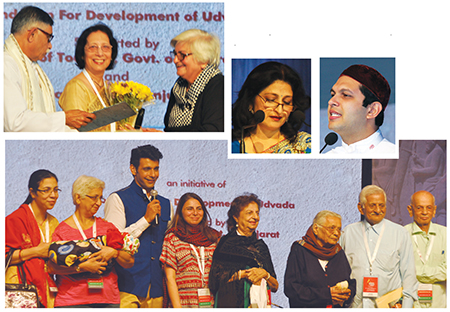
Awards were given to three young Zoroastrian achievers from Gujarat — Yazad Chinoy who represented Gujarat at national shooting events, entrepreneur Delzad Khambata who recycled municipal solid waste, biomass and rubber, and Julie Pardiwala, a
PhD student focusing on industrial waste and water treatment to save the environment.
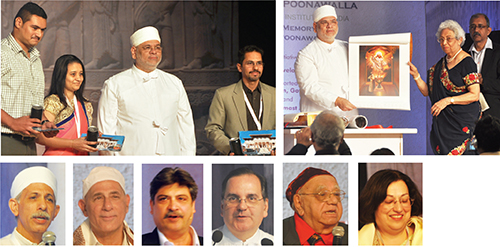
There was also a launch of a Gatha calendar by the Ushta-Te Foundation from Ahmedabad released by Dastoor and Meher Medhora. The calendar has been designed by Cyrus Mobedji, the paintings are by Rustom Daboo and the convenor of the Gatha Study Circle is
Dr Astad Pastakia. The calendar is available in two sizes with six scenes depicted.
Discourses by dignitaries
The three luminaries who graced the morning session on December 27, Union finance minister Arun Jaitley, Tata Sons chairman emeritus Ratan Tata and IUU sponsor
Dr Cyrus Poonawalla and his son Adar made separate entrances to standing applause from the gathering of over 4,000 Parsis and others. Karanjia recited passages from the Shahnameh by Firdausi in song in the Pahlavi language which his wife Havovi then repeated in Gujarati, carrying the same tune. This recitation was followed by
monajats by students of the Bai Avabai Petit Girls High School and the rendition of Chhaiyé Hamé Zarthoshti by a choir in traditional dress with long sleeves and scarves.
Poonawalla’s voice was choked with emotion when he recalled his wife
Villoo in whose memory he sponsored the three-day meet. He quickly regained his composure and
noted "Happiness is when what one thinks what one wants to do and what one does is in harmony. I sold vaccines at the cost of a cup of tea… not wasting money on public marketing but just giving (them) to children directly.” A market of a billion doses was captured "not because I am a genius. It’s because of the blessings of the parents whose children’s lives I have saved.”
His firm Serum Institute of India (SII) makes vaccines for polio, diphtheria, tetanus, BCG (Bacillus Calmette-Guérin), hepatitis B, measles, mumps, rubella and even snake bite. About 65% of the children in the world are vaccinated
by products of SII, catering to 50% of world requirements. The United Nations Children’s Fund is their biggest client, using their products in around 170 countries.
Chief guest Jaitley spoke of three main Parsi influences in his life: a Parsi paternal aunt, senior advocate Raian Karanjawala who was one of the few who associated himself with Jaitley during the Emergency (1975-77) and Soli Sorabjee, former attorney general and Jaitley’s "ethical guru” who once asked him – "Hope you have not started overcharging?” when Jaitley returned to the Bar after being additional solicitor general.
Jaitley went on to appreciate Parsi concern for numbers, the culture, values and heritage asserting, "Most remarkable is the desire to strive for excellence and that too the ethical way… (Parsis are) almost role models in this.” He then held the example of the two gentlemen on the stage who had just been felicitated — Tata and Poonawalla. Tata was one of the first industrialists to take advantage of the free economy when India opened up. Jaitley was struck by Poonawalla’s speech where he mentioned about saving 10 million lives rather than the profit made or the net worth of SII in Poona. His parting thought was "India is trying to struggle to grow. For
that we need a lot more of you. How you can produce more business leaders is for you to decide as a community.”
Tata said he was "Overwhelmed with emotion to receive this recognition. It humbles me when I am amongst you.” He drew attention to "What small numbers did in their adopted country… and done so well for themselves. I am proud to be a Parsi and a Zoroastrian… Excel in what you do – we have a tradition of leadership and have contributed to this country.”
11th World Zoroastrian Congress
Australia has been officially assigned the 11th World Zoroastrian Congress by the Global Working Group following deliberations in Udvada on Christmas day, December 25. Perth representative Firoz Pestonji told the gathering that Australia is in the process of forming a federation of Zoroastrian associations to manage the international meet held once in four/five years. Pestonji said 400 to 500 Zoroastrians reside in Perth and over 5,000 in Australia and New Zealand combined.
The Congress organizers want to shift the date from December to June 2018 to avail of the cheaper air fares. December is peak season. June is winter but it’s mild weather, assured Pestonji who runs a travel business. He estimates the fares from Bombay to be around Rs 45,000 to Rs 50,000. The hotel rooms start at around Rs 7,000 a night. The delegate fee may be around Rs 30,000. The gathering was shown a promotional film on Australia. To be continued
With inputs from Mehroo Kotval and photos by a staff correspondent.