
Drama
Nascency of nataks
Modern Parsi theater, with its genesis in the mid-19th century, was widely copied and became the template for Indian national theater
Under British rule and fighting for Independence, Indians wanted to prove that India was a symbol of great culture and civilization. From the middle of the 19th century, the British had started influencing Indian thoughts on one hand and on the other hand, for the first time, Indians started expressing their feelings of unity. British arrogance and show of superiority forced Indians to fight for their own culture and come out of the inferiority complex they had developed.
Parsis were eager to start something in Indian theater along the lines of the European dramas they had been watching. In about 1850 Parsi students of the Elphinstone College had formed the Parsi Elphinstone Dramatic Society which staged English plays. These performances were very well received and the Company remained active till the end of the century, taking their plays even to London. In 1853 the first Parsi Gujarati theater company came into being. This was brought about by stalwarts in the Parsi community such as Dadabhai Naoroji, Nusserwanji Mazgaonwala, Khurshetji Cama, Ardeshir Moos, Jehangir Vacha and also by Dr Bhau Daji, a firm supporter.
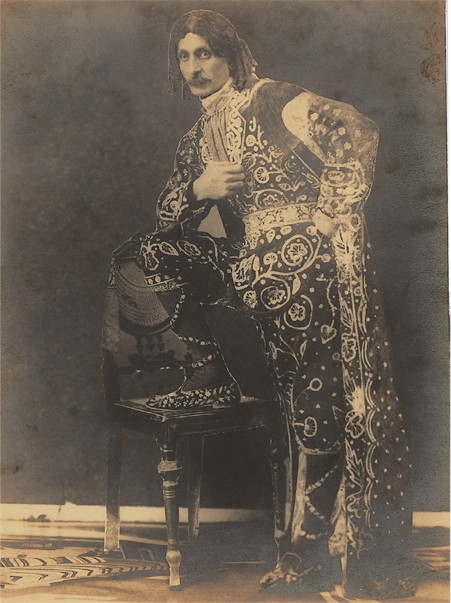
Dossabhai Hathiram dressed for a performance in 1932 Photo: India in Focus — Camera Chronicles of Homai Vyarawalla
The company was called Parsi Natak Mandali and was owned and directed by Gustadji Dalal. At first they presented plays based on Iranian history and mythology. The first play to be staged was the very popular Rustom and Sohrab from the Shahnameh. For various commercial reasons the company did not last for long, but the enthusiasm and support it had generated encouraged many other Parsi groups to start their theatrical units. Between 1853 and 1869 nearly 19 theater companies came into being, some very short lived. The most active ones were the Zoroastrian Theatrical Club, the Parsi Theatrical Company, the Student Amateur Club, the Victoria Natak Mandali and the Alfred Natak Mandali, the latter two being the most successful. The emergence of so many groups testified to the rapid growth and acceptance of Parsi theater in vernacular languages.
Kaikushru Kabraji who was the guiding spirit of the Victoria Natak Mandali started introducing themes not only from the Shahnameh but also from Hindu mythology and the Puranas. He wrote plays based on the Ramayana and Mahabharata such as Luvkush, Nand Batisi and Harishchandra. At the same time he used his English scholarship to introduce themes from famous English plays of Shakespeare and many others. To make sure that the script, acting, choreography was up to the mark, he used to present rehearsals before a committee of eminent scholars headed by Jagannath Shankarsheth. The plays were put on the stage only after their approval. In this way he made sure of getting the approval of society. Also, the members, many of them social reformers, introduced themes dealing with social problems. The companies performed both full scale dramas as well as one-act plays.
Through their historical, mythological and social plays, the Parsi theater movement spread Indian culture, strengthened national integration and aroused awareness of social evils. Parsi Rangmandali or theater is a wide term. Historically speaking, in a way it was Indian theater. Its writings covered all India. In the plays, stories from many Indian languages were included, specially from Hindi, Gujarati, Urdu, Marathi and Bengali. Most of the dramas were written in Hindi, Gujarati and Urdu.
The spectators included Hindus, Muslims, Sikhs and Parsis. Whether they lived in villages or cities, all were interested in watching dramas based on Indian culture, great leaders and their lives, their sacrifices, their heroes and their love stories. When such dramas were performed, the theaters were filled with spectators. Parsi theater did not imitate English theater, but was at first under its influence. It had its own independent existence. If the Parsi dramas of this period are analysed we would find that they were not only influenced by English dramas but also by Sanskrit, Marathi, Gujarati, Urdu plays and by what is called Lok Natak. Plays of this period were written in both prose and poetry. They included different themes from different dramas in various languages. Plays from Sanskrit dramas, operas from Marathi stage and musical folk dramas were adopted. In relation to Indian culture and language a lot was done by ‘Parsi theater’ so it can be properly called ‘Parsi Indian theater.’
When the vernacular theater movement started in Bombay there were only two theaters in existence, the Grant Road Theatre and another one in Khetwadi. The one in Khetwadi was an open air theater with a pit for staging the play with the audience sitting around. It had no other accoutrements and was not suitable for the new dramatic presentations. It was used to stage Bhavais, Tamashas and folk plays in Gujarati and Marathi, all of which were considered vulgar and loud by the changing cultural milieu of Bombay. The profession of theater, then considered low, was generally patronized by the poorer classes. The emerging Parsi theater movement had to face the disapproving attitude of the social elite in the beginning. However they and their sponsors played a great role in making it accepted as a respectable profession.
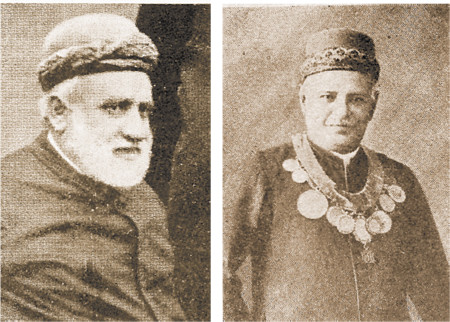
Kaikushru Kabraji (left) and Khurshedji Baliwala Photos: Parsi Lustre on Indian Soil
The new movement began to attract people from all the communities speaking Gujarati, Marathi, Urdu and Hindustani. As the audiences grew, the need for more theaters arose and very soon Bombay saw the emergence of many theaters, the Edward Theatre near Dhobi Talao and the Elphinstone Theatre near Crawford Market to start with. In spite of these more theaters were needed and we see the appearance of the Golpitha Theatre in the Golpitha area and the Rivoli in the place where the Times of India building is to be found today. In about 1870, the Victoria Theatre was built in Grant Road where the performances of the Victoria Theatrical Company were held under the management and direction of Dadi Patel. The theater was very badly constructed and was said to be like a ‘cattle stable.’ In spite of this people flocked there to see the plays. The Novelty Theatre opposite the Victoria Terminus (now CST station) housed the famous and most popular Victoria Theatrical Company which was owned by Khurshedji Baliwala. In the beginning of the 20th century two other well known theaters came into being, the Empire Theater near the Victoria Terminus in 1908 and the Royal Opera House in 1928.
All these theaters and more catered to the growing popularity of ‘Parsi’ theater, which had now become an Indian/national theater movement from the point of production, language, themes and its influence all over India.
People from different provinces, languages and religions came together to watch the plays. This further led to a feeling of unity.
It was also through their dramatic writings that Parsis of this period had proved their mastery over Gujarati and some were acknowledged as such by Gujarati scholars. Foremost amongst them, apart from Kabraji, the doyen of dramatists, were Edulji Khan, Shapurji Bhedwar and Boman Cawas, Nanabhai Ranina, Baliwala, Bamanji Kabraji and Gulfam Jehangir Patel. The last four were pioneers of one-act plays which attracted large audiences. They were usually humorous and farcical.
Edulji Khan was renowned for his plays. Of the 18 plays he wrote, the most popular were Khudabux and Sonana Mulni Khorshed, the latter being translated into Urdu by Behramji Marzban. Many of his other plays were also translated into Urdu and Hindustani. Ranina owned a press where he published his own and the writings of other dramatists. He had begun by translating Shakespeare’s plays into Gujarati for the Parsi Shakespeare Natak Mandali. He also wrote original plays based on social problems such as Naja-Shirin and Karm Tevi Par Utarni.
Cawas wrote about a dozen plays on social issues and also penned stories and contributed to newspapers and journals. Another important innovator on the Parsi stage was Dorabji Aapkattiyar, writer, poet, a gymnast and musician. He started his own opera company to popularize opera plays. In 1853 he composed an opera from the first part of the Shahnameh called Rustom Zabooli and Sohrab in which he played the role of Rustom. It was very successful and he thus had laid the foundation for a series of operas in Parsi theater.
Patel also initiated the Urdu opera by staging Banazir Munir. This was written by the popular Parsi poet-cum-playwright, Nusserwanji Khansaheb. The Victoria Natak Mandli had by now established proper theatrical infrastructure including musicians and produced the ‘opera.’
Having ventured into Urdu and opera production, Patel decided to take his Victoria Company outside Bombay and introduce ‘Parsi’ theater to other Indian audiences and thus give it a ‘national’ flavor. It began when Sir Salar Jung attended one of Patel’s plays in Bombay and subsequently invited him to visit Hyderabad with his troupe. Thus in 1872 the Victoria Mandali gave its first performance before the Nizam and the Darbar.
The visit to Hyderabad opened out other innovations. Coming into contact with court dancers and singers, Patel invited them to join his theater and perform in Bombay, thus introducing a novel element in the theater of the day.
Up to now, women’s roles were played by young good looking boys and men as society did not consider the stage as a respectable career for women. Patel took the risk and succeeded. He wrote a play called Indra Sabha in which he cast Muslim women actresses to act and dance in the main parts. One of the them was Lalata Begum, an expert dancer, who performed so well that she won the approval of the audiences and attracted full houses. Having once got the acceptance of the public, other Parsi groups introduced women on the stage also. Amongst many women players we see the rise and fame of Mary Fenton, Munnibai and Gauben.
Fenton (aka Meharbai), the daughter of a retired Irish soldier, who already spoke Hindi and Urdu, was to have been trained in singing and acting by Kavas Khatau. Her appearance on the Parsi stage launched a new era. Her ability to mimic Parsi and Hindu modes of feminity, her touching singing, accurate pronunciations, acting talent and fair skin created a sensation in the theater. In 1890 Fenton appeared in Gamdeni Gori at the Gaiety Theatre. The play was performed many times by Khatau’s Alfred and Baliwala’s Victoria theaters and later became a popular silent film starring Sulochana (1927). Fenton also featured in Alfred productions’ Alauddin (1891), Bholi GuI (1892), Tara Khurshed (1892) and Kalyug (1895). She is said to have died at the age of 42.
Around 1880 Baliwala brought women into the Victoria Company beginning with Gohar, who was followed by Malka Fatima, Khatun and others. A given actress could racially be Irish, British, Anglo-Indian or Indian. It is important to remember that as a rule, Parsi women did not appear on the Parsi stage. Hindu actresses in the Parsi theater were also next to non-existent. What the audience wanted from the Anglo-Indian actress nonetheless, was a convincing portrayal of the Hindu or Parsi middle-class housewife. Fenton’s ability to imitate the signs of respectable married women, the use of the sari ‘anchal’ over the head, the jewellery, the particular cut of the bodice earned her the highest esteem from the public. Once more the spectators’ pleasure lay in the seemingly effortless impersonation of domestic feminity.
Female impersonators likewise stood their ground and remained as popular as ever as a stage convention and continued well into the 20th century, retaining their popularity with audiences and with company managers. The long list of men who played women’s roles in the history of Parsi theater is remarkable. They seem to form the majority rather than the minority of the class of actors. Jayshankar Sundari from the Gujarati stage and Bal Gandharva from the Marathi musical theater (‘sangit natak’) are well-known. Sundari was discovered by recruiters from the Urdu language Parsi company of Dadabhai Thuthi. Sundari perfected his knowledge of Urdu and developed his characteristic feminine gait during his apprenticeship with the Parsi company. Bal Gandharva (aka Narayan Shripad Rajhans, 1888-1967) was a contemporary of Sundari. In 1905 he joined the Kirloskar Drama Company replacing Bhaurau Kolhatkar, the first successful female impersonator of the Marathi musical stage who had just died. His debut was in the title role of Shakuntala on a newly built stage before the Prince of Miraj.
"Through the institution of female impersonation a publicly visible respectable image of ‘woman’ was constructed, one that was of use to both men and women. This was a representation that even attached to the material male body, bespoke modernity. As one response to the British colonial discourse on Indian womanhood, the accusations against Indian men on account of their backward degraded females, the representation helped support men dovetailing with the emerging counter discourse of Indian masculinity. Moreover, women derived from these enactments an image of how they should represent themselves in public. Female impersonators by bringing into the public sphere mannerisms, speech and distinctive appearance of middle class women defined the external equivalents of the new gendered code of conduct for women. That such tastes were crafted by men (albeit men allegedly imitating women) gave them the imprimatur of acceptability,” wrote Kathryn Hansen in her article in the Economic and Political Weekly of August 29, 1998.
Both the Gujarati and Marathi theater movements were heavily influenced by the Bombay Parsi theater. Indeed, they were in competition with Parsi productions for the heterogeneous cosmopolitan audience throughout the latter half of the 19th century. Linguistic and communal differentiation became more marked after 1900 but the mutual contact and exchange among these theaters continued particularly in the areas of musical style, popular stories, scenery and costume design. The functioning of Parsi theater was widely copied. The infrastructure and organization of the theater and its themes were adopted by Marathi, Gujarati and Hindi theater towards the end of the century. Thus the Parsi theater became the Indian national theatre.
The main attributes of Parsi theater, appreciated and accepted, were its excellence of performance as well as its discipline and infrastructure. As the theater developed, its commercial viability had to be looked after. For this it had to maintain a very high standard of performance and management. From acting, diction, singing, stage management, the proprietors and directors of the mandals tried to perfect every aspect. The choice of the play depended many times on the abilities of the actors and the suitability of the part. The writers were often asked to rewrite the parts and situations accordingly. Next came very meticulous rehearsals usually taken up during the daytime as the shows were usually in the evenings, as Kabraji used to do.
Some mandals even rehearsed a play for a full year. The director also decided on the sets, costumes, and saw that the music was well organized. Great care was taken by him in the choice of dress and ‘period’ dresses were carefully researched. Scripts were carefully scanned by the proprietor and director and frequently, sentences were changed till they expressed the exact meaning. Sometimes different writers were asked to express particular sentiments.
With the introduction of singing and dance in Parsi drama the director and manager of a company usually invited a music director and senior and junior harmonium masters who trained the singers and dancers. The music was a synthesis of Hindustani classical and folk music, usually from Gujarat. The Parsi theater also introduced intricate sets. A great deal of thought went into designing them and guiding the craftsmen concerned. Here, we see the influence of European stage management.
All these elements of Parsi theater were adopted by other Indian language groups, making Parsi theater a leading part of the Indian cultural scene in the second half of the 19th century. ‘Parsi’ theater became the ‘Indian stage’ in that sense. Annasaheb Kirloskar of the Marathi stage for instance was inspired to stage the operatic form of Shakuntala after seeing the performances of Indra Sabha staged by the Victoria Natak Mandali in 1880. The beginning of Hindi theater is indebted to ‘Parsi’ theater. Bhartendu Harischandra adopted the stage and technique of Parsi theater in the production of Hindi drama.
In the beginning in Parsi theater most of the directors and actors were Parsis. However, in the first decade of the 20th century, Marathi, Gujarati, Marwadi and Hindi speaking persons started joining the Parsi theater as directors, actors and singers. This changed the form and activity of the Parsi theater. It created a New ‘Rangmanch’ which attracted Marathi, Gujarati and Urdu speaking actors. Even the music now changed and was based on classical music. At this time Baliwala’s Victoria Company started performing dramas based on religion.
These Parsi dramatic companies were Parsi just in name. Their involvement was completely Indian. In thought, language and acting, even though it was known as Parsi, it was an integral part of the whole nation. By presenting mythological heroes and other stories they contributed to the development of national feeling amongst Indians, thus making a valuable contribution. They raised the level of plays and made it possible for women to attend the dramas.
Parsi theater continued to be popular till about the middle of the 20th century when its popularity seems to have petered out. However, Adi Marzban, Feroze Antia, Ratan Marshall and Homi Tavadia had kept the theater alive till then. After Marzban, the last ‘great’ of Parsi dramatists passed away the spirit seems to have gone out of the Parsi theater. It still exists, but in a very limited form. The audience of Gujarati, Hindi and Marathi speaking people began to be divided with the growth of these language theaters which developed new techniques and new styles and theories of modern drama. Parsi dramas did not keep pace with these changes. Fewer and fewer dramatists were found writing for the theater and gradually Parsi theater began to represent ‘farce’ rather than drama. The growth of the cinema also ate into the Parsi theater audience.
A historian and writer interested in Parsi history, the late Dr Mani Kamerkar was vice president of The Asiatic Society of Bombay. She was former director, College Development Council, of the S. N. D. T. Women’s University in Bombay and served as principal of the Nanavati College.
◆ ◆ ◆
From the archive