
Books
To protect and preserve
Another book from the prolific pen of Dr Thrity D. Patel, co-authored with Dr Azimkhan B. Pathan, titled Protection and Conservation of Biodiversity: Legal Regime. National and International Perspective, throws light on a pressing national and international socio-legal issue.
 Patel, an academician-cum-activist is Emeritus Professor and former head of the department of law and dean, Faculty of Law, Nagpur University. She is also chairperson of the Centre for Education of Human Rights, Research and Advocacy (CEHRRA). Her earlier books were titled Personal Liberty under the Constitution of India and Death Penalty. Guide to 21 PhD research scholars, Patel is on the board of trustees of the J. N. Tata Parsi Girls High School and Junior College, Nagpur. Pathan, a faculty member and research associate in Hidayatullah National Law University, Raipur, has presented research papers at national and international conferences. "Emerging Concept of Global Warming at International Level and effect of Climate Change on the Environment” was the topic for his PhD.
The book under review has an interesting Foreword by Justice V. S. Sirpurkar, retired judge of the Supreme Court. It begins with a quote from nuclear scientist and former President of India Dr A. P. J. Abdul Kalam which serves as a dire warning of things to come: "We won’t have trees in parks or houses with beautiful gardens. We won’t be able to enjoy having a shower for half an hour. Within a short time life on earth will not be possible, as destruction of nature has reached an irreversible state.”
Sirpurkar lauds the painstaking efforts of the authors in presenting a detailed analysis of the legal issues pertaining to the preservation of our environment. He says, "Laws alone cannot transform the outlook or the circumstances. It is the people of India who have to adopt a positive, pro-active attitude for the preservation and betterment of our mother earth.”
Patel, an academician-cum-activist is Emeritus Professor and former head of the department of law and dean, Faculty of Law, Nagpur University. She is also chairperson of the Centre for Education of Human Rights, Research and Advocacy (CEHRRA). Her earlier books were titled Personal Liberty under the Constitution of India and Death Penalty. Guide to 21 PhD research scholars, Patel is on the board of trustees of the J. N. Tata Parsi Girls High School and Junior College, Nagpur. Pathan, a faculty member and research associate in Hidayatullah National Law University, Raipur, has presented research papers at national and international conferences. "Emerging Concept of Global Warming at International Level and effect of Climate Change on the Environment” was the topic for his PhD. The book under review has an interesting Foreword by Justice V. S. Sirpurkar, retired judge of the Supreme Court. It begins with a quote from nuclear scientist and former President of India Dr A. P. J. Abdul Kalam which serves as a dire warning of things to come: "We won’t have trees in parks or houses with beautiful gardens. We won’t be able to enjoy having a shower for half an hour. Within a short time life on earth will not be possible, as destruction of nature has reached an irreversible state.”
Sirpurkar lauds the painstaking efforts of the authors in presenting a detailed analysis of the legal issues pertaining to the preservation of our environment. He says, "Laws alone cannot transform the outlook or the circumstances. It is the people of India who have to adopt a positive, pro-active attitude for the preservation and betterment of our mother earth.”

Dr Thrity Patel, author and activist and Dr Azimkhan Pathan co-author
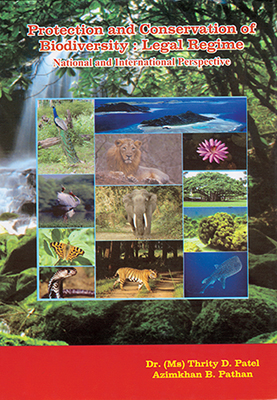
The book has a fine cover picturing the flora and fauna of the country and well edited content. It would be most informative for students of law and the environmental sciences, for policy makers and public administrators in implementing laws for the protection of the environment.
The authors have made an in-depth study of endangered wildlife and threatened plant species of the country from a geographic background as well as a historic presentation of awareness regarding their conservation from Vedic times to the present day.
In ancient India, protection of biodiversity and cleaning up of the environment was the essence of Vedic culture. The forces of nature were feared, respected and worshipped. The Atharva Veda considers trees as the abode of the gods. The Yajur Veda emphasizes that the relationship of human beings with nature should be one of mutual respect. The Vishnu Dharmasutra went so far as to say that if you plant a tree today, it will be re-born as your son!
Sadly, during the Mughal and British period the protection and conservation of our biodiversity was almost non-existent. To both these invaders, forests meant no more than wooded areas where they could hunt for their selfish pleasure. During British rule specially, there was exploitation with the primary objective of earning revenue.
Soon after independence, in 1950 to be exact, the country adopted a national tree planting festival, Van Mahotsava to sensitize people on the importance of the forest cover for human well-being. The government also took a fresh look at the Forest Policy of 1894 and put forth a revised National Forest Policy, 1952. Under the latter, the states were given control and it was their responsibility to provide timber and other forest produce to industries and the railways. In spite of the supposed state control, depletion of natural resources continued unabated.
The 1970s marked the beginning of the history of biodiversity and environmental policy in India. The entire world was becoming acutely aware that thousands of species of trees, plants, flowers and fruit as also insects and animals were on the verge of extinction. Some had vanished altogether.
In the Eleventh Five Year Plan (2007-2012) the Indian government finally took cognizance of the gravity of the problem of depletion of natural resources and of wild animals. The following umbrella schemes were launched: Development of National Parks and Sanctuaries (DNPS); Project Tiger (PT); Project Elephant (PE); and Protection of Wildlife Outside Protected Areas (PWOPA).
Many worms, insects and creatures deemed useless or undesirable actually play a crucial role in maintaining the eco-balance. Earthworms and termites aerate the soil. An adult frog consumes its own weight in insects each day. Innumerable such examples, not widely known, are mentioned.
The 42nd Amendment to the Indian Constitution enumerates certain fundamental duties under Article 51-A, making it mandatory for every citizen to protect and preserve and in no way degrade the environment. Part IV of the Constitution which deals with Directive Principles of State Policy imposes under Article 48-A a mandatory duty on the states to protect the environment and biodiversity.
"Sustainable Development” is the new mantra. It is development that meets the needs of the present without jeopardizing the well-being and existence of future generations. While on the one hand we must not ravage the environment, on the other we must develop alternate sources of energy such as solar panels to replace fossil fuels like oil and coal.
The book enumerates various international treaties and Indian laws, plans and policies to recognize and protect the boundaries of a finite and delicate environment that we must protect for ourselves and more importantly for our children and grandchildren.
Patel and Pathan have presented an exhaustive and interesting collection of case laws and judicial pronouncements. If any criticism can be made, it is that the book is repetitive in parts.
◆ ◆ ◆
From the archive