
Cover Story
An eye on the environment
As Asia regional director of the International Union for Conservation of Nature Aban Marker Kabraji oversees the functioning of nearly 100 enviornmental initatives
"We get up every morning believing we can achieve something,” observed Aban Marker Kabraji who as Asia regional director of the International Union for Conservation of Nature (IUCN) has been providing strategic leadership for the organization’s work in 24 countries. With a seat reserved for IUCN in the United Nations’ general assembly, they maintain "a scientific core that advises the international organization’s agencies on issues concerning environment, social development, equity, gender…” she explains referring to her privileged position where she can "influence a country’s work without being a politician.”

Aban Marker Kabraji
On her way to Delhi to attend the Delhi Development Summit in early 2011, Kabraji had made time for an interview with Parsiana when passing through Bombay. Traveling is an integral part of her job, for though she chose Bangkok for the headquarters of the Asia region, she oversees the working of 350 staff in offices in Bangladesh, Cambodia, China, India, Indonesia, Lao PDR, Nepal, Pakistan, Sri Lanka and Vietnam. "Bangkok is accessible within five hours from any of these countries. Further, this country gives access to anybody, the environment is safe and secure and it is cost effective,” Kabraji cites her reasons for choosing the capital of Thailand over alternatives like Singapore, Hong Kong, Kuala Lumpur.
The working of IUCN is divided amongst eight regions with each of the eight regional directors reporting to the director general who is based in Switzerland. "IUCN gets its funding from the governments of member countries foundations, business houses, nongovernmental organizations and philanthropists,” explains Kabraji. Membership to this body is granted to states as also to governmental and nongovernmental agencies. There are business houses too with which they collaborate without granting them membership. When the Tata Group faced hurdles whilst developing the port of Dhamra in Orissa due to the possibility of sea turtles being endangered, it was IUCN’s expertise that they sought, mentioned Kabraji. At another time they were consulted by the Oil and Natural Gas Commission, she cites recent instances.
 IUCN.jpg)
 Oscar Gutierrez.jpg)
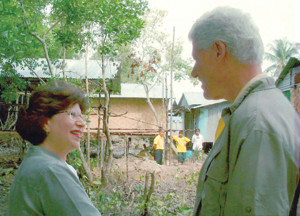
Aban Marker Kabraji with Nelson Mandela (left) and Bill Clinton; (Above) Planting mangroves in Baluchistan, Pakistan as an IUCN effort
In recognition of her running one of IUCN’s largest regional programs with nearly 100 environmental initiatives in the Asia region, she has been additionally appointed as the director general’s senior advisor on regionalization and as coordinator of all regional programs worldwide. The director has had extensive experience negotiating with governments, IUCN members and partners to support implementation of major global treaties like Convention on Biological Diversity (where 189 countries and the European community have agreed to share resources and technology so that all biodiversity benefits), Convention on the International Trade in Endangered Species and the Ramsar agreement (advocating conservation and wise use of wetlands). It may be difficult to talk of saving trees and tigers in countries where the majority are living below the poverty level yet the environmentalist is constantly impressing on policy makers the need to introduce programs whereby the poor who are heavily dependent on natural resources for their survival do not suffer when there is degradation of forest and water bodies.
The Asia director is additionally a member of the wildlife trade monitoring network TRAFFIC Committee, has served on the governing board of the International Institute for Sustainable Development and was a founding member of Shirkat Gah: Women’s Resource Centre (a leading women’s rights organization in Pakistan). To effect socioeconomic value change, "Start with the assumption that you can trust people, and people rise to that expectation… through sheer persistence you will wear out all opposition for the simple reason that most people will not have the patience or the interest in continuing to argue against you,” the optimist had shared her work philosophy in an earlier interview.
Besides serving as the lead liaison between IUCN and the Asian Development Bank, Kabraji co-chairs the Regional Steering Committee for the IUCN-UNDP (United Nations Development Program) led Mangroves for the Future that promotes investment in coastal ecosystems. With this project spanning 12 countries IUCN studies "how they manage the ecosystem, within the country and transboundary; take things done at the demonstration level and step it up to implementation level,” she elaborates. She cites the example of Sunderbans in the Ganga-Brahmaputra Eco System where they "start forging links, talking to experts, coordinating with the government and institutes.” Yet other regional initiatives she co-chairs include Ecosystems for Life covering Bangladesh and India, and the Mekong Water Dialogues. Hitherto her region has been focusing on southeast Asia but she would now like to give attention to Korea, China and Japan in the north.
Whilst Kabraji has been Asia director for the last nearly 12 years, her association with IUCN has been for twice this period, spending the initial years from 1988-99 as Pakistan country representative when she had to develop a National Conservation strategy and secretariat within the ministry of environment in Pakistan. Prior to this posting Kabraji was regional director, World Wildlife Fund, Sindh Region and principal investigator, Marine Turtle Conservation Project, Sindh Wildlife Management Board.
Her skills were further honed by participating in the World Bank Sustainable Development Leadership Programme at Churchill College, Cambridge, World Bank Executive Development Programme at Harvard and Stanford, and Women in Management, Centre for Development and Population, Washington. As McCluskey Fellow and visiting professor at the Yale School of Forestry and Environmental Studies she designed and taught the Masters and PhD research seminar: "Ecology in Practice: Issues in Conservation and Development in Asia.”
With 2011 being declared the International Year of Forests, does burning of wood in fire temples cause a conflict of interest between her professional life and religious practice? "I see nothing wrong in burning wood, if it is sustainable. As an environmentalist I’m against overuse and exploitation…” maintains Kabraji who is well aware that sandalwood features in the endangered list. The consumption of sandalwood by Zoroastrians must be but a fraction of that used by other faiths and denominations, she adds.
 IUCN.jpg)
 IUCN.jpg)
IUCN monitors mountains and mangroves: Mt Kanchenjunga, Nepal (left) and mangrove nursery, Thailand
Viewing Doongerwadi as an ideal environ to witness "the cycle of birth and rebirth,” Kabraji would like the dakhmenashini system to continue although she considers pollution from an electric crematorium "too minor to be of significance.” She maintains, "It might be feasible to bring back the vultures from extinction… to support a resident colony of raptors with the help of avian biologists… I don’t think there is lack of money among the Parsi community.”
There is no stench of rotting bodies emanating from the dakhmas in Karachi, states Kabraji. But then community deaths in Karachi may average three a month as compared to over 60 a month in Bombay. Viewing the Doongerwadi land as "the lungs of the city,” she continues, "That area is so vital to Bombay.” If use of the dakhmas were ever to be discontinued, "we would lose land that is too valuable,” she observes. The respect that Zoroastrians have for nature and their world view "has evolved from the rugged landscape and harsh and demanding climate” in Iran where the religion had its roots, points out Kabraji. When helping her daughter Rosheen select a subject for her PhD thesis she noticed that the terrain in Quetta, Baluchistan where Kabraji had her parental home was similar to the territory that made ancient Zoroastrians who were pantheists (believers in the doctrine that God could be equated with the forces and laws of the universe) "feel very close to the soil and perceive an interdependence between all elements in nature.”
In the course of her frequent travels, Kabraji visits an agiary whenever possible. "If I can’t find an agiary I go to a church and light a candle or spend some time in a tranquil spot like in a park,” she states. During her childhood, a trip to an agiary in Bombay invariably meant the Vachaghandhy Agiary on Hughes Road, identified by the Marker family as "Mummy’s agiary.” During the winter months from November to March when it was too uncomfortable for her polio afflicted mother to face the Quetta cold, her father Kurhseed would send the family (wife Roshan with children Aban, Meher and Ardeshir) to Bombay. And since there were no steps to navigate when entering the Vachaghandhy Agiary it was considered user friendly for her mother who was confined to the wheelchair.
Kabraji is familiar with the religious rituals and their significance but admits that her use of sudreh-kusti is "very variable. If it gets very hot, I may take it off or if I run out of clean sudrehs when traveling, I may not wear it. I am not hung up about it.” Her twin sons, Shahpur and Sheheryar, aged 28, although living in London wear the sudreh regularly and ask her for a new set every six months. Sheheryar’s marriage to a non-Parsi was accepted by the family once they realized that "with the best of efforts finding (a suitable partner) from the community is the greatest problem in the diaspora. If the youth meet more (community members) regularly, they would find them.” As long as outmarried individuals "maintain their identity and faith in their religion,” she is amenable to accepting the children of interfaith unions, irrespective of whether the man or woman has a non-Zoroastrian spouse.
On graduating from the University of London as a biologist after her schooling at St Joseph’s Convent in Quetta followed by the Karachi Grammar School, Marker enjoyed her work as a "hardcore biologist doing biological research, microbiology and pharmacology.” Besides gaining some experience in Germany, England, and USA where she worked as consultant to the Ford Foundation, she devoted herself to the family owned Marker Alkaloids and spent some years as manager, Biological Quality Control. Marriage to Kairas Kabraji who has a law practice in the name of Kabraji and Talibuddin, made her shift base from Quetta to Karachi where started her involvement with environmental issues.
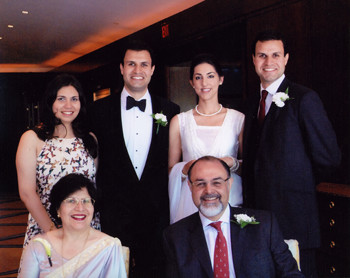
Aban and Kairas (seated) with children (from left) Rosheen, Sheheryar, Yureeda and Shahpur Kabraji
"We are part of the post women’s lib generation,” stresses Kabraji. "My maiden name, Marker, was my identity to which I added my husband’s surname, Kabraji.” Likewise did her sister Meher Marker Noshirwani who based in Pakistan is supportive of Parzor’s efforts to revive community arts and crafts. Kabraji too has an eye for crafts and unusual artifacts she can purchase during her tours. Going to museums and galleries, reading on heritage and culture on her flights, and her love for dogs she lists among her interests. Since she cannot keep a dog at her house in Bangkok, their office has adopted two dogs. She further supports the organization Guide Dogs for the Blind which sponsors a dog for someone who is visually handicapped.
Leading a "hip-hop life between three homes,” Bangkok, where she has her base, Karachi, to which she returns every six weeks, her husband being there, and London where her children are settled, for the present Kabraji does not want to accept any more responsibilities. She is clear, "Ambition is not always to move to the top but pursuing what you want to do. If what you do satisfies you, that’s more important.”
◆ ◆ ◆
From the archive