
Books
To kill, or not to kill
Death Penalty — National and International Perspective by Dr Thrity D. Patel and Rohini A. Mahurkar. Published in 2010 by CEHRRA Publications, 001, Konark Apartment, Khare Town, Dharampeth, Nagpur 440010. Pp: 412. Price: Rs 600.
The book release function organized by the High Court Bar Association in Nagpur, on June 19, 2010, starting with a quote on the quality of mercy being twice blessed, was a morning of muted grace, elegance and erudition.
The book in question was titled Death Penalty — National and International Perspective, jointly authored by Dr Thrity Dinshaw Patel, Professor Emeritus, former Dean and Head of Department of Law, Nagpur University and Rohini A. Mahurkar, a research scholar.
The book was released at the hands of Justice V. S. Sirpurkar of the Supreme Court of India. In his inimitable, wise and witty style the judge congratulated the authors on an excellent book dealing with a very controversial and current question. Talking of the public clamor to execute the 26/11 accused Ajmal Kasab, Sirpurkar said society needs to under- stand the seriousness of the death pen- alty. "It is not as easy as going into a shop and buying candy,” he opined. "Imagine the feelings of a judge who knows that his signature will put to death a person who is someone’s son, brother or mother. It is a grave responsibility.”
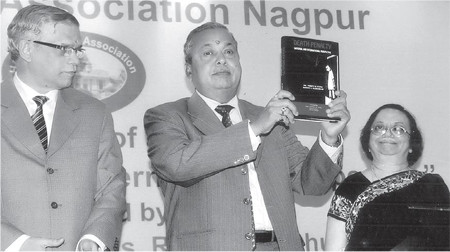
Justice V. S. Sirpurkar releases book as Justice A. P. Lavande and Dr Thrity Patel look on
With a smart black, red and white cover and 412 pages of clear print, the USP (unique selling proposition) of Death Penalty is that it is easy and inter- esting reading for the lay person and is not directed only to the legal fraternity. The authors have taken a holistic ap- proach, going back in history to differ- ent, often gory modes of execution; making a geographic assessment of coun- tries that have abolished the death pen- alty or not used it for the last 10 years and those who have retained it but use it in the "rarest of rare” cases, as in India. They have researched in depth the co- relation between religion and capital punishment, studying legal case histo- ries and precedents, making a lucid pre- sentation of the pros and cons of the death penalty, which makes the reader pause and ponder over his own stand on the subject.
No aspect of justice has aroused as much controversy as the death penalty. In layman’s terms it is legalized killing of human beings.
The arguments in favor of the death penalty are strong for it contains ele- ments of deterrent effect and retributive effect. It is invoked to protect society from heinous crimes by violent crimi- nals. It saves the state an enormous amount of money and man-power that can be put to more produc- tive use. The final argu- ment is that those who do not value the life of others nullify their own right to life.
The anti death penalty lobby is equally persua- sive. They argue that it is irreversible. If a miscar- riage of justice is subsequently discov- ered, the extinguished life cannot be restored. Another line of reasoning is that the crime, not the criminal, is the actual problem. One needs to get to the root of the crime and remedy it. Most violent crimes are committed in the heat of passion by persons who may nor- mally be peaceful, law-abiding citizens, it is argued.
The author categorizes heinous crimes like murder under four main heads: neu- rotic and psychological murders that stem from strong emotions like love, honor, jealousy and greed; political murders that are mostly planned and committed in cold blood; economic murders due to extreme poverty or immense wealth; and religious fanaticism. The criminal law system in India seeks to balance indi- vidual freedom with the social and col- lective interests of society, a balancing act requiring great expertise.
Standing out brightly amid a lot of dreary legal jargon, is a page delineating Article 21. The legal interpretation of Article 21 includes, as part of the right to life, the right to live with human dignity, the right to livelihood, the right to shel- ter, the right to health and environment, the right to development and education, the right to privacy, among other rights.
There is the other side of the coin. Does the right to live with human dignity confer a corresponding right to die with dignity if a person chooses to end his life? This is a debatable issue, but being outside the ambit of the book it receives only passing mention.
The sentence of death can be reversed by the President of India or the governor of the state by an act of grace or mercy. In some cases the pardon is an executive expediency, when there is perceived danger of riots, revolution and loss of life on a large scale.
While the death penalty is yet to be banned under international law, there is a growing consensus in favor of its abo- lition. In 1982 Justice V. R. Krishna Iyer made a strong plea for abolition of the death penalty, but did not succeed. As a consequence India is among the coun- tries that has retained capital punish- ment, albeit in the rarest of rare cases.
Patel and Mahurkar have presented an unbiased and objective collection of facts in their book. However, when asked her personal opinion on the subject, Patel opined the time was not ripe to abolish capital punishment, especially in view
of terrorist and Maoist threats to the nation. When asked whether the death penalty was not inhuman, she said, "Hu- man rights should be applicable to those who consider the human rights of others. Criminals who have no respect for life or law cannot expect a ‘humane’ response from society.”
The book is not Patel’s first one. Nor will it be the last. Her first book Personal Liberty under Constitution of India pub- lished in 1993 was well received. Writ- ing of her third book, Protection and Conservation of Bio-Diversity, is already under way.
The youngest of seven children whose father worked for the Model Mills in Nagpur, Patel has risen to the top of her profession against all odds. Her mentor or guiding light was her older brother,
the late Justice Hoshang Patel. Intelligence, ethics, hard work and a sense of duty are the steps she used to climb the steep stairway of success. From a young age, even while studying, the devoted daughter looked after her ailing mother and until recently a brother as well. Emerging from the crucible of fire is a woman of courage, character and com- passion. At present her main area of concern is human rights, specially the rights of prisoners, children and women which she addresses through an NGO (nongovernmental organization), CEHRRA (Centre for Education of Hu- man Rights, Research and Advocacy), of which she is the chairperson.
Patel was conferred an Emeritus Fel- lowship by the University Grants Com- mission when she retired as head depart- ment of Law and dean, Faculty of Law, Nagpur University. For the third time in succession she was appointed a nominee member of the NHR (National Human Rights) Commission for Nagpur Central Prison. Her term ended recently.
Amongst the many awards she has won, innumerable to name, are the Gov- ernment of Maharashtra Best Teacher Award in 2004; the Rajiv Gandhi Excellence Award and Rashtriya Gaurav Award in 2009 and the Excellence in Education Award, 1995, given by the Federation of Parsi Zoroastrian Anjumans of India.
Patel has been teaching law for the last 30 years. Thirteen research scholars have acquired their PhD under her guid- ance and eight are conducting their re- search work at present.
Despite her deep involvement in aca- demics and human rights, she is active in the affairs of the Zoroastrian community of Nagpur, extending the benefit of her legal expertise and her time. A member of the managing committee of the Nagpur Parsi Anjuman for the past 25 years, Patel is also vice president of the Nagpur Parsi Gymkhana and on the board of trustees of the J. N. Tata Parsi Girls High School there.
At the end of the interview, Patel recalled that the first ever article on her was written by this reviewer in 1972 and published in the local community maga- zine Dharmaprakash. It had been titled "Little legal eagle.” The eagle has soared to great heights impressing her students and readers with the wingspan of her activities and achievements.
DILNAVAZ BHAGWAGAR
◆ ◆ ◆
From the archive