
10WZC
Till death do us apart
Divorce lawyers favor early marriage and permanence
"Marriage is a sacrament. Temulji Nariman (the founder and chief physician of the Parsi Lying-in Hospital), married at the age of five, lived till 92 and was married for 87 years,” sermonized Ervad Burjor Antia, aged 80, whilst chairing a panel discussion on "Late marriages and divorce amongst Parsis” on December 28, 2013 at the 10th World Zoroastrian Congress. "Now courtship is two-three years, marriage is two-three years. What happened to our vow of pasandé kardam (do you accept your new spouse)? It is a mockery of our ashirwad,” the solicitor exclaimed. One of the youngsters present wondered if he would even live for 87 years, leave alone remain married for so long.
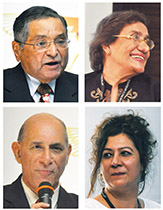
Clockwise from top left: Burjor Antia; Armaity Khushrushahi;
Taubon Irani; and Firoze Andhyarujina
Antia quoted that average age at marriage for the Indian male is 20-24 years whilst for females it is 18-24 years. The average age at marriage for Parsi men is 34 years and for women, 30. He also mentioned that the divorce rate in the community is around 10%.
The panel comprised practicing lawyers Firoze Andhyarujina, Armaity Khushrushahi and Taubon Irani. There were references to social, demographic and "religious” data and reasons given for late marriages and divorces. No marriage, restricted families, being nitpicky about choice of spouse, differences in age, out-marriages and all the other often heard causes were also articulated.
Andhyarujina reiterated that marriage was a sacrament, a holy union. He acknowledged the absolute necessity to re-define marriage. He advised couples not to "think of the word ‘compromise’ as an ugly word.” He bemoaned that "even when couples are told to compromise, they are not willing” to do so. He blamed parents for "taking back children” into their parental homes when marriages do not work out and "thereby showing leniency.” Family’s inability to defining what is acceptable as unobjectionable hardship, leading to grounds for separation and social dereliction formed the prime basis for divorce by mutual consent. Andhyarujina also blamed narcissism: "I for me, my and mine which leads to no collaboration… The easiest is to divorce on ‘mis-match,’” he said. He felt, "As the community advances, more divisions take place. Both late marriages and divorce are negative issues.” The tax lawyer, who has been giving public talks on the annual Union budget since 1994, then noted that "girls outshine boys and are higher educated because of their genes.” He referred to statistics such as 31% of the Parsi population is over 60 years, 30% are unmarried and then posed the question: "How can we grow?”
In the same mold, Khushrushahi, with 40 years’ practice at family courts, bemoaned that there are fewer arranged marriages now; that the community is liberal and influenced by western thought; she claimed lack of housing and parents not telling the girl to go back to her married home led to divorces. Parents today say that they don’t mind whomsoever the girl marries, whether Zoroastrian or non-Zoroastrian. "When girls go to work, they meet males of other communities and so get married to anyone, (but) to get adjusted, a couple needs to be alone.” She also made reference to reasons leading to out-marriages — emigration resulting in Parsis marrying locals and little religious education being imparted.
Irani quoted instances from her 20 years of practice in the matrimonial court. She alluded to a client who came to her the day after the marriage complaining that his new wife was disrespectful of his parents. "Tolerance is low and we snap,” she proclaimed. She also noted how couples use children to extort money, how parents make children lie, manipulate and disregard ethics. She cautioned the young audience with "stop behaving like babes or mama’s boys.” She too reiterated Antia’s advice to marry early and have two or three children.
At the question and answer session, a delegate commented that he was told that "if you marry at 20, it’s like leaving a party at 8 (pm).” Irani’s quick repartee was: "Marriage is not a party, man; this is life.”
◆ ◆ ◆
From the archive