
Avenues for alliances
Despite the plethora of matrimonial websites, the traditional matchmaker is still in demand
Through their educational institutions, work place, residential colonies, membership on different cultural and sports organizations, religious and social commitments, those in their twenties have avenues aplenty to compare and contrast the members of their own community with those of others and narrow down their choices depending on their priorities. If they have not found a spouse before they reach their thirties, pressure starts mounting and the services of self-appointed or professional matchmakers are considered.
 When speaking to groups and individuals endeavoring to play matchmaker in the community, we realized that most had taken up the mantle in the interests of preserving the Parsi race and the Zoroastrian religion. In the last few decades there has been a spurt of community organizations viewing their role as matchmakers seriously: the Bombay Parsi Punchayet’s (BPP) matrimonial bureau, online portals like Chaalo Kaaj Kariye, masterminded from Delhi, and the FEZANA Journal, the quarterly publication of the Federation of Zoroastrian Associations of North America (FEZANA). There are yet other organizations like the Federation of Zoroastrian Youth Associations (FOZYA), the Zoroastrian Youth for the Next Generation (ZYNG) and the Holiday Programme for Youth whose activities have brought young couples together.
The revived BPP matrimonial bureau under trustee Arnavaz Mistry had its first function in February 2010. Currently registered with them are 400 females and 700 males of whom 40 ladies and 140 men are aged over 40, reports Mistry’s colleague Zarin Havewala. Those on their list include "even those aged 70 who seek marriage partners for companionship,” states Mistry. Besides India, they have candidates from New Zealand, Karachi and the US with whom they keep in touch by email. They expect no payment for this voluntary service and state they have been able to arrange 19 marriages during this period.
For their regular monthly meets at Della Towers at Dadar around 30 are in attendance and only those under 40 are encouraged to attend the functions which in addition to fraternization include programs like karaoke, sessions on grooming, religious discourse by Ervad (Dr) Ramiyar Karanjia… Parents are not permitted in the same hall to ensure that the children shed their inhibitions. On their picnics the attendance is twice that at their monthly meets.
The ladies clearly want husbands in the high income bracket and Mistry has realized that young men in the "Rs 25,000-30,000 monthly income bracket né jota bhi nathi (are summarily dismissed).” The other mindset among the females is to look for spouses who have large premises and are from south Bombay and if they hear of those with residences in Borivli or Vikhroli or New Bombay, their immediate reaction is "o baap ré (Oh my God)!” Men want not only spouses who are good looking and refined, but also those who can supplement their income.
Mistry would like to introduce counseling sessions prior to marriage so that the partners develop patience and have realistic expectations of each other "instead of complaining that ‘péli èm boli, né pélo tèm bolio (she said this and he said that).’” Besides Havewala, Mistry’s team of volunteers includes Kashmira Khambatta, Shiraz Guard and Hutokshi Dadabhoy.
ZYNG had their first Speed Dating session in 2010 after which they have had two more. Young men and women are given an opportunity for one-to-one interaction for three minutes after which they move to the next individual. To impress on the individuals that "you can’t judge a person in limited time” they have youth icons like Parizad Kolah-Marshall to remind them that even a 10% interest in one individual should be nurtured by giving him/her a chance at a subsequent meeting when respect may increase to 30% or 50%, mentions ZYNG core team member Pearl Tirandaz. Contrary to the usual stereotype that Zoroastrian females and males have unrealistic demands, ZYNG organizers believe the right person in front of those seeking matrimony would convince them to level their expectations and find a meeting point.
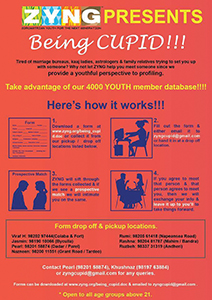
Under their Being Cupid initiative they invite those interested in matrimony to fill out their online forms after which the ZYNG team "will try and match according to what we think is appropriate. The first date is then sponsored by us,” adds Tirandaz. Although they are aware that 20 couples have been out on the first date, ZYNG has no records of how many marriages materialized through them. They see their role as bringing couples together, not in cajoling or forcing them to take it forward. "Our approach is different… We do not want to nag them or pressurize them with regular follow-up. We believe individuals are old and mature enough to take their own decisions.” Their data base includes more than 220 names including those aged up to 60 years "who may find our concepts funkier.” In their Speed Dating sessions though the age limit is 40 years.
Chaalokaajkariye.com, a free matrimonial service open to Parsis and Zoroastrians aged 18 years and above from anywhere in the world as long as they are not engaged or married at the time of application, is the initiative of Delhi Parsi Anjuman trustees Cyrus Engineer and Veera Mavalwala. Since they started in September 2011, they know that eight matches were made through them. Currently enrolled with them are 323 males and 186 females.
Whilst some of those enrolled are "too choosy...too demanding” there are others with "set ideas and very closed mind who reject profiles without even meeting them personally.” They cite instances where one woman refused 27 proposals for trivial reasons like "he is too tall,” "he looks old” (forgetting that she herself is 42 years old), "I will not stay with his mother,” "his house is too small;” and one man who declined 23 proposals!
Their online application form requires details on the person’s name, gender, father and mother’s full name, religion/caste (to match applicants of mixed parentage), date, time ("strongly recommended”) and place of birth, marital status, city of residence, preference of city after marriage, number of siblings, educational qualifications, profession/employment details and annual income; height and weight; food habits (vegetarian or non-vegetarian); smoking habits; mobile, email, Facebook/Twitter profile and mailing address. This year they have also started a telephone hotline to improve and personalize their service.
As compared to this exhaustive form, the details sought on interfaith matrimonial websites like shaadi.com, jeevansathi.com and Bharat Matrimony never enquire about educational qualifications or employment details. Among personal details sought, only the date of birth, mother tongue, religion, marital status and height need to be furnished.
Yet another online service is the Zoroastrian Matrimonial Page (matrimonial.parsizoroastrianism.com) that has been active on the internet since 1996, sponsored by Firoza Porusp Tarapore in memory of her father Jamshedji Cawasji Gay. The home page carries a benediction "May Ava Ardvisur, the Ahura created divinity of fertility and childbirth, come to our aid and enable many fruitful marriages among us.” As is clearly mentioned, "As fellow Zarathushtis, it is our duty to encourage marriages within the community only...Only when the Parsi youth start working as a whole towards furthering marriage within our community will we be able to defeat the wrong of intermarriage which is destroying our forefathers’ lineage, heritage, culture, community and religion. Intermarriage is disastrous for any small community and any person with common sense would realize this fact.” This website further carries several other articles to discourage mixed marriages and lists the names and individuals of those who render matchmaking services for community members.
Ever since she introduced the Matrimonials column in 1991 during her stint as editor of FEZANA Journal, Roshan Rivetna must have been approached by nearly 1,000 candidates or their families and been successful with nearly 50-60 couples, she states. "I am primarily focussed on connecting those in North America but I do have names from other countries like UK, Australia, New Zealand, India and Iran. The generation born and brought up here in North America feel most comfortable with someone from the same background though I do tell them that in this day of easy connectivity that should not be a major consideration,” she adds. She has additionally found that brides-to-be want grooms who are well educated and well placed professionally. Men specify that the prospective partner should live close to where he resides because he is not interested in a long-distance relationship.
Operating in an "old-fashioned way” Rivetna used to earlier file the data of those in the 20-80 age group in a folder but has now progressed to an Excel spreadsheet for easy reference and sharing of information. Interested parties (frequently it is the parents or family) can approach her or insert a fresh announcement on the FEZANA Journal Matrimonials page or visit the archives on www.fezana.org to refer to past data. "Young folks here in North America are not comfortable getting help from an old lady matchmaker,” realizes Rivetna who wonders "how can we make this process ‘cool’ whereby the young men and women would willingly participate? I would love to evolve my personal services into a hi-tech confidential process where the young would voluntarily sign up and enter their profiles in confidence. I would be happy to add my personal touch in vetting the entries and looking for matches.” Not seeking any financial reimbursement, Rivetna maintains, "I am more than amply rewarded when a match is made.”
Engaging efforts
In the last nearly 50 years Gool Banaji says she has facilitated nearly 300 marriages within the community. She was happy to report that two marriages in Bombay this November had been made possible by her. One of these weddings was of two overseas delegates who had registered for the 10th World Zoroastrian Congress last December and were introduced to each other by Banaji. There are many couples who do not care to inform her of their wedding plans and she only finds out later when she sees their names in the marriage list carried in Parsiana. When she confronts them saying, "Tamuné étli decency nathi mané janaavaani (You lack the basic decency to keep me in the know)?” she was told by one mother, "Tamé hamuné naam aapyaa tau soo moto wagh maariyo (by merely giving us names what major feat have you accomplished)?”
Whilst for the first 40 years she rendered such matrimonial service in an honorary capacity, after the bypass surgery of her husband Pesi she says she cannot afford to continue with the rising costs of paper, electricity and phone bills and now charges Rs 1,000 for registration. From the residents of Tata Mills Co-operative Housing Society where she resides or families of priests she does not charge her fees. And in fact if families of modest means gift her a sari she tells them to use their funds for more useful purposes.
A former employee of Air India she states that she is not flush with funds to host matrimonial meets nor is she very computer savvy but continues to be approached by families from Bombay, Gujarat, Rajasthan and even Calcutta. Earlier there were no divorcees "but now every alternate person who comes is a divorcee,” she reveals. Another common fad is to match horoscopes and to reject good partners on the advice of some astrologer who says "naari nahi malee (an indicator that the couple may not beget children).”
She says she initiated her service when she saw poor Parsi girls from mofussil towns staying in hostels in Bombay and felt that if they were married at a young age into good Parsi homes they could lead a settled life.
Women are now looking for grooms with monthly salary of over one lakh rupees, says Banaji. They are not willing to stay with parents-in-law bluntly stating "hamé kai kootraa billari nahi paalsu (we won’t look after in-laws, derogatorily referring to them as pets)!” There are some who also specify that "rahni maa kaam nahi karsu (won’t work in the kitchen).”
To the men who say "Fataakri chhokri joié (the girl should be sexy),” she counsels, "Tamaaraa fataakraa fori désé (she will burst your bubble).” Her advice to both the sexes is to look for someone who is presentable, with good qualities and from a respectable family. Registered with her are even some born in 1950 and her rationale is simple: "Even he/she has a right to get married.”
Today even the expectations of the parents have changed, points out Anahita Hakim who started her matrimonial service 10 years ago and sees about two-three marriages being arranged through her each year. With the groom’s mother demanding a Honda car and diamond jewelry from only high-end shops, Hakim commented that such greediness was never seen before. She reports that six or seven marriages arranged through her were called off at the last moment because of these demands. "When I started, there were more males. Today the ratio of females to males is 75:25,” she observes.
In love marriages, compromises are made by both the parties but "in the case of arranged marriages the family wants to double check everything about the partner from A to Z, from a pin to an elephant. With girls now earning well, they definitely will not want to compromise on their expectations.” They will visit astrologers, check the kundli, see the place of residence of the groom. "The mother has to be satisfied first, because Parsi mai na nakhraa bau hoi (Parsi mothers are known to be very finicky).”
She charges Rs 2,500 from each applicant on registration and Rs 5,000 from each side if the marriage is finalized. To prospective couples, many of whom are her students, Hakim who also runs tuition classes counsels: "Think 100 times before sitting on the ‘hot seat’ (her term for marriage). Don’t see the outside show and material wealth but follow the middle path.” She registers names from those of mixed parentage as also those in the 70 plus age bracket who after the death of a spouse or retirement or the moving away of children look for companionship, someone with whom they can share their life.
For the last 20 years Ervad Marazban Maney has been rendering matchmaking services, continuing his father-in-law Kersi Amrolia’s honorary efforts in the preceding 26 years when he must have brought about 28 couples together. With the children of these couples approaching them as also other individuals, they now have 28 males and 70 females on their register in the age group of 28 to 46 years. "Financial stability” in the prospective grooms is important for the ladies as also "a separate house where privacy is guaranteed.” They also want to ensure that there will be no parental interference in their lives. The males have told Maney that they are open to "any type of girl so long as she keeps the religion and cooperates and supports my decisions.”
Khorshed Vesuna has succeeded in bringing together five couples in the last 10 years, mentions her daughter Maharukh Khambatta. In 90% of the cases, interest in her services is shown by the parents rather than the eligible members themselves. She has around 10 males and 10 females on her list seeking matrimonial alliance. Although age, qualifications, job details are important to all candidates, women will ask upfront "bank balance kétloo chhè (how much is the bank balance)?” and specify "dustbins saathé nahi joié (a derogatory reference to the boy’s aged parents living with them).” The males would prefer a partner who is "seekhéli/bhanéli, naukri karti and ghér sambhalé tévi (one who is educated, earning an income and capable of running a house).”
"Chhokriona bau naatak. Jaraa bhi compromise karvaa nathi maangtaa (Girls are very finicky and unwilling to compromise). Pachhi beechaaraa chhokraao (Then the poor boys) marry out of the community,” has been the observation of Katy Marfatia who has been rendering matrimonial service free of cost since 2002. She does all this work by email or phone saying she does not have face-to-face interactions with anyone. Whilst there is no bar on age, she ensures that only the offspring of both Parsi parents or of a Parsi father are registered with her. She is unable to accurately trace the success rate of her attempts since many of the parties are from overseas. Occasionally she learns of a marriage when a new registrant cites the recommendation of another couple she had introduced.
Whilst the sight of a wedding invitation from a couple they have brought together gladdens all matchmakers, an unexpected reward is a box of sweetmeats from a happy couple when it is least expected!