
Events & Personalities
A “shubh divas”
"Religion to a lay person means prayers, ceremonies, going to fire temples and a pilgrimage to Udvada. Is it anything more? Our approach to religion is casual. But is our approach to education, jobs, business, finance, home, etc also casual and routine? If so what be the results? Why do we have a casual approach to religion? Religion teaches us how to live a healthy and peaceful life. It is a manual for life and living,” expounded Kersi Limathwalla, chairman of the Muncherji Jamshetji Wadia Fire Temple Trust addressing a large congregation of devotees gathered to observe the seventh anniversary of the renovated M. J. Wadia Fire Temple in Lalbaug on March 1, 2014.
Following a jashan headed by Udvada high priest Dastur Khurshed Dastoor, monajats were sung led by Marzban Mehta and a humbandagi by Ervad (Dr) Ramiyar Karanjia, principal of the Dadar Athornan Institute. Students of the Institute presented a short skit representing the various Ameshaspands.
Following a jashan headed by Udvada high priest Dastur Khurshed Dastoor, monajats were sung led by Marzban Mehta and a humbandagi by Ervad (Dr) Ramiyar Karanjia, principal of the Dadar Athornan Institute. Students of the Institute presented a short skit representing the various Ameshaspands.
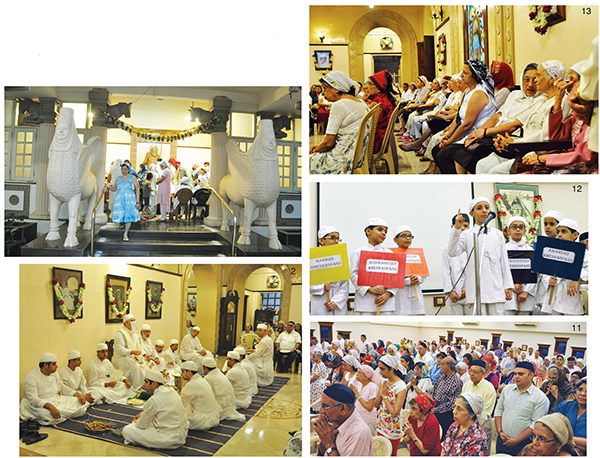
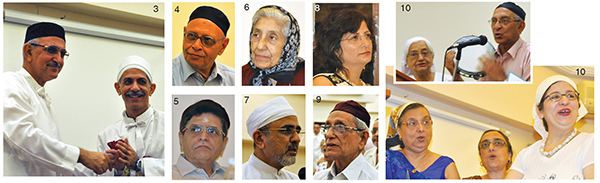
1. Entrance of M. J. Wadia Agiary; 2. jashan; 3. Kersi Limathwalla, Ervad (Dr) Ramiyar Karanjia;
4, 5, 6. trustees Dara Mehta, Shyam Wadia and Shirin Wadia;
7. Ervad Parvez Bajan; 8. Roxane Desai; 9. Tehmtan Daver;
10. Marzban Mehta and ladies singing; 11. humbandagi; 12. skit by DAI boys; 13. audience
"Religion does not end with prayers, it is a way of life,” explained Karanjia who has been overseeing a structured annual course on the Zoroastrian religion conducted at the fire temple over the past six years. Described as the "backbone of the course” by course coordinator Roxane Desai, Karanjia is assisted by Ervads Asphandiar Dadachanji, Parvez Bajan and others.
Karanjia termed the day a "shubh divas” (auspicious day) being Meher mah and Meher roz. He noted the festival called Mihrgan was widely observed in Iran. "In India it is referred to as Mehrangan. It is of immense significance as it reminds one of the ultimate victory of good over evil by celebrating the defeat of evil Zohak at the hands of King Faridun. Meher Yazad is one of the most ancient and powerful Yazatas from pre-Zoroastrian times,” notes a report on the meet quoting Karanjia.
"Meher Yazad is the eternal arbiter and hence presides over justice, friendships, promises, contracts, wars, relationship and love – in all matters where two or more are involved. He is respectfully referred to as Meher Davar, that is, Meher, the Judge. He is one of the judges of the soul at the judgment on the dawn of the fourth day after death (chahrum)…
"Meher Yazad has authority over rituals” hence Zoroastrian houses of worship are also referred to as Dar-i-Mihr or House of Mihr.
"After the Arabs, the successive dynasties like the Seljuq, the Mongols, the Tartars, the Safavids, the Afghans, Zands and the Qajars did not give much reprieve to Zoroastrians. During the early period of the Safavid dynasty, Zoroastrians were forced to settle in an Isfahan suburb known as Gabrābād, where all houses were low, one-storeyed, and plain. Zoroastrians had to be dressed in honey-colored gowns called ‘taylasān,’ a garment which non-Muslims were compelled to wear since 850 AC. This imposition continued up to 1886, and was relaxed only in the last decade of the 19th century.
"Fortunately during the Zand and Qajar dynasties saviors arrived for Zoroastrians. First it was Mulla Kavus, and then in 1854 the great Maneckji Limji Hataria.”
A slide show on the life of Hataria with a running commentary was delivered by his great-great-grandson, Tehmtan M. Daver.
In a colored, printed pamphlet titled "Sant Musafir Arbab Maneckji Limji Hataria Missionary to Iran” distributed at the function Davar had written "Extreme provocation led some Iranian Zoroastrians to flee to Bombay around 1790, where they were taken care of by benevolent and wealthy Zoroastrians like Framji Vhikhaji Panday, who was fondly called ‘The father of the Irani Parsis.’ About 20 years later the fervor spread amongst the eminent and wealthy Parsi families such as the Camas, Wadias, Petits, Pandays and others and a society known as the Persian Amelioration Society was formed…
"It was as an emissary of this Society that Maneckji Hataria was sent to Iran on March 31, 1854… Maneckji got repaired the ancient Atash Behram in Yazd… within a year of his landing in Iran. Similarly the adarians and dakhmas were repaired and erected... He established schools for Zoroastrian boys and girls of Persia to receive modern education. He even built a dharamshala in Tehran… (He relieved) the Zoroastrians from the bondage of the jazia tax which had become a harsh tool for extortion, brutality and forced conversions.” He died in Iran in 1890.
◆ ◆ ◆
From the archive