
Events & Personalities
Zoroastrian principles
A conference on the Zoroastrian religion organized by the M. J. Wadia Fire Temple Trust in memory of Ervad (Dr) Sir Jivanji Modi received an overwhelming response with the organizers having to close registrations a week before the event. Held on January 14 and 15 in Lalbaug, the conference was attended by 175 participants who filled the Agiary’s Hall to capacity, mentions a write-up sent to Parsiana by Kersi Limathwalla, chairman of the Trust. A number of scholars presented papers during the two-day conference.
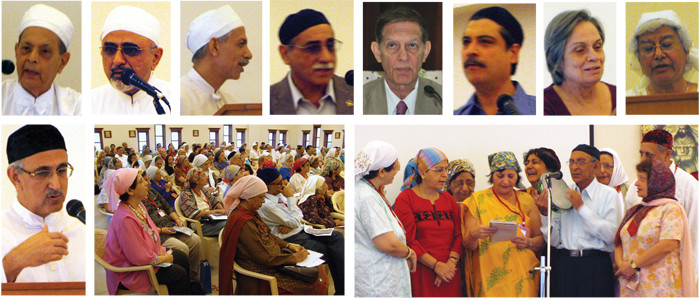
Top row, from l: Ervads Nadir Modi, Parvez Bajan and Dr Ramiyar Karanjia, Rohinton Rivetna, Dr Homi Dhalla, Noshir Dadrawala, Meher Contractor and Shirin Contractor; 2nd row: Kersi Limathwalla; participants in seminar; singing a monajat at the conference organized by the M. J. Wadia Fire Temple Trust
On both days the proceedings commenced with an invocation by Ervad Parvez Bajan and Ervad (Dr) Ramiyar Karanjia, followed by the recitation of a monajat. Rohinton Rivetna, founder of the Society of Scholars of Zoroastrianism in Chicago was requested by Limathwalla to take charge of the first session. He set the tone for the conference by emphasizing the importance of hamazori and requested those present to perform it in the traditional manner with the person seated next to him/her.
According to the Hoshbam, in the Zoroastrian religion there is no fear of God; emphasis is on friendship with Ahura Mazda, which is unique to Zoroastrianism, said former Bombay Parsi Punchayet trustee Noshir Dadrawala who is well versed in religious matters. He spoke of life being a battle between good and evil and the need to attune divine energies with spiritual forces. Spirituality should lead us deeper into the self. Also, since negativity moves one away from God one must always remain positive, Dadrawala emphasized.
The path for spiritual growth was revealed to Zarathushtra by Ahura Mazda, Limathwalla told those present. This is laid down in the Gathas where the scheme of things is explained with the help of the Amesha Spentas. One cannot see Ahura Mazda in the physical form but "from the eyes of your soul.” He then explained the Zoroastrian concepts of Asha, Vohu Mano, Khshathra, Armaiti, Haurvatat and Ameratat.
Zoroaster played an important role in maintaining the natural environment, a theme which was highlighted by Meher Contractor who has a master’s degree in Avesta. The Prophet was the greatest ecologist who executed Ahura Mazda’s plan for restoring and preserving nature. It is now man’s turn to maintain the environment and the best way in which to do so is to stop pollution. The Vendidad details all aspects of pollution and exhorts cleanliness and purity, she informed the gathering.
Expanding on the theme, Dr Homi Dhalla, founder of the World Zarathushti Cultural Foundation detailed the Zoroastrian concepts of ecology through nidhasnaithishem (non-violence), asha (divine plan) and hamazor (harmony, pertaining to moral ecology). In Zoroastrianism all creatures have fravashi, all nature is sacred and we pray for all creations. To illustrate his talk Dhalla presented a slide show with facts and figures on how to preserve the environment.
In her well researched paper, Shirin Contractor, who has a master’s degree in Avesta, explored the Zoroastrian concept of an ideal life. She touched on asha, religion, gender, human rights, environment, choices and inner will of the self, bringing out a new perspective on Khordad and Amardad.
Ervad Nadir Modi, chairman of the board of trustees of the Athornan Mandal, spoke on how Zoroastrianism emphasizes health, wealth and happiness. In our religion health is not absence of sickness but healthy energy; wealth is not of the fiscal kind but of the spiritual variety; happiness lies not in material achievements but in love and compassion. One must ask Ahura Mazda on a daily basis to bless, guide and help, he exhorted the attendees.
Zarathushtra was chosen by Ahura Mazda to deliver the message of good to the people, explained Bajan. Zoroastrianism is essentially different from other religions of the world as it maintains that material acquisitions are not a bad thing, nor does it permit fasting or asceticism. Good and evil are real forces and man was created to fight evil.
Zoroastrianism, the first revealed religion of the world, impacted all the civilizations and religions that followed, noted Karanjia. Its teachings have a fine balance between being philosophical, scientific and ecologically sensitive, while also being metaphysical and mystical, the scholar priest explained. The harmony we talk about in religions is mostly cosmetic. Real harmony has to be consciously sought as there is a treasure trove of unified spirituality hidden under the diversity of world views and practices.
Limathwalla mentions that all the speakers were extremely eloquent while expressing how we can practice Zoroastrian principles in day-to-day life.
◆ ◆ ◆
From the archive